

On this page
Statement and match-the-list questions appear in recent NEET papers and are slow: every statement or pair needs its own check. Here are eight original Electromagnetic Waves questions, four per format, easy to hard.
What do these Electromagnetic Waves questions cover?
Every item fits Unit 15 of the NMC's NEET (UG)-2026 syllabus. The NEET (UG)-2026 information bulletin sets single-correct questions, +4 for a right answer and −1 for a wrong one. Facts follow NCERT Class 12 Physics Chapter 8. New to the chapter? Read our guide on how to prepare Electromagnetic Waves for NEET.
Take c = 3 × 10⁸ m/s.
Statement questions
Q1 (easy, statements). Which detector pairings are correct? A. Photocells detect ultraviolet. B. Thermopiles and bolometers detect infrared. C. Geiger tubes and ionisation chambers detect X-rays. D. Point-contact diodes are a standard detector of visible light. E. Receiver aerials detect gamma rays.
(1) A, B and D only (2) A, B and C only (3) B, C and E only (4) A, B, C and D only
Answer: (2). A, B and C true: all three pairings are in Table 8.1's detection column. D false: point-contact diodes detect microwaves. E false: aerials detect radio waves.
Trap: (4) misplaces the microwave detector.
Q2 (easy, Statement I/II). Statement I: Most of the Sun's ultraviolet reaches the ground, because the atmosphere absorbs little of it. Statement II: Infrared waves are longer than red light.
(1) Both correct (2) Both incorrect (3) I correct, II incorrect (4) I incorrect, II correct
Answer: (4). I is incorrect: NCERT says the ozone layer, 40–50 km up, absorbs most of it. II is correct: infrared begins at 700 nm, just beyond red.
Trap: (2) places infrared on the violet side.
Q3 (medium, Statement I/II). Statement I: Gauss's law for magnetism, ∮B·dA = 0, has no source term because no magnetic monopoles are known. Statement II: A charge moving in a circle at constant speed does not radiate, because its speed never changes.
(1) Both correct (2) Both incorrect (3) I correct, II incorrect (4) I incorrect, II correct
Answer: (3). I is correct: NCERT notes no magnetic monopoles are known. II is incorrect: the direction of velocity keeps changing, so the charge accelerates, and accelerated charges radiate.
Trap: (1) treats constant speed as zero acceleration.
Q4 (hard, statements). In vacuum, a wave has E_y = (30 V/m) sin[(2.0 × 10⁷ m⁻¹)x + ωt]. Which are correct? A. It travels along −x. B. Its wavelength is about 314 nm, in the ultraviolet. C. Its peak magnetic field is 1.0 × 10⁻⁷ T. D. Its frequency is 6.0 × 10¹⁵ Hz. E. Its magnetic field oscillates along the x-axis.
(1) A, B and C only (2) A, C and D only (3) B, C and E only (4) A, B, C and D only
Answer: (1). A true: kx + ωt stays constant only if x falls as t grows. B true: λ = 2π/k = 3.14 × 10⁻⁷ m, inside UV's 400 nm to 1 nm. C true: B₀ = E₀/c = 30/(3 × 10⁸). D false: ω = ck = 6.0 × 10¹⁵ rad/s, so ν = ω/2π ≈ 9.5 × 10¹⁴ Hz. E false: B is perpendicular to E (y) and travel (x), so along z.
Trap: (4) reads ω as ν.
Match-the-list questions
Q5 (easy, match). Radiation and a use from NCERT. List-I: (A) microwaves (B) infrared (C) ultraviolet (D) radio waves. List-II: (I) LASIK eye surgery (II) remote switches of TV sets (III) AM broadcasting, 530–1710 kHz (IV) speed guns that time fast balls.
(1) A-III, B-II, C-I, D-IV (2) A-IV, B-I, C-II, D-III (3) A-IV, B-II, C-I, D-III (4) A-IV, B-II, C-III, D-I
Answer: (3). A-IV: speed guns are radar. B-II: remote LEDs emit infrared. C-I: UV focuses into narrow beams. D-III: AM is radio.
Trap: (1) swaps microwaves and radio.
Q6 (medium, match). SI units. List-I: (A) displacement current ε₀ dΦ_E/dt (B) μ₀ε₀ (C) electric flux Φ_E (D) wave number k = 2π/λ. List-II: (I) V m (II) A (III) s² m⁻² (IV) m⁻¹.
(1) A-I, B-III, C-II, D-IV (2) A-II, B-III, C-I, D-IV (3) A-II, B-IV, C-I, D-III (4) A-II, B-III, C-IV, D-I
Answer: (2). A-II: it is a current. B-III: c = 1/√(μ₀ε₀), so μ₀ε₀ = 1/c². C-I: field × area, (V/m)(m²). D-IV: one over a length.
Trap: (1) swaps flux and current.
Q7 (medium, match). Frequency and band (Table 8.1). List-I: (A) 2.5 × 10¹⁰ Hz (B) 1.0 × 10¹⁴ Hz (C) 2.0 × 10¹⁵ Hz (D) 1.0 × 10¹⁸ Hz. List-II: (I) ultraviolet (II) microwave (III) X-rays (IV) infrared.
(1) A-II, B-I, C-IV, D-III (2) A-IV, B-II, C-I, D-III (3) A-II, B-IV, C-III, D-I (4) A-II, B-IV, C-I, D-III
Answer: (4). λ = c/ν. A-II: 1.2 cm, between 0.1 m and 1 mm. B-IV: 3 μm. C-I: 150 nm. D-III: 0.3 nm, between 1 nm and 10⁻³ nm.
Trap: (1) puts higher frequency on the infrared side of visible.
Q8 (hard, match). A 500 MHz wave (λ = 0.60 m in vacuum) enters different media. Match the wavelength inside. List-I: (A) εr = 6.25, μr = 1 (B) εr = 2.25, μr = 1 (C) εr = 2.25, μr = 4 (D) εr = 1.44, μr = 1. List-II: (I) 0.20 m (II) 0.24 m (III) 0.40 m (IV) 0.50 m.
(1) A-II, B-III, C-I, D-IV (2) A-II, B-I, C-III, D-IV (3) A-I, B-III, C-II, D-IV (4) A-II, B-III, C-IV, D-I
Answer: (1). Frequency is unchanged and v = c/√(εrμr), so λ = 0.60/√(εrμr). A-II: ÷2.5. B-III: ÷1.5. C-I: ÷3. D-IV: ÷1.2.
Trap: (2) ignores μr in C, giving it 0.40 m.
How do you work these faster?
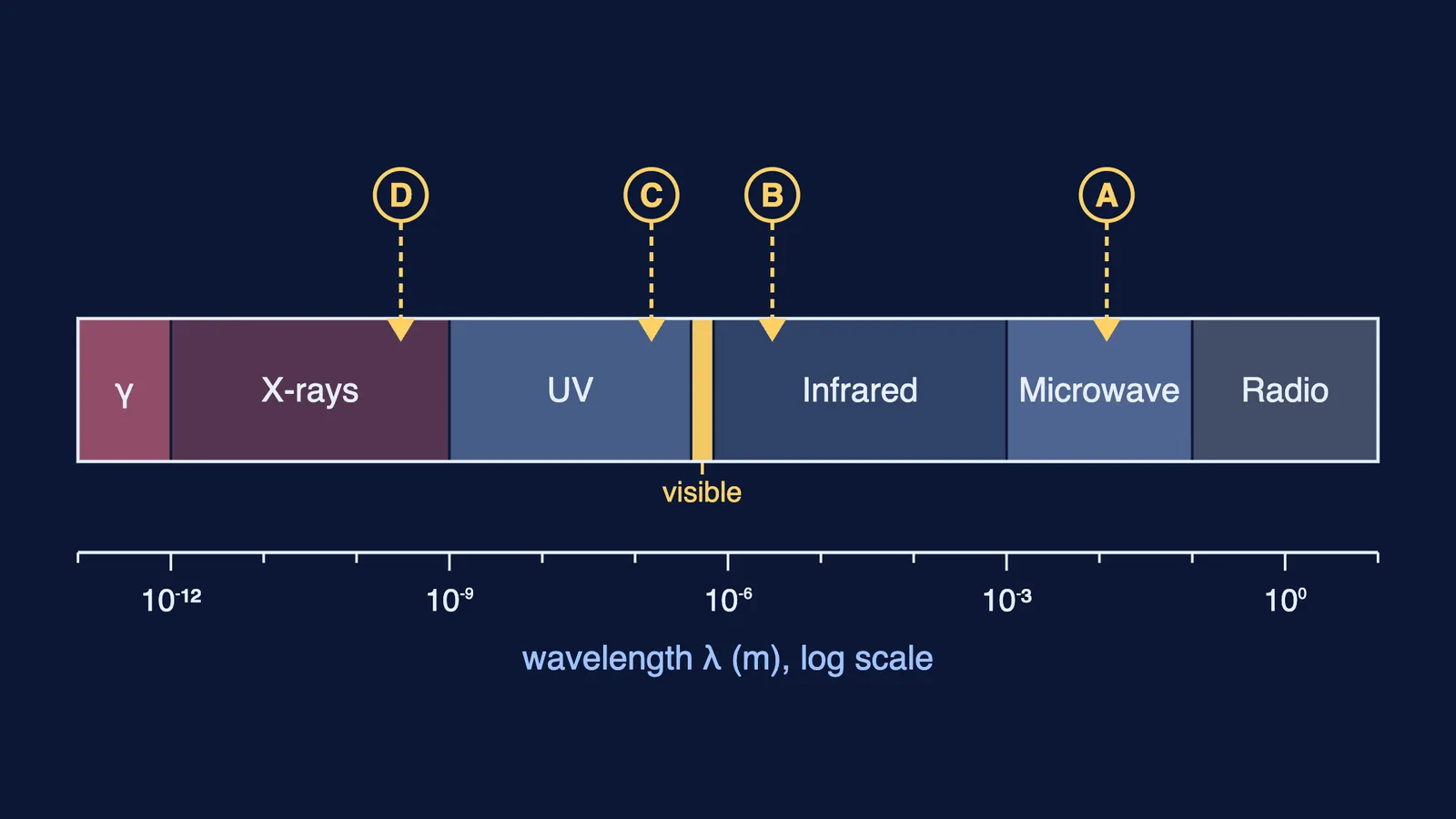
Learn Table 8.1 as a ladder of edges: 0.1 m, 1 mm, 700 nm, 400 nm, 1 nm, 10⁻³ nm.
In a wave equation, read k first, then λ = 2π/k; never treat ω as ν.
In a medium, frequency stays fixed and the square root of εrμr divides both speed and wavelength.
Hard to picture E, B and the direction of travel together? The Fermi Simulation Lab has interactive simulations for the ideas that are easier to see than to read.
For a method for any chapter, read our strategy for NEET statement-based questions, then try the Electromagnetic Waves NEET practice questions with solutions.


