

On this page
Statement and match-the-list questions appear in recent JEE Main papers. Here are eight original ones, easy to hard.
What do these electromagnetic waves questions cover?
Every item sits inside Unit 15 of the NTA's Syllabus for JEE (Main) - 2027. Facts follow NCERT Class 12 Physics Chapter 8. New to the chapter? Read our guide on how to prepare Electromagnetic Waves for JEE Main. Take c = 3.0 × 10⁸ m/s.
Statement questions
Q1 (easy, Statement I/II). Statement I: In vacuum, E₀/B₀ equals c for every frequency. Statement II: With μ₀ = 4π × 10⁻⁷ T m/A and ε₀ = 8.85 × 10⁻¹² F/m, 1/√(μ₀ε₀) ≈ 3.0 × 10⁸ m/s.
(1) Both correct (2) Both incorrect (3) I correct, II incorrect (4) I incorrect, II correct
Answer: (1). I: B₀ = E₀/c. II: the root is 2.998 × 10⁸ m/s.
Trap: (3), letting E₀/B₀ vary with frequency.
Q2 (medium, statements). Which are correct? A. A 3.0 cm wave has frequency 10 GHz and is a microwave. B. A 1.0 nm wave has frequency 3.0 × 10¹⁶ Hz. C. Infrared lies next to the violet end of the visible spectrum. D. A 10 μm wave has frequency 3.0 × 10¹³ Hz and is infrared. E. A 6.0 × 10¹⁷ Hz wave has wavelength 0.50 nm and is an X-ray.
(1) A, D and E only (2) A, B and D only (3) A, C, D and E only (4) B, D and E only
Answer: (1). A true: c/λ = 10¹⁰ Hz, inside 0.1 m to 1 mm. B false: it is 3.0 × 10¹⁷ Hz. C false: infrared sits at the red end. D true: inside 1 mm to 700 nm. E true: c/ν = 0.50 nm, in Table 8.1's X-ray range only.
Trap: (2), a lost power of ten.
Q3 (medium, Statement I/II). Statement I: A wave travels along −z with E along +x, so B is along −y. Statement II: A wave travels along +z with E along (x̂ + ŷ)/√2, so B is along (x̂ − ŷ)/√2.
(1) Both correct (2) Both incorrect (3) I correct, II incorrect (4) I incorrect, II correct
Answer: (3). E × B points along travel. I is correct: x̂ × (−ŷ) = −ẑ. II is incorrect: (x̂ + ŷ) × (x̂ − ŷ) = −2ẑ, so B must be along (−x̂ + ŷ)/√2.
Trap: (1), checking only that B ⊥ E.
Q4 (hard, statements). In vacuum, E = (12 V/m) x̂ sin[(5√2π m⁻¹)(y + z) − (3π × 10⁹ s⁻¹)t]. Which are correct? A. It travels along (ŷ + ẑ)/√2. B. Its wavelength is 0.28 m. C. Its frequency is 1.5 GHz. D. Its magnetic field amplitude is 40 nT. E. Where E points along +x, B points along (ẑ − ŷ)/√2.
(1) A, B and D only (2) A, C and D only (3) A, C, D and E only (4) A, D and E only
Answer: (2). A true: the phase depends on y + z. B false: |k| = 5√2π × √2 = 10π m⁻¹, so λ = 2π/|k| = 0.20 m. C true: ν = ω/2π. D true: B₀ = 12/(3.0 × 10⁸) = 4.0 × 10⁻⁸ T. E false: B lies along k̂ × Ê ∝ (ŷ + ẑ) × x̂ = ŷ − ẑ, so (ŷ − ẑ)/√2.
Trap: (1), taking 5√2π as |k|.
Match-the-list questions
Q5 (easy, match). List-I: (A) infrared (B) ultraviolet (C) X-rays (D) microwaves. List-II: (I) made by bombarding a metal target with fast electrons (II) produced by Gunn diodes (III) trapped by carbon dioxide and water vapour (IV) germ-killing lamps in water purifiers.
(1) A-III, B-IV, C-I, D-II (2) A-IV, B-III, C-I, D-II (3) A-III, B-IV, C-II, D-I (4) A-III, B-I, C-IV, D-II
Answer: (1). A-III: greenhouse effect. B-IV: UV lamps. C-I: X-ray tube. D-II: Gunn diodes make microwaves.
Trap: (2), swapping IR and UV.
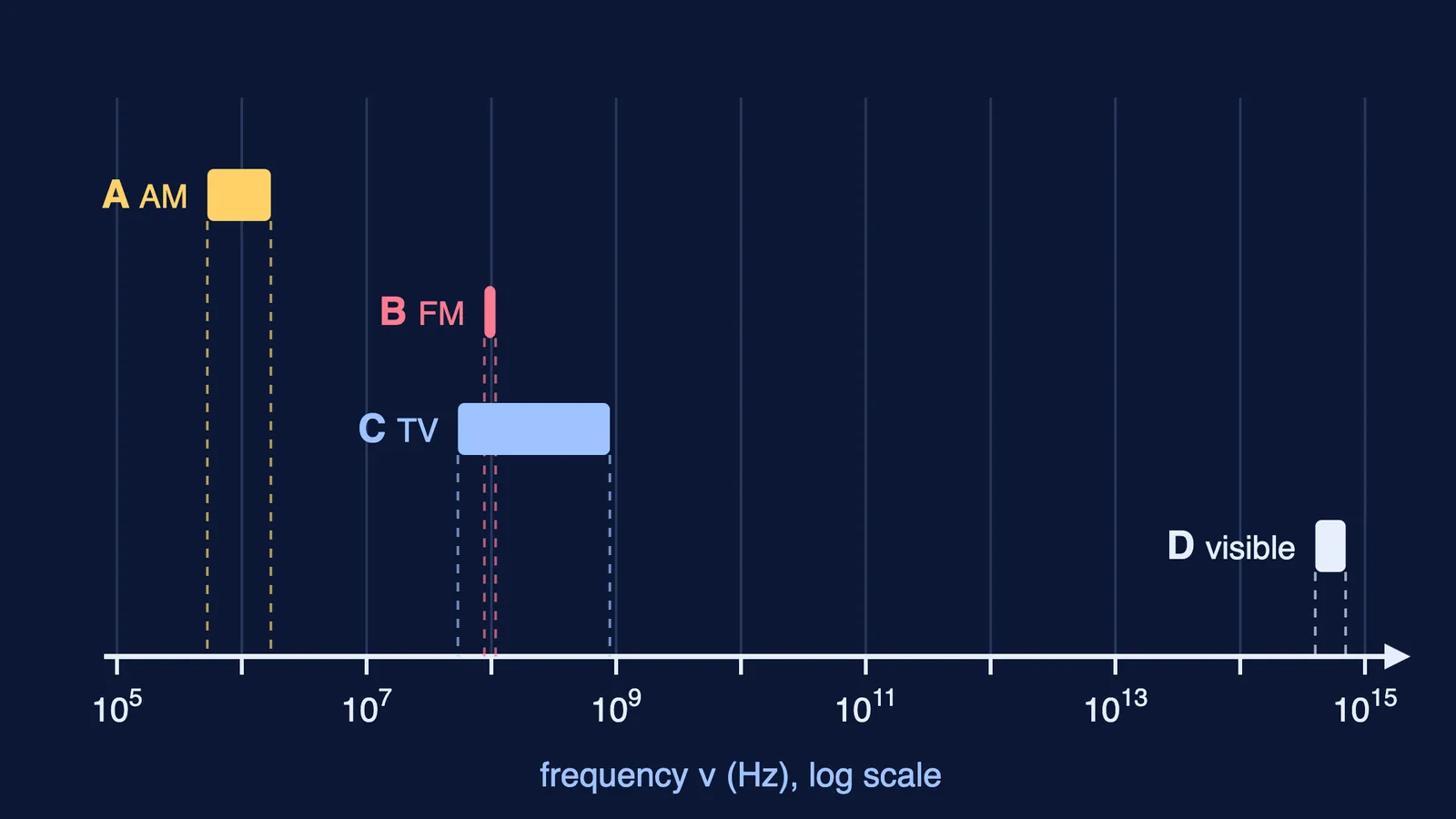
Q6 (medium, match). Vacuum wavelength ranges. List-I: (A) AM, 530–1710 kHz (B) FM, 88–108 MHz (C) TV, 54–890 MHz (D) visible, 4–7 × 10¹⁴ Hz. List-II: (I) 2.78–3.41 m (II) 429–750 nm (III) 175–566 m (IV) 0.337–5.56 m.
(1) A-III, B-IV, C-I, D-II (2) A-III, B-I, C-IV, D-II (3) A-I, B-III, C-IV, D-II (4) A-III, B-I, C-II, D-IV
Answer: (2). λ = c/ν. A-III: c/1.71 MHz = 175 m. B-I: c/108 MHz = 2.78 m. C-IV: c/890 MHz = 0.337 m. D-II: c/7 × 10¹⁴ Hz = 429 nm.
Trap: (1), swapping FM and TV.
Q7 (medium, match). In vacuum, E_x = (45 V/m) sin(kz − ωt), with wavelength λ and period T. Match each point and instant with B_y there. List-I: (A) z = λ/4, t = 0 (B) z = 0, t = T/4 (C) z = λ/12, t = 0 (D) z = λ/4, t = T/4. List-II: (I) 0 (II) +75 nT (III) +150 nT (IV) −150 nT.
(1) A-III, B-I, C-II, D-IV (2) A-IV, B-III, C-II, D-I (3) A-III, B-IV, C-II, D-I (4) A-III, B-IV, C-I, D-II
Answer: (3). B_y = B₀ sin(kz − ωt), in phase with E_x, and B₀ = 45/(3.0 × 10⁸) = 150 nT. A-III: sin(π/2). B-IV: sin(−π/2). C-II: sin(π/6) = 1/2. D-I: sin 0.
Trap: (2), reading the phase as ωt − kz.
Q8 (hard, match). A 2.0 μF capacitor is across V = (50 V) sin(1000t). List-I: (A) peak displacement current (B) displacement current when V = +50 V (C) peak displacement current if ω becomes 2000 rad/s (D) displacement current when V = +25 V and rising. List-II: (I) 0 (II) 0.087 A (III) 0.10 A (IV) 0.20 A.
(1) A-III, B-IV, C-I, D-II (2) A-IV, B-I, C-III, D-II (3) A-III, B-I, C-II, D-IV (4) A-III, B-I, C-IV, D-II
Answer: (4). i_d = ε₀ dΦ_E/dt = C dV/dt = CV₀ω cos ωt. A-III: 2.0 × 10⁻⁶ × 50 × 1000 = 0.10 A. B-I: cos ωt = 0 at peak V. C-IV: 2ω doubles it. D-II: cos ωt = √3/2.
Trap: (1), equating peak V with peak i_d.
How do you work these faster?
For directions, check that E × B points along travel.
When k has several components, use |k| in λ = 2π/|k|.
For displacement current, differentiate V first: it peaks as V crosses zero.
Hard to picture E, B and the direction of travel together? The Fermi Simulation Lab has interactive simulations for the ideas that are easier to see than to read.
Next, try our Electromagnetic Waves JEE Main practice questions with solutions.


