

On this page
Statement and match-the-list questions appear in recent NEET papers and are slow. Here are eight original EMI and AC questions, four per format, easy to hard.
What do these EMI and AC questions cover?
Every item fits Unit 14 of the NMC's NEET (UG)-2026 syllabus, which covers induction and alternating currents together. The NEET (UG)-2026 information bulletin set single-correct questions, +4 or −1. Facts follow NCERT Physics Chapter 6 and Chapter 7. New to the unit? Read our guide on how to prepare EMI and AC for NEET.
Statement questions
Q1 (easy, statements). Which are correct? A. A coil's self-inductance depends on its geometry and the permeability of its core. B. Mutual inductance of two coils does not depend on their relative orientation. C. Stretching a closed loop in a steady, uniform field can induce an emf. D. A soft-iron core lowers a solenoid's self-inductance. E. For a pair of coils, M₁₂ = M₂₁.
(1) A, B and C only (2) A, C and E only (3) A, C, D and E only (4) B, D and E only
Answer: (2). A true: NCERT. B false: M depends on separation and orientation. C true: the area, and so the flux, changes. D false: L = μᵣμ₀n²Al and soft iron has a large μᵣ. E true: NCERT.
Trap: (3) forgets μᵣ multiplies L.
Q2 (easy, Statement I/II). Statement I: In a purely resistive AC circuit, the voltage and current are in phase. Statement II: An ideal capacitor on AC draws an average power of V_rms × I_rms.
(1) Both correct (2) Both incorrect (3) I correct, II incorrect (4) I incorrect, II correct
Answer: (3). I is correct: v and i peak together. II is incorrect: current leads by π/2, so cos φ = 0 and P = 0.
Trap: (1) forgets the power factor.
Q3 (medium, Statement I/II). Statement I: A series RC circuit can be brought to resonance by choosing the right source frequency. Statement II: At resonance in a series LCR circuit, the voltages across L and C cancel and the whole source voltage appears across R.
(1) Both correct (2) Both incorrect (3) I correct, II incorrect (4) I incorrect, II correct
Answer: (4). I is incorrect: resonance needs both L and C. II is correct: X_L = X_C, their voltages are opposite in phase, Z = R.
Trap: (1) assumes every circuit has a resonant frequency.
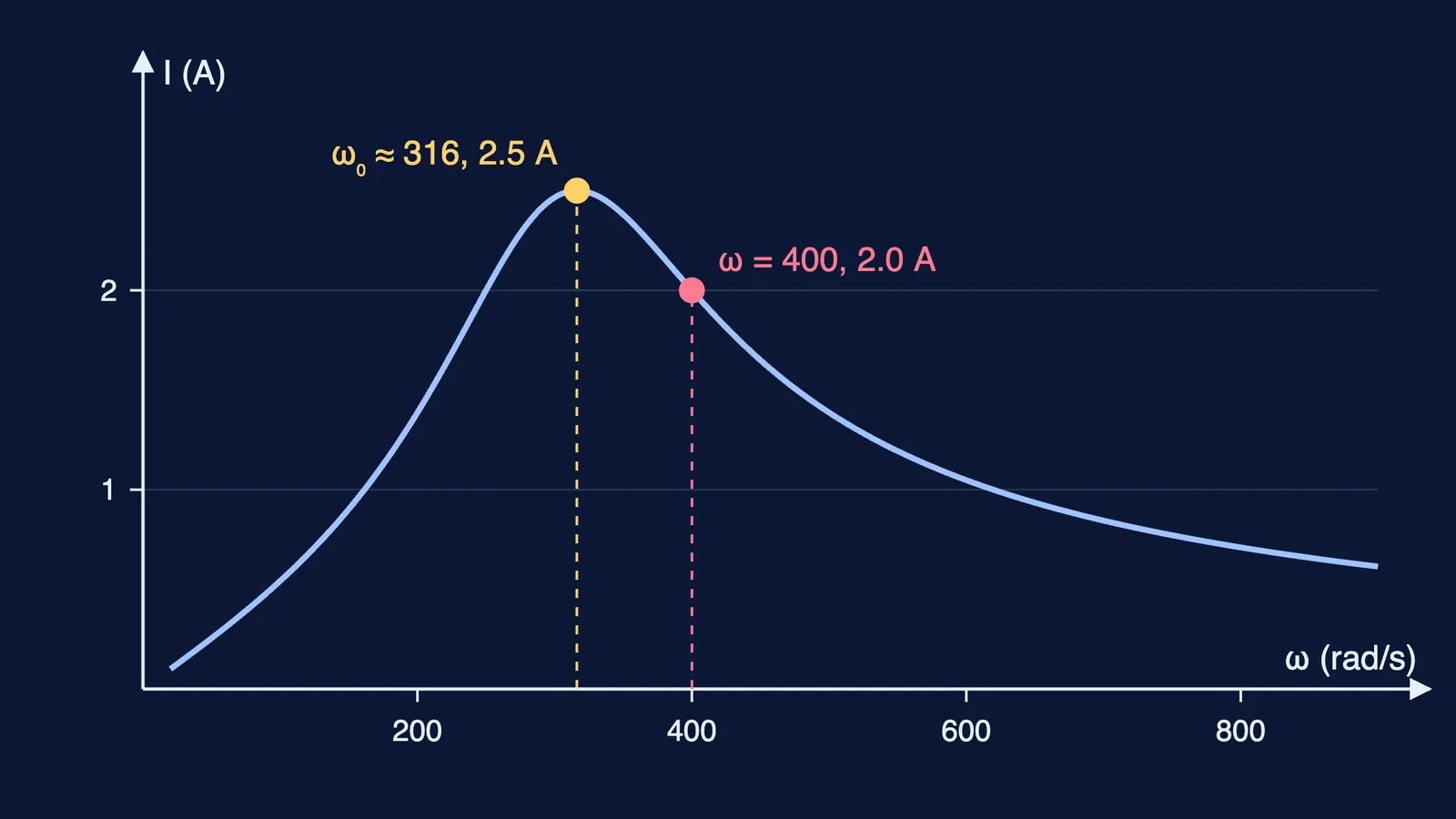
Q4 (hard, statements). Series R = 80 Ω, L = 0.40 H, C = 25 μF; 200 V rms at ω = 400 rad/s. Which are correct? A. The impedance is 100 Ω. B. The current leads the voltage. C. The average power is 320 W. D. The power factor is 0.6. E. Resonance would occur below 400 rad/s.
(1) A, C and E only (2) A, B and C only (3) A, C, D and E only (4) B, D and E only
Answer: (1). X_L = 160 Ω, X_C = 100 Ω. A true: Z = √(80² + 60²). B false: X_L > X_C, so current lags. C true: I = 2.0 A, I²R = 320 W. D false: cos φ = R/Z = 0.8. E true: ω₀ = 1/√(LC) ≈ 316 rad/s.
Trap: (3) takes sin φ = 0.6 as the power factor.
Match-the-list questions
Q5 (easy, match). SI units. List-I: (A) magnetic flux (B) self-inductance (C) the ratio L/R (D) 1/√(LC). List-II: (I) s (II) s⁻¹ (III) Wb A⁻¹ (IV) T m².
(1) A-III, B-IV, C-I, D-II (2) A-IV, B-III, C-II, D-I (3) A-IV, B-III, C-I, D-II (4) A-III, B-IV, C-II, D-I
Answer: (3). A-IV: Φ = BA. B-III: L = NΦ/I. C-I: H/Ω = (V s A⁻¹)/(V A⁻¹) = s. D-II: LC is in s².
Trap: (2) flips the last two.
Q6 (medium, match). List-I: (A) transformer core heating that laminating reduces (B) a changing primary current induces emf in the secondary (C) a coil's back emf opposes changes in its current (D) a coil spun in a uniform field gives a sinusoidal emf. List-II: (I) self-induction (II) mutual induction (III) eddy currents (IV) flux changing through a change in orientation.
(1) A-II, B-III, C-I, D-IV (2) A-III, B-I, C-II, D-IV (3) A-II, B-III, C-IV, D-I (4) A-III, B-II, C-I, D-IV
Answer: (4). A-III: NCERT's eddy-current core loss, cut by laminating. B-II: the transformer's principle. C-I: back emf. D-IV: the angle between B and area vector changes.
Trap: (1) calls the core heating mutual induction.
Q7 (medium, match). On 100 V rms, 50 Hz. List-I: (A) peak current in 50 Ω (B) rms current in a pure 0.5/π H inductor (C) rms current in a 100/π μF capacitor (D) rms current in 50 Ω and 0.5/π H in series. List-II: (I) 1.0 A (II) 1.41 A (III) 2.0 A (IV) 2.83 A.
(1) A-III, B-IV, C-I, D-II (2) A-IV, B-III, C-I, D-II (3) A-IV, B-I, C-III, D-II (4) A-III, B-IV, C-II, D-I
Answer: (2). A-IV: 2√2 A. B-III: X_L = 2πfL = 50 Ω. C-I: X_C = 1/(2πfC) = 100 Ω. D-II: Z = √(50² + 50²) = 70.7 Ω.
Trap: (3) swaps the two reactances.
Q8 (hard, match). Emf magnitude. List-I: (A) a 0.50 m rod moving at 4.0 m/s perpendicular to a 0.20 T field (B) the same rod turning about one end at 40 rad/s, field along the axis (C) a 100-turn, 20 cm² coil; the perpendicular field falls steadily from 0.30 T to zero in 0.10 s (D) a 20 mH coil; current falls steadily from 3.0 A to 1.0 A in 20 ms. List-II: (I) 0.40 V (II) 0.60 V (III) 1.0 V (IV) 2.0 V.
(1) A-I, B-III, C-II, D-IV (2) A-I, B-IV, C-II, D-III (3) A-II, B-III, C-I, D-IV (4) A-I, B-IV, C-III, D-II
Answer: (1). A-I: Blv = 0.40 V. B-III: ½Bωl² = 1.0 V. C-II: NAΔB/Δt. D-IV: L|ΔI/Δt|.
Trap: (2) uses Bωl², the tip speed for the whole rod.
How do you work these faster?
Mark each statement T or F before reading options.
In LCR items, write X_L − X_C first; its sign gives lag or lead.
For a rotating rod, use the average speed, ωl/2.
Why does the current peak at ω₀ in Q4? The Fermi Simulation Lab has interactive simulations for ideas that are easier to see than to read.
For a general method, read our strategy for NEET statement-based questions, then try EMI and AC NEET practice questions with solutions.


