

On this page
Statement and match-the-list questions appear in recent JEE Main papers. These eight original ones run easy to hard within Unit 14 of NTA's JEE (Main) 2027 Physics syllabus and Chapter 6 of NCERT Class 12 Physics Part I. For theory, see how to prepare electromagnetic induction for JEE Main.
Statement questions: can you judge each claim?
Options for Q1 and Q3: (1) Both correct (2) Both incorrect (3) I correct, II incorrect (4) I incorrect, II correct
Q1 (easy, statements). A 50-turn, 40 cm², 2.0 Ω coil lies with its plane perpendicular to a 0.30 T field, which reverses in 0.10 s. Statement I: Reversing in 0.05 s sends twice the charge. Statement II: 60 mC flows.
Answer: (4). I is incorrect: q = ∫I dt = NΔΦ/R, so time cancels. II: 50 × 40 × 10⁻⁴ × 0.60/2.0 = 0.060 C.
Trap: (1) thinks faster means more charge.
Q2 (medium, statements). A 100-turn, 0.020 m² coil spins at 100 rad/s in a 0.50 T field, axis perpendicular to the field. At t = 0 its plane is perpendicular to the field. Which are correct? A. The peak emf is 100 V. B. At t = π/600 s the emf is 50 V. C. Doubling ω doubles the peak emf and the frequency. D. The average emf over a full turn is about 64 V. E. Spinning about an axis along the field gives the same peak emf.
(1) A, B and C only (2) A, B, C and D only (3) A and C only (4) B, C and E only
Answer: (1). A: NBAω. B: 100 sin(π/6). C: e₀ ∝ ω, f = ω/2π. D is false: a full turn averages zero; 2e₀/π is a half-turn's. E is false: the flux then stays constant.
Trap: (2) takes the half-turn average.
Q3 (medium, statements). Long air-core solenoids P and Q share length, turns and current; Q has twice P's radius. Statement I: Q stores four times P's magnetic energy. Statement II: Q's energy per unit volume is four times P's.
Answer: (3). I: L = μ₀n²Al, so ½LI² quadruples. II is incorrect: B = μ₀nI is equal, so B²/2μ₀ is too.
Trap: (1) thinks a wider coil has a stronger field.
Q4 (hard, statements). A 0.40 m, 0.50 Ω rod is pulled at a steady 5.0 m/s along ideal rails closed by 2.0 Ω, in a perpendicular 0.50 T field. Which are correct? A. The resistor's potential difference is 1.0 V. B. The pulling force is 0.08 N. C. The resistor heats at 0.32 W. D. Doubling the speed doubles the force and quadruples the power. E. Reversing the field reverses the force needed.
(1) A, B and D only (2) B, C and D only (3) B, C, D and E only (4) A, C and E only
Answer: (2). A is false: 1.0 V drives 0.40 A through 2.5 Ω, so 0.8 V. B: BIl. C: I²R. D: I ∝ v, so F ∝ v, Fv ∝ v². E is false: the current reverses too, so drag still opposes motion.
Trap: (3) flips the drag with the field.
Match-the-list questions: can you pair all four?
Q5 (easy, match). A 0.20 m² loop sits in a uniform 0.50 T field B. Match orientation with flux.
List-I: A. Area vector along B; B. Plane parallel to B; C. Area vector at 60° to B; D. Plane at 60° to B.
List-II: I. 0; II. 0.050 Wb; III. 0.087 Wb; IV. 0.10 Wb.
(1) A-IV, B-I, C-III, D-II (2) A-I, B-IV, C-II, D-III (3) A-IV, B-I, C-II, D-III (4) A-IV, B-II, C-I, D-III
Answer: (3). Φ = BA cos θ, θ from the area vector. A-IV: θ = 0. B-I: θ = 90°. C-II: 0.10 cos 60°. D-III: θ = 30°.
Trap: (1) uses the plane's angle as θ.
Q6 (medium, match). Match each change to a long air-core solenoid with its inductance factor.
List-I: A. Radius halved, rest fixed; B. Length doubled, same n (turns per metre); C. Length doubled, same total turns N; D. n and length both doubled.
List-II: I. ×1/4; II. ×1/2; III. ×2; IV. ×8.
(1) A-I, B-II, C-III, D-IV (2) A-II, B-III, C-I, D-IV (3) A-I, B-III, C-IV, D-II (4) A-I, B-III, C-II, D-IV
Answer: (4). Use L = μ₀n²Al = μ₀N²A/l. A-I: A falls to a quarter. B-III: n fixed, l doubles. C-II: N fixed, l doubles. D-IV: 2² × 2.
Trap: (1) confuses n with N.
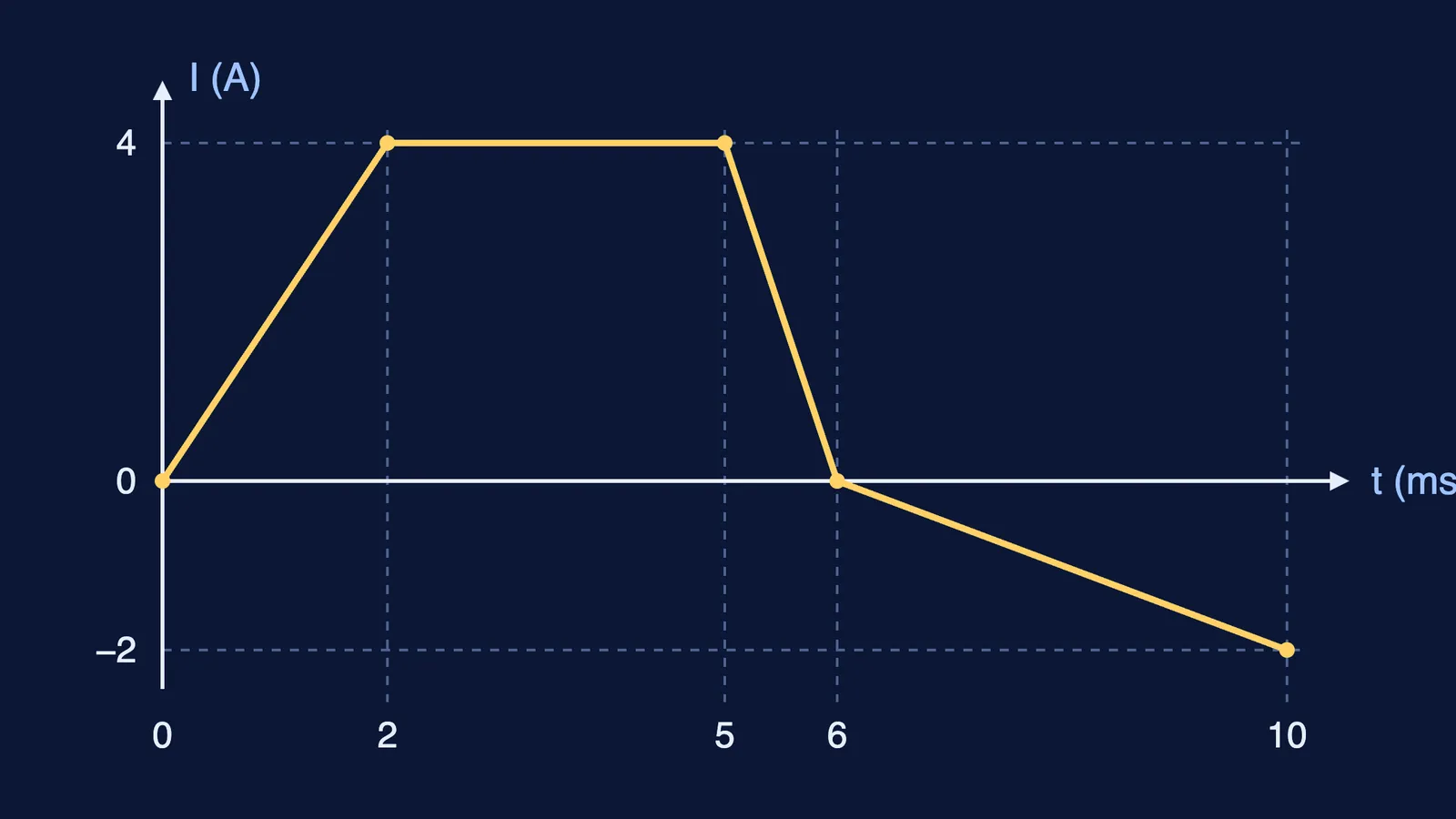
Q7 (medium, match). For coils P and Q, M = 20 mH. P's current rises steadily from 0 to 4 A by 2 ms, holds until 5 ms, falls steadily to 0 at 6 ms and to −2 A at 10 ms. Match interval with emf size in Q.
List-I: A. 0-2 ms; B. 2-5 ms; C. 5-6 ms; D. 6-10 ms.
List-II: I. 0; II. 10 V; III. 40 V; IV. 80 V.
(1) A-III, B-I, C-IV, D-II (2) A-IV, B-I, C-III, D-II (3) A-III, B-II, C-IV, D-I (4) A-II, B-I, C-IV, D-III
Answer: (1). |e| = M|dI/dt|: A-III, 2000 A/s. B-I, steady. C-IV, 4000 A/s. D-II, 500 A/s.
Trap: (2) misses the steeper fall.
Q8 (hard, match). A perpendicular field rises at 0.40 T/s. It fills only part of loop A; loops B-D lie wholly in a uniform field. Each figure-of-eight is twisted at the crossing, so its lobes circulate oppositely. Match loop with emf size.
List-I: A. A 20 cm-radius loop around a field filling only a concentric 10 cm-radius circle; B. A figure-of-eight, both lobes of radius 5 cm; C. A 5-turn square coil, side 5.0 cm; D. A figure-of-eight, lobes of radius 8 cm and 6 cm.
List-II: I. 0; II. 3.5 mV; III. 5.0 mV; IV. 12.6 mV.
(1) A-IV, B-II, C-III, D-I (2) A-IV, B-I, C-III, D-II (3) A-III, B-I, C-IV, D-II (4) A-II, B-I, C-III, D-IV
Answer: (2). A-IV: only the field's area counts, 0.40π(0.10)². B-I: opposite emfs cancel. C-III: 5 × 0.05² × 0.40. D-II: 0.40π(0.08² − 0.06²).
Trap: (4) adds D's lobes, which gives 12.6 mV.
How do you work these faster?
Write Φ = NBA cos θ and ask which factor changes.
Charge is NΔΦ/R; time never appears.
For L scaling, pick μ₀n²Al or μ₀N²A/l to match what stays fixed.
Did a lobe trip you in Q8? The Fermi Problem Library has worked problems with a step-by-step solver that explains the reasoning rather than printing an answer.
Next, try our electromagnetic induction JEE Main practice questions with solutions or our method for match-the-list questions.


