

On this page
Heat 2-bromobutane with ethoxide in ethanol and you get mostly but-2-ene. Saytzeff's rule explains that part. But but-2-ene comes as two geometrical isomers, cis and trans, and the rule says nothing about which one you get more of. In practice trans-but-2-ene is the major product. The reason is the shape of the E2 transition state, and you can see it in two Newman projections.
Why does 2-bromobutane give two different but-2-enes?
2-Bromobutane, CH₃–CHBr–CH₂–CH₃, has two β-carbons. Removing an H from C1 gives but-1-ene. Removing an H from C3 gives the more substituted but-2-ene, which is why it is the major product with ethoxide. That regiochemistry is covered in E1, E2 and Saytzeff's rule.
The new question starts here. C3 carries two hydrogens, and they are not equivalent. Removing one of them gives trans-but-2-ene. Removing the other gives cis-but-2-ene. So the question "cis or trans?" is really "which H on C3 leaves?". E2 answers that through its geometry.
What does anti-periplanar mean for 2-bromobutane?
In E2, the base pulls off the β-H while the C–Br bond breaks, in one step. This works well only when the H and the Br lie in one plane on opposite sides of the C2–C3 bond, 180° apart. That is the anti-periplanar arrangement. Why it is needed is explained in why E2 needs an anti-periplanar hydrogen, which applies it to cyclohexanes.
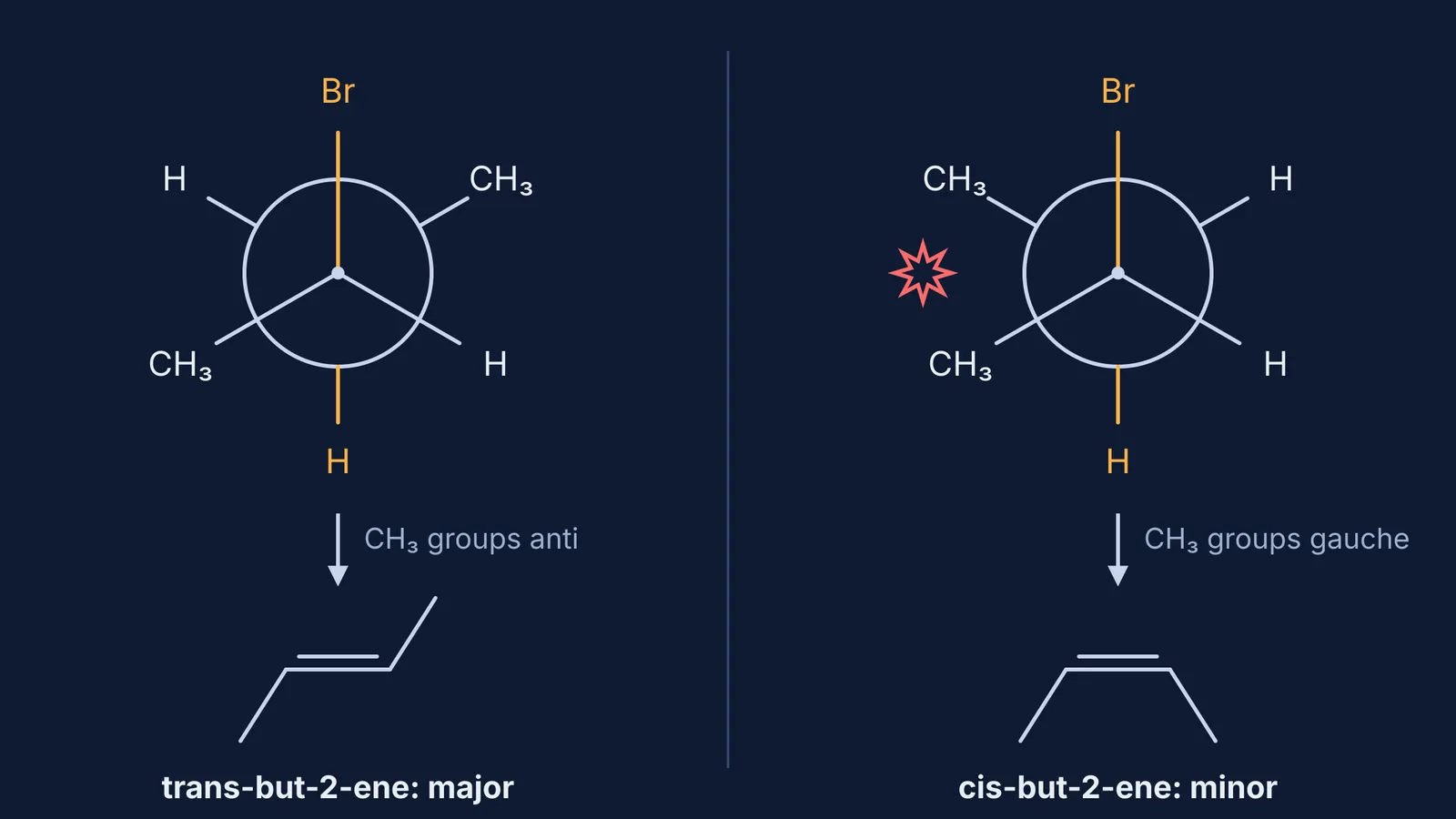
Look down the C2–C3 bond. The front carbon, C2, holds Br, CH₃ and H. The back carbon, C3, holds CH₃, H and H. Fix Br pointing straight up. The H that leaves must point straight down. There are three staggered conformers, and one of them puts the back CH₃ down, so it has no H anti to Br and cannot eliminate toward C3. The other two each put an H down:
Conformer A. The back CH₃ sits opposite the front CH₃. The two methyl groups are anti.
Conformer B. The back CH₃ sits next to the front CH₃, 60° away. The two methyl groups are gauche.
As the C–H and C–Br bonds break, the two carbons flatten and the groups left on them swing into the plane of the new double bond. Groups that were on opposite sides of the Newman projection end up on opposite sides of the C=C. So conformer A gives trans-but-2-ene and conformer B gives cis-but-2-ene.
Why is the trans pathway faster?
In conformer B the two methyl groups are already gauche, which costs some strain, as in the gauche form of butane. In the transition state it gets worse. The C2–C3 bond is partly double, the carbons are flattening, and the two methyl groups are pushed toward the crowded cis arrangement. This is the same clash that makes cis-but-2-ene about 4 kJ/mol less stable than trans, as shown in why trans but-2-ene is more stable than cis.
Because the transition state already has some double-bond character, part of that product strain is felt on the way up. The cis transition state is higher in energy, its activation energy is larger, and it forms more slowly.
E2 is not reversible here, so the two alkenes do not equilibrate. The ratio comes from the relative rates. It is a kinetic result that happens to agree with stability.
How big is the trans to cis ratio? A worked estimate
The conformers interconvert by bond rotation far faster than either one eliminates. So the product ratio depends only on how far apart the two transition states are in energy:
trans : cis = k(trans) ÷ k(cis) = e^(ΔΔG‡ ÷ RT)
Here ΔΔG‡ is the extra activation energy of the cis pathway. Assume a value and see what it predicts.
Assume the gap. Take ΔΔG‡ ≈ 4 kJ/mol = 4000 J/mol, the same as the gap between the products. This is an assumption: the real transition-state gap could be somewhat smaller.
Pick a temperature. Warm ethanol, 55 °C, is T = 328 K.
Find RT. RT = 8.314 × 328 ≈ 2727 J/mol.
Divide. ΔΔG‡ ÷ RT = 4000 ÷ 2727 ≈ 1.47.
Take the exponential. e^1.47 ≈ 4.3.
Answer. trans : cis ≈ 4 : 1 among the but-2-enes, as an estimate.
Check how sensitive this is. The same 4 kJ/mol gives about 5.0 at 298 K and about 3.9 at 351 K, the boiling point of ethanol. Higher temperature makes the reaction less selective, because RT grows while the gap stays the same.
Treat 4:1 as a rough estimate, not a measured value. Real trans:cis ratios change with the base, solvent, leaving group and temperature, and published figures differ. What holds across conditions is the direction: trans is the major but-2-ene. Also remember that some but-1-ene forms alongside, so as a share of the whole product mixture each but-2-ene is smaller than this ratio suggests.
Is this E2 stereospecific or stereoselective?
This example shows the difference.
Stereoselective: one starting material can give two stereoisomeric products, and one is favoured. 2-Bromobutane gives both cis and trans but-2-ene, with trans major. That is stereoselective.
Stereospecific: different stereoisomers of the starting material are forced by the mechanism to give different stereoisomers of the product.
2-Bromobutane cannot show stereospecificity in this sense. (R)- and (S)-2-bromobutane are enantiomers. With an achiral base they react at the same rate and give the same mixture of alkenes. E2 becomes stereospecific when the β-carbon has only one H, so only one conformer can put an H anti to the leaving group. Then one diastereomer of the substrate gives only one alkene isomer, and the other diastereomer gives the other. So do not call the 2-bromobutane result stereospecific.
A bulky base such as tert-butoxide changes a different thing: it raises the share of but-1-ene. Among the but-2-enes that still form, the same Newman argument applies.
How does E1 dehydration of butan-2-ol compare?
Heat butan-2-ol with concentrated H₂SO₄ and you also get trans-but-2-ene as the major alkene. The route is different. The OH is protonated, water leaves, and a planar secondary carbocation forms. There is no leaving group left to be anti to. Instead, a C–H bond on C3 must line up with the empty p orbital, and C2–C3 can rotate freely to allow that. The lineup that keeps the two methyl groups apart is lower in energy, for the same steric reason, so trans forms faster.
There is a second factor in acid. The alkenes can be protonated again and lose H⁺ again, which lets cis turn into trans over time and pushes the mixture further toward the more stable isomer. So E2 and E1 both favour trans-but-2-ene, but E2 does it through a fixed anti-periplanar geometry and E1 through a free planar carbocation.
If rotating Newman projections in your head is hard, the Simulation Lab has interactive simulations for ideas that are easier to see than to read.
Quick checklist
Saytzeff decides which carbon loses the H. Geometry decides cis or trans.
In E2, the H and the leaving group must be anti-periplanar.
Methyl groups anti in the reacting conformer give trans. Gauche gives cis.
The gauche transition state is more crowded, so trans forms faster.
A 4 kJ/mol gap at 328 K gives trans : cis ≈ 4 : 1, as an estimate only.
2-Bromobutane E2 is stereoselective, not stereospecific.
E1 dehydration of butan-2-ol also favours trans, through a planar carbocation.


