

On this page
Two molecules with the same formula, C4H8, the same double bond and the same product when you add hydrogen. Yet one sits about 4 kJ/mol lower in energy than the other (LibreTexts: Stability of Alkenes/07%3A_Alkenes-_Structure_and_Reactivity/7.06%3A_Stability_of_Alkenes)). This small gap is a standard example in JEE Main and board chemistry, and it is easy to explain once you look at where the methyl groups are.
Why is trans but-2-ene more stable than cis?
In but-2-ene, each carbon of the C=C carries one methyl group and one hydrogen. The double bond cannot rotate, so the two methyls are locked either on the same side (cis) or on opposite sides (trans). In cis, the methyl groups sit close enough to push against each other. That repulsion is steric strain, and it raises the energy of the molecule.
The OpenStax Organic Chemistry text says cis alkenes are less stable than their trans isomers "because of steric strain between the two larger substituents on the same side of the double bond" (LibreTexts: Stability of Alkenes/07%3A_Alkenes-_Structure_and_Reactivity/7.06%3A_Stability_of_Alkenes)). In trans, the methyls point away from each other, so there is no such clash.
Hyperconjugation does not decide this one. Both isomers have two methyl groups on the double bond, so both have six alpha hydrogens and the same hyperconjugation count (see how to count alpha hydrogens for hyperconjugation). Steric strain is the difference that is left.
How does heat of hydrogenation prove it?
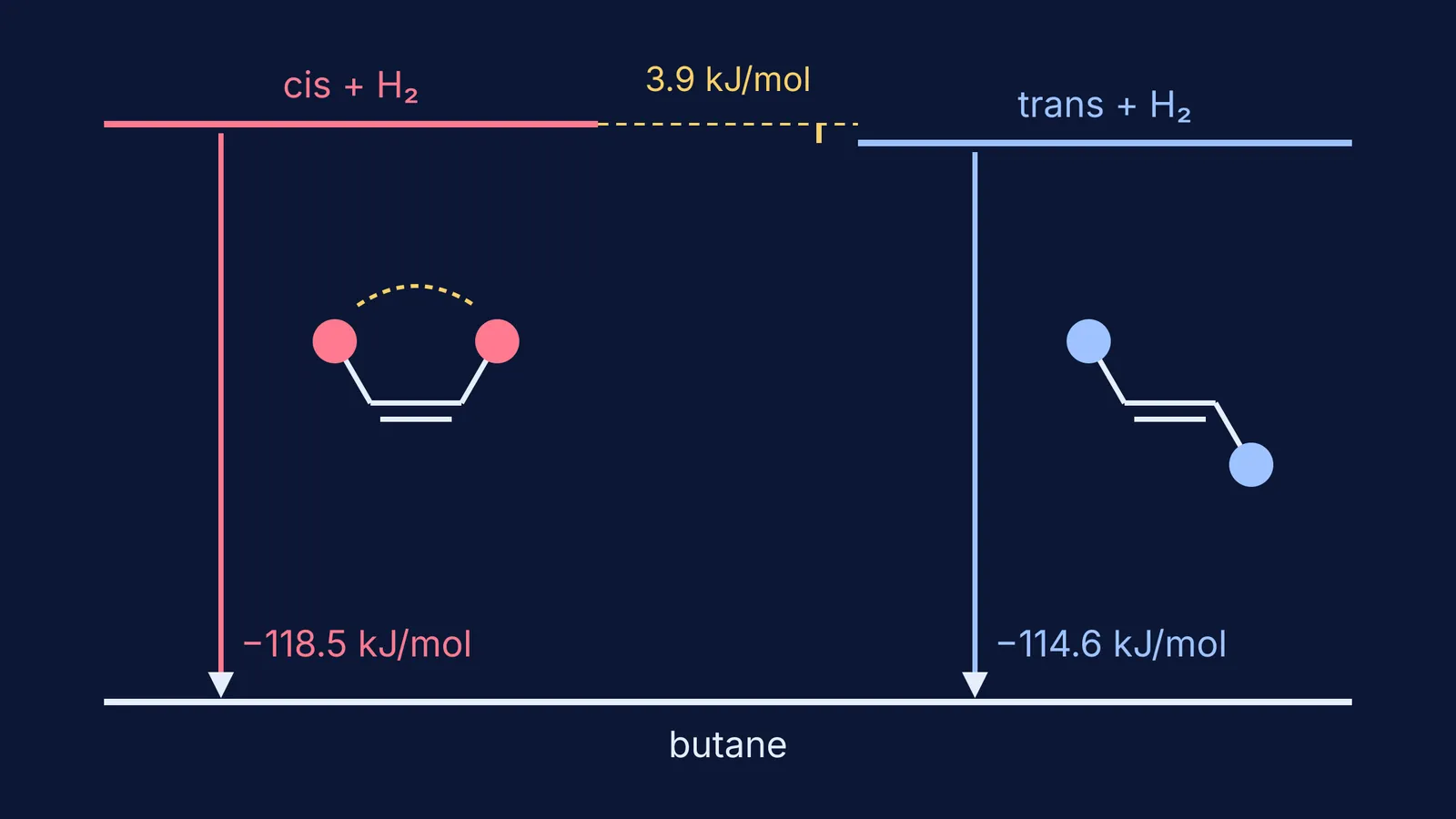
Add H2 across the double bond of either isomer and you get the same product, butane. If both end at the same energy, any difference in the heat released must come from where they started. More heat out means the starting alkene had more energy, so it is less stable.
The measurements go back to 1935, when G. B. Kistiakowsky and colleagues measured heats of hydrogenation of simple alkenes in the gas phase (Journal of the American Chemical Society, 1935). The NIST Chemistry WebBook lists their values as reanalysed by Cox and Pilcher in 1970:
cis-but-2-ene + H2 to butane: ΔH = −118.5 ± 0.42 kJ/mol (NIST: cis-2-butene reactions)
trans-but-2-ene + H2 to butane: ΔH = −114.6 ± 0.42 kJ/mol (NIST: trans-2-butene reactions)
The difference is 3.9 kJ/mol. The OpenStax text quotes rounded values of −119 and −115 kJ/mol, a difference of 4 kJ/mol (LibreTexts/07%3A_Alkenes-_Structure_and_Reactivity/7.06%3A_Stability_of_Alkenes)). Cis gives out more heat, so cis started higher. For the same method applied to a whole series of alkenes, read ranking alkene stability with heat of hydrogenation data.
Worked example: does a second method agree?
A good exam habit is to check a number another way. Here the check uses enthalpies of formation, measured by burning the gases rather than hydrogenating them.
NIST lists gas-phase enthalpies of formation from combustion calorimetry (Prosen, Maron and Rossini, 1951): cis-but-2-ene −7.7 ± 1.3 kJ/mol (NIST: cis-2-butene) and trans-but-2-ene −10.8 ± 1.0 kJ/mol (NIST: trans-2-butene).
For cis to trans: ΔH = −10.8 − (−7.7) = −3.1 kJ/mol.
From the hydrogenation data by Hess's law: ΔH(cis to trans) = −118.5 − (−114.6) = −3.9 kJ/mol.
Compare: the two answers differ by 0.8 kJ/mol, less than the 1.0 to 1.3 kJ/mol uncertainties on the enthalpies of formation. NIST's average of seven values for the cis-to-trans change is −4 ± 2 kJ/mol (NIST: cis-2-butene reactions).
Two independent experiments, 16 years apart, point the same way: trans is lower in energy by roughly 3 to 4 kJ/mol.
What does a gap this small do in a real flask? From equilibrium data, the OpenStax text gives trans as more stable by 2.8 kJ/mol at room temperature, which corresponds to a 76 : 24 trans : cis mixture (LibreTexts/07%3A_Alkenes-_Structure_and_Reactivity/7.06%3A_Stability_of_Alkenes)). You can check it yourself: K = e^(2800 / (8.314 × 298)) ≈ 3.1, and 3.1 / 4.1 ≈ 0.76.
How do you write this in an exam answer?
Use three lines: structure, cause, evidence.
Structure: in cis-but-2-ene both CH3 groups are on the same side of the C=C; in trans they are on opposite sides.
Cause: in cis the methyl groups repel each other (steric strain), raising its energy. Hyperconjugation is equal, since both have 6 alpha hydrogens.
Evidence: both give butane on hydrogenation; cis releases about 119 kJ/mol and trans about 115 kJ/mol (LibreTexts/07%3A_Alkenes-_Structure_and_Reactivity/7.06%3A_Stability_of_Alkenes)), so trans is lower in energy and more stable.
If the four C4H8 isomers blur together, start with all the isomers of C4H8, including geometrical ones. To revise geometrical isomerism and steric strain from the start, each idea has its own lesson in the Fermi Concept Library. And when ranking alkenes by heat of hydrogenation still trips you up, the Fermi Problem Library has worked problems with a step-by-step solver that explains the reasoning rather than printing an answer.
Next time you see a heat of hydrogenation question, find the common product first; the rest follows.


