

On this page
Eight original questions in two formats seen in recent NEET papers, each with reasons and a trap. New to the chapter? Read how to prepare Dual Nature of Matter and Radiation for NEET.
What do these questions cover?
The NMC syllabus for NEET (UG)-2026 lists Dual Nature of Matter and Radiation as Physics Unit 17. Every fact matches Chapter 11 of NCERT Class 12 Physics Part II (Reprint 2026-27). Take h = 6.63 × 10⁻³⁴ J s, e = 1.6 × 10⁻¹⁹ C, hc = 1240 eV nm, electron mass 9.1 × 10⁻³¹ kg and proton mass 1.67 × 10⁻²⁷ kg.
Key for Q1 and Q3: (1) Both correct (2) Both incorrect (3) I correct, II incorrect (4) I incorrect, II correct.
Statement questions: which ones are true?
Q1 (easy, statements). Statement I: The group velocity of a matter wave equals the particle's velocity, while its phase velocity has no physical meaning. Statement II: Zinc is more photosensitive than selenium.
Answer: (3). I is true (NCERT points to ponder). II is false: NCERT says selenium is more sensitive than zinc or copper.
Trap: (1) assumes zinc, the classic test metal, is the most sensitive.
Q2 (easy, statements). For NCERT's photoelectric set-up, which are correct?
A. A quartz window lets ultraviolet light reach the emitter. B. The intensity of light is varied by changing the distance of the source from the emitter. C. At the same intensity, a higher frequency gives a higher saturation current. D. A higher frequency needs a more negative collector potential to stop the current. E. All photoelectrons leave the emitter with the same kinetic energy.
(1) A, B and C only (2) A, B and D only (3) B, D and E only (4) A, C, D and E only
Answer: (2). A, B: NCERT's apparatus. C: Fig. 11.4 shows equal saturation currents at equal intensity. D: higher frequency, higher K_max. E: only the fastest have K_max = eV₀.
Trap: (4) links frequency to current.
Q3 (medium, statements). A metal has threshold frequency 4.5 × 10¹⁴ Hz. Statement I: Its work function is about 1.9 eV. Statement II: Red light of 700 nm will eject electrons from it if made bright enough.
Answer: (3). I: φ₀ = hν₀ ≈ 1.86 eV. II: threshold wavelength c/ν₀ ≈ 667 nm; below threshold there is no emission at any intensity.
Trap: (1) lets intensity make up for frequency (wave-theory thinking).
Q4 (hard, statements). Light of 413 nm falls on a metal of work function 2.1 eV. Which are correct?
A. The stopping potential is about 0.90 V. B. Doubling the intensity makes K_max about 1.8 eV. C. The fastest photoelectrons move at about 5.6 × 10⁵ m/s. D. The threshold wavelength is about 590 nm. E. More tightly bound electrons also emerge with about 0.90 eV.
(1) A, C and D only (2) A, B and C only (3) A, C, D and E only (4) C, D and E only
Answer: (1). A: 1240/413 ≈ 3.0 eV, so K_max ≈ 0.90 eV. B: intensity leaves K_max unchanged. C: v = √(2 × 0.90 × 1.6 × 10⁻¹⁹/9.1 × 10⁻³¹) ≈ 5.6 × 10⁵ m/s. D: 1240/2.1 ≈ 590 nm. E: NCERT says they emerge with less.
Trap: (3) gives every electron the maximum energy.
Match-the-list questions: can you pair them in one pass?
Q5 (easy, match). List-I: (A) Planck's constant (B) Stopping potential (C) Work function (D) Threshold frequency. List-II: (I) [T⁻¹] (II) [ML²T⁻²] (III) [ML²T⁻¹] (IV) [ML²T⁻³A⁻¹].
(1) A-II, B-IV, C-III, D-I (2) A-III, B-IV, C-II, D-I (3) A-III, B-II, C-IV, D-I (4) A-IV, B-III, C-II, D-I
Answer: (2). A: h = E/ν. B: energy per charge. C: an energy. D: a frequency.
Trap: (1) swaps h and φ₀.
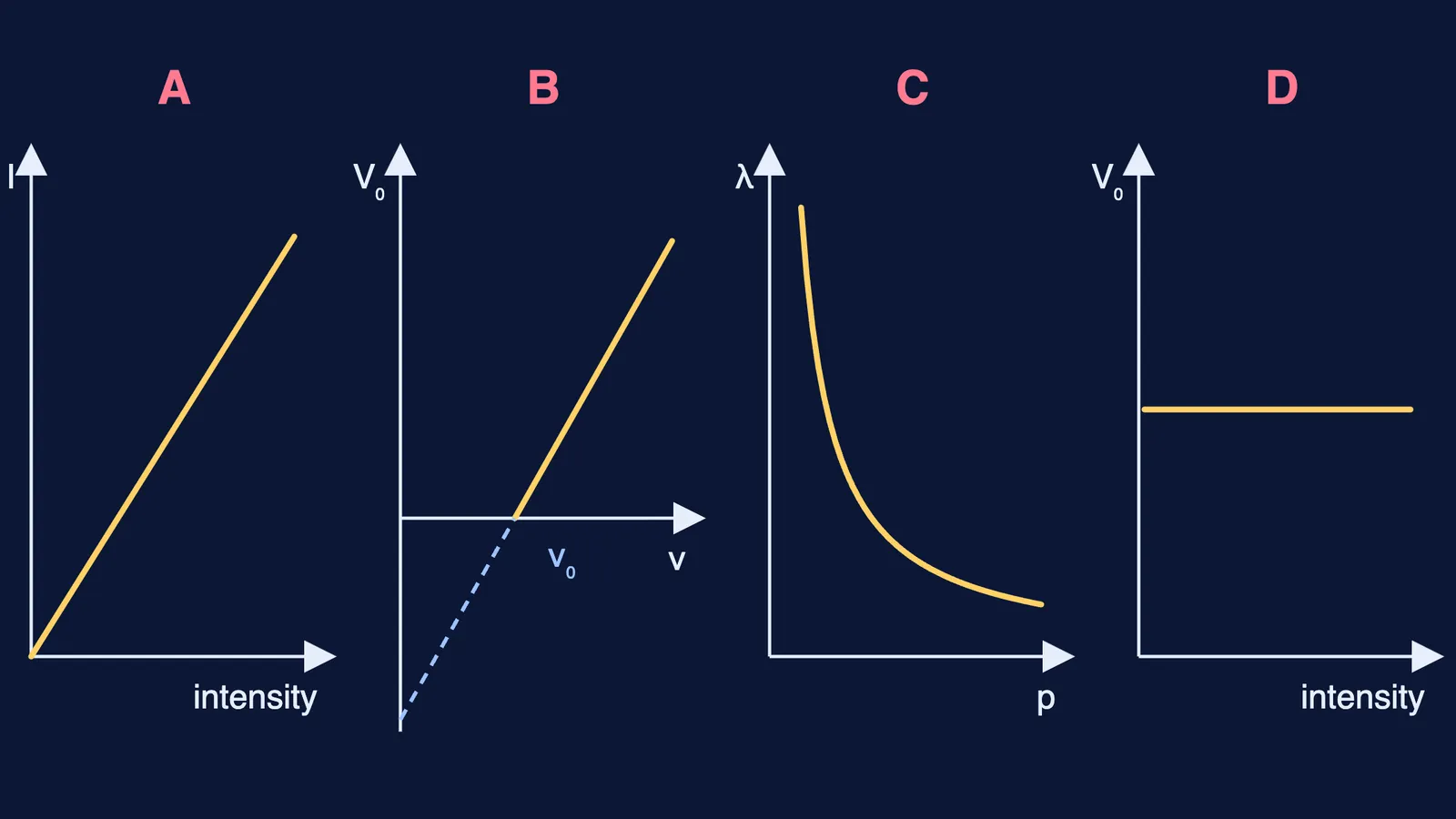
Q6 (medium, match). Graphs in the diagram above. List-I: (A) Photocurrent against intensity, frequency and accelerating potential fixed (B) Stopping potential against frequency (C) de Broglie wavelength against momentum (D) Stopping potential against intensity, frequency fixed. List-II: (I) Straight line through the origin (II) Straight line cutting the frequency axis at ν₀ (III) Rectangular hyperbola (IV) Line parallel to the horizontal axis.
(1) A-I, B-II, C-III, D-IV (2) A-IV, B-II, C-III, D-I (3) A-I, B-III, C-II, D-IV (4) A-II, B-I, C-III, D-IV
Answer: (1). A: current ∝ intensity. B: V₀ = (h/e)ν − φ₀/e. C: λp = h. D: V₀ is independent of intensity.
Trap: (2) swaps the two intensity graphs.
Q7 (medium, match). List-I: (A) Hertz, 1887 (B) Einstein, 1905 (C) Millikan, 1906-1916 (D) Compton, 1924. List-II: (I) Measured the slope of the V₀-ν line for sodium and found h (II) Scattering of X-rays from electrons confirmed photon behaviour (III) Sparks across a detector loop grew stronger under ultraviolet light (IV) Radiation energy comes in quanta of hν, giving K_max = hν − φ₀.
(1) A-III, B-IV, C-I, D-II (2) A-III, B-I, C-IV, D-II (3) A-II, B-IV, C-I, D-III (4) A-III, B-IV, C-II, D-I
Answer: (1). A: during his electromagnetic wave experiments. B: Einstein's equation. C: he aimed to disprove it but confirmed it. D: X-ray scattering.
Trap: (2) credits Millikan with the equation he tested.
Q8 (hard, match). de Broglie wavelengths. List-I: (A) Electron accelerated from rest through 600 V (B) Photon of energy 6.2 keV (C) Proton moving at 3.97 × 10³ m/s (D) Electron moving at 4.86 × 10⁶ m/s. List-II: (I) 0.15 nm (II) 0.050 nm (III) 0.20 nm (IV) 0.10 nm.
(1) A-II, B-III, C-I, D-IV (2) A-IV, B-III, C-II, D-I (3) A-II, B-III, C-IV, D-I (4) A-II, B-I, C-IV, D-III
Answer: (3). A: λ = h/√(2meV) ≈ 0.050 nm. B: λ = hc/E = 1240/6200 nm = 0.20 nm. C: λ = h/mv = 6.63 × 10⁻³⁴/(1.67 × 10⁻²⁷ × 3.97 × 10³) ≈ 0.10 nm. D: 6.63 × 10⁻³⁴/(9.1 × 10⁻³¹ × 4.86 × 10⁶) ≈ 0.15 nm.
Trap: (1) swaps C and D, forgetting the slower proton is 1,835 times heavier.
How do you work these faster?
Ask whether each statement changes frequency or intensity.
Convert wavelengths to eV with 1240/λ(nm) before anything else.
Photon: λ = hc/E. Particle: λ = h/p or h/√(2mK).
In a match, fix your surest pair and strike codes that disagree.
Next: how to solve NEET match-the-list questions or try the Dual Nature NEET practice set.
Can't picture why intensity leaves V₀ unchanged? The Fermi Simulation Lab has interactive simulations for the ideas that are easier to see than to read.


