

On this page
Eight original questions, easy to hard, in two formats that appear in recent JEE Main papers. Start with how to prepare Dual Nature of Matter for JEE Main.
All stay inside Unit 17 of the NTA Syllabus for JEE (Main) - 2027 and follow Chapter 11 of NCERT Class 12 Physics Part II (Reprint 2026-27).
Take h = 6.63 × 10⁻³⁴ J s, e = 1.6 × 10⁻¹⁹ C, c = 3.0 × 10⁸ m/s, electron mass 9.1 × 10⁻³¹ kg, hc = 1240 eV nm.
Key, Q1-Q2: (1) Both correct (2) Both incorrect (3) I correct, II incorrect (4) I incorrect, II correct.
Statement questions: which statements hold?
Q1 (easy, statements). Statement I: In a photon-electron collision, the number of photons is always conserved. Statement II: A 620 nm photon has energy 2.0 eV and momentum about 1.07 × 10⁻²⁷ kg m/s.
Answer: (4). I: NCERT: a photon may be absorbed or created. II: 1240/620 = 2.0 eV; p = h/λ ≈ 1.07 × 10⁻²⁷ kg m/s.
Trap: (1) treats photons like conserved charges.
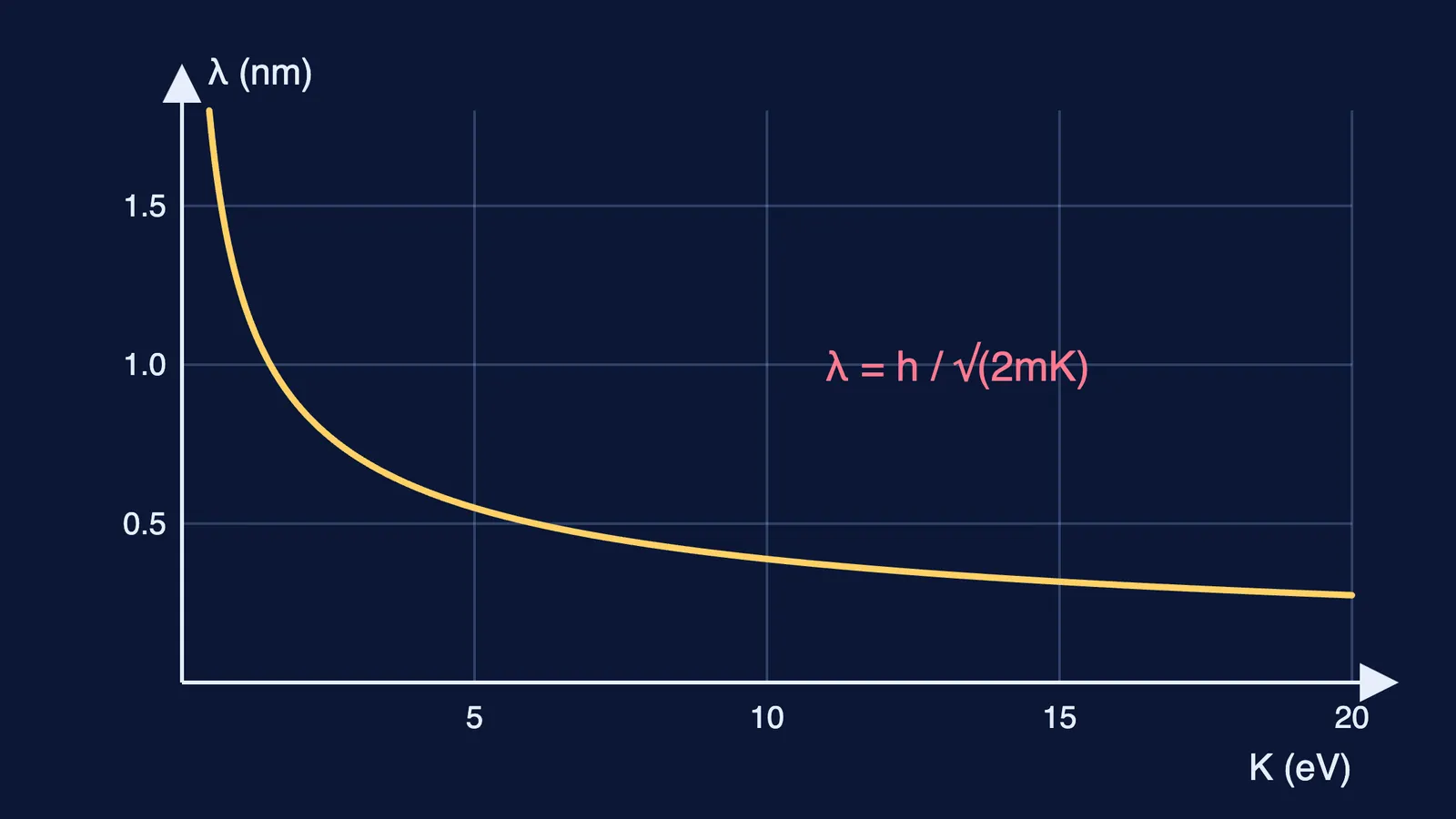
Q2 (easy, statements). An electron and an alpha particle (mass 6.64 × 10⁻²⁷ kg) are accelerated from rest through the same voltage. Statement I: The electron's de Broglie wavelength is about 120 times the alpha's. Statement II: Doubling the voltage halves both wavelengths.
Answer: (3). I: λ = h/√(2mqV), so the ratio is √(2mα/mₑ) ≈ 121. II: λ ∝ 1/√V, so λ falls by √2.
Trap: (1) drops the square root.
Q3 (medium, statements). On one metal, 250 nm light gives V₀ = 2.46 V and 400 nm light gives V₀ = 0.60 V. Which are correct?
A. The work function is 2.50 eV. B. The threshold wavelength is about 496 nm. C. 300 nm light would give V₀ of about 1.53 V. D. These two points alone give h/e ≈ 4.1 × 10⁻¹⁵ V s. E. A metal of work function 3.2 eV would still emit under the 400 nm light.
(1) A, B, C and D only (2) A, B and D only (3) A, D and E only (4) B, C and E only
Answer: (2). A: 1240/250 − 2.46 = 2.50 eV. B: 1240/2.50 = 496 nm. C: 4.13 − 2.50 = 1.63 V. D: ΔV₀/Δν = 1.86/(4.5 × 10¹⁴) ≈ 4.13 × 10⁻¹⁵ V s. E: 3.10 eV < 3.2 eV.
Trap: (1) interpolates V₀ linearly in wavelength.
Q4 (hard, statements). 124 nm light falls on a metal of work function 4.0 eV. Which are correct?
A. V₀ is 6.0 V. B. In a uniform 300 V/m retarding field, the fastest electrons, leaving normally, travel at most 2.0 cm. C. Each photon has more momentum than the fastest photoelectron. D. Doubling the field in B halves V₀. E. A metal of work function 10.5 eV emits nothing under this light at any intensity.
(1) A, B, C and E only (2) A and B only (3) B, D and E only (4) A, B and E only
Answer: (4). A: 10.0 − 4.0 = 6.0 eV. B: d = K/(eE) = 6.0/300 m = 2.0 cm. C: photon p = E/c ≈ 5.3 × 10⁻²⁷; electron p = √(2mK) ≈ 1.3 × 10⁻²⁴ kg m/s. D: V₀ depends only on light and metal. E: 10.0 eV < 10.5 eV.
Trap: (1) equates more energy with more momentum.
Match-the-list questions: which code fits every pair?
Q5 (easy, match). Changes to a V₀-ν graph. List-I: (A) Larger work function (B) V₀ plotted against 1/λ (C) K_max (J) instead of V₀ (D) V₀ plotted against λ. List-II: (I) Straight line of slope hc/e (II) Parallel line shifted to higher frequency (III) Straight line of slope h (IV) Not a straight line.
(1) A-II, B-I, C-IV, D-III (2) A-I, B-II, C-III, D-IV (3) A-II, B-I, C-III, D-IV (4) A-II, B-III, C-I, D-IV
Answer: (3). A: same slope h/e, larger ν₀. B: V₀ = (hc/e)(1/λ) − φ₀/e; hc/e ≈ 1.24 × 10⁻⁶ V m. C: K_max = hν − φ₀. D: hc/(eλ) is not linear in λ.
Trap: (4) swaps the slopes h and hc/e.
Q6 (medium, match). List-I: (A) A particle's kinetic energy × 9 (B) An electron's accelerating voltage 50 V → 200 V (C) Mass × 2, same kinetic energy (D) A photon's energy halved. List-II, factor by which λ changes: (I) 2 (II) 1/3 (III) 1/2 (IV) 1/√2.
(1) A-II, B-III, C-I, D-IV (2) A-III, B-II, C-IV, D-I (3) A-II, B-III, C-IV, D-I (4) A-IV, B-III, C-II, D-I
Answer: (3). A: λ ∝ 1/√K. B: √(50/200) = 1/2. C: λ ∝ 1/√m. D: λ = hc/E doubles.
Trap: (1) swaps C and D.
Q7 (medium, match). 300 nm light on metals of threshold wavelength (List-I): (A) 650 nm (B) 480 nm (C) 375 nm (D) 270 nm. List-II, V₀: (I) No emission (II) 0.83 V (III) 1.55 V (IV) 2.23 V.
(1) A-IV, B-III, C-II, D-I (2) A-I, B-II, C-III, D-IV (3) A-IV, B-II, C-III, D-I (4) A-III, B-IV, C-II, D-I
Answer: (1). Photon: 4.13 eV; φ₀ = 1240/λ₀. A: 4.13 − 1.91 = 2.23. B: 4.13 − 2.58 = 1.55. C: 4.13 − 3.31 = 0.83. D: λ₀ < 300 nm, so none.
Trap: (2) reads a longer λ₀ as a larger φ₀.
Q8 (hard, match). A 2.0 mW beam of 200 nm light hits a metal of work function 4.2 eV; when emission occurs, one electron leaves per 1000 photons. List-I: (A) Power doubled (B) 155 nm, same power (C) Work function 5.0 eV (D) 310 nm, same power. List-II, saturation current and V₀: (I) 0.32 µA, 1.2 V (II) 0.25 µA, 3.8 V (III) 0.65 µA, 2.0 V (IV) Zero current.
(1) A-III, B-I, C-II, D-IV (2) A-III, B-II, C-I, D-IV (3) A-II, B-III, C-I, D-IV (4) A-III, B-II, C-IV, D-I
Answer: (2). Base: 2.0 × 10⁻³/(6.2 × 1.6 × 10⁻¹⁹) ≈ 2.0 × 10¹⁵ photons/s, so 0.32 µA and V₀ = 2.0 V. A: 0.65 µA. B: fewer 8.0 eV photons. C: 1.2 V, same current. D: 4.0 eV < 4.2 eV.
Trap: (1) keeps the current fixed for B.
How do you work these faster?
With two stopping potentials, get φ₀ from one and check it on the other.
Tag every change: frequency or metal moves V₀; intensity moves only the current.
Before comparing momenta, write p = E/c for photons and p = √(2mK) for electrons.
Next: Dual Nature JEE Main practice questions with full solutions.
Stuck? The Fermi Problem Library has worked problems with a step-by-step solver that explains the reasoning rather than printing an answer.


