

On this page
This set follows our first set of Dual Nature JEE Main practice questions and tests what that set skipped: photocurrent graphs, the wave picture's failure, accelerated electrons, mixed light, photon recoil and light pressure.
Unit 17 of the NTA Syllabus for JEE (Main) - 2027 lists the photoelectric effect, Hertz and Lenard's observations, Einstein's photoelectric equation, the particle nature of light and the de Broglie relation. The matching text is NCERT Class 12 Physics Chapter 11 (Reprint 2026-27). New to the chapter? Read our guide on how to prepare Dual Nature of Matter for JEE Main first.
How should you use this second set?
Allow 16 minutes for all eight.
Cover each answer and commit first.
Q5 is numerical-value: give an integer.
Log the trap behind every miss.
Take h = 6.63 × 10⁻³⁴ J s, c = 3.0 × 10⁸ m/s, e = 1.6 × 10⁻¹⁹ C, electron mass 9.1 × 10⁻³¹ kg, g = 9.8 m/s² and hc = 1240 eV nm.
Easy: graphs, the wave picture and accelerated electrons
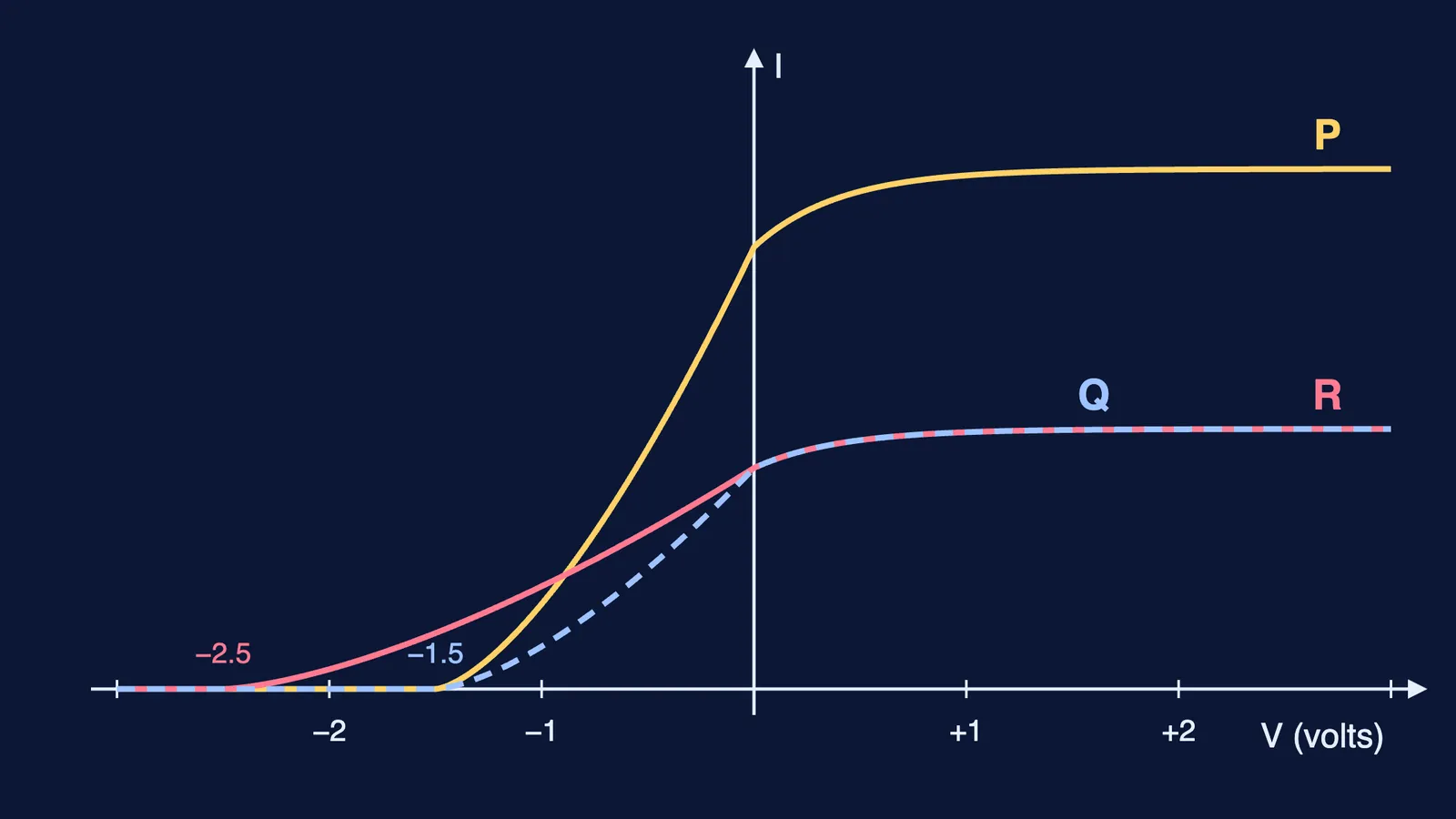
Q1 (easy). Three photocurrent-versus-collector-potential curves use one emitter. Curves P and Q both fall to zero at −1.5 V; curve R falls to zero at −2.5 V. P's saturation current is twice Q's, and R's equals Q's. Which statement is correct?
(A) P and Q use the same frequency, P being more intense; R uses a higher frequency than Q
(B) P uses a higher frequency than Q; R uses a lower frequency than Q
(C) P and Q have the same intensity; R uses a higher frequency than Q
(D) P and Q use the same frequency; R uses a lower frequency, since its curve starts further left
Answer: (A). For one metal, stopping potential depends only on frequency, so equal cut-offs mean equal frequency. Saturation current counts photons per second, so P is twice as intense. R's larger cut-off means more energetic photons. Trap: (D) reads "further left" as "weaker light"; a more negative cut-off means faster electrons.
Q2 (easy). Which observation can the classical wave picture of light NOT explain?
(A) Emission starts with no measurable delay, even in very dim light
(B) Saturation current rises with intensity
(C) Photocurrent drops to zero at a large enough retarding potential
(D) A brighter beam delivers more energy per second to the plate
Answer: (A). NCERT Section 11.5 notes that a spread-out wave would take hours to give one electron enough energy, yet emission is instantaneous. A photon hands its whole hν to one electron at once. Trap: (B) feels quantum, but the wave picture also explains it.
Q3 (easy). An electron starts from rest and is accelerated through 600 V. What is its de Broglie wavelength?
(A) 0.050 nm (B) 0.0020 nm (C) 0.50 nm (D) 0.0012 nm
Answer: (A). K = eV, so p = √(2meV) = √(2 × 9.1 × 10⁻³¹ × 1.6 × 10⁻¹⁹ × 600) ≈ 1.32 × 10⁻²³ kg m/s, and λ = h/p ≈ 5.0 × 10⁻¹¹ m = 0.050 nm. Trap: (B) uses the shortcut λ = 1.227/√V nm but divides by 600, not √600.
Medium: mixed light, recoil and speed
Q4 (medium). Light containing 400 nm and 310 nm in equal intensity falls on a metal of work function 1.8 eV. What is the stopping potential?
(A) 1.3 V (B) 1.75 V (C) 2.2 V (D) 5.3 V
Answer: (C). Photon energies are 1240/400 = 3.1 eV and 1240/310 = 4.0 eV. The stopping potential must halt the fastest electrons, which come from the 4.0 eV photons: V₀ = 4.0 − 1.8 = 2.2 V. Trap: (B) averages the two photon energies; no electron absorbs an average photon.
Q5 (medium, numerical). A free sodium atom of mass 3.8 × 10⁻²⁶ kg, at rest, emits a photon of wavelength 589 nm. Find its recoil speed in mm/s, to the nearest integer.
Answer: 30. The atom's momentum equals the photon's, h/λ. v = h/(mλ) = 6.63 × 10⁻³⁴ / (3.8 × 10⁻²⁶ × 589 × 10⁻⁹) ≈ 0.0296 m/s = 29.6 mm/s, which rounds to 30. Trap: equating the atom's kinetic energy to the photon's energy gives kilometres per second; it is momentum that balances.
Q6 (medium). Photoelectrons from a metal are stopped by 0.91 V. What is the maximum speed of the photoelectrons?
(A) 4.0 × 10⁵ m/s (B) 5.7 × 10⁵ m/s (C) 8.0 × 10⁵ m/s (D) 3.2 × 10¹¹ m/s
Answer: (B). ½mv² = eV₀, so v = √(2eV₀/m) = √(2 × 1.6 × 10⁻¹⁹ × 0.91 / 9.1 × 10⁻³¹) ≈ 5.7 × 10⁵ m/s. Trap: (A) drops the 2 from ½mv²; (D) forgets the square root.
Hard: light pressure and a two-step electron
Q7 (hard). A horizontal 1.0 mg disc reflects half the light falling on it and absorbs the rest. What vertical laser power, at normal incidence, just holds it up?
(A) 1.47 kW (B) 1.96 kW (C) 2.94 kW (D) 1.96 MW
Answer: (B). A beam of power P carries momentum P/c per second: absorbed light transfers P/c, reflected light 2P/c. With half reflected, F = (1 + 0.5)P/c = 1.5P/c. Setting 1.5P/c = mg gives P = (10⁻⁶ × 9.8 × 3.0 × 10⁸)/1.5 ≈ 1960 W. Trap: (A) treats the disc as a perfect mirror; (C) as a perfect absorber.
Q8 (hard). Photons of 4.5 eV fall on a metal of work function 2.6 eV. The fastest photoelectrons are then accelerated through a potential difference V that halves their de Broglie wavelength. Find V.
(A) 1.9 V (B) 5.7 V (C) 7.6 V (D) 13.5 V
Answer: (B). The fastest electrons start with K = 4.5 − 2.6 = 1.9 eV. Since λ = h/√(2mK), halving λ needs four times the kinetic energy, 7.6 eV. The field must add 7.6 − 1.9 = 5.7 eV, so V = 5.7 V. Trap: (C) forgets the 1.9 eV the electrons already had; (A) doubles K, as if λ were proportional to 1/K.
What should you do after set 2?
Sort your misses into piles: graph reading (Q1, Q2), the λ–K link (Q3, Q8), momentum (Q5, Q7) and energy balance (Q4, Q6). Redo each pile cold the next day.
If a step still feels shaky, the Fermi Problem Library has worked problems with a step-by-step solver that explains the reasoning rather than printing an answer.


