On this page
Moving a limit inside an integral usually works. Sometimes it quietly gives the wrong answer, and nothing on the page warns you. The dominated convergence theorem tells you which case you are in.
What does Lebesgue's dominated convergence theorem say?
Henri Lebesgue published his new definition of the integral in the Comptes Rendus on 29 April 1901 and developed it in his 1902 doctoral thesis, Intégrale, longueur, aire (MacTutor biography of Lebesgue). The dominated convergence theorem entry counts the theorem's power and usefulness among the main theoretical advantages of Lebesgue's integral over Riemann's. If the Lebesgue integral is new to you, start with how Lebesgue slices the range instead of the domain.
The statement, as given in the dominated convergence theorem entry (which cites Evans and Gariepy's Measure Theory and Fine Properties of Functions):
Let fₙ be measurable functions with fₙ(x) → f(x) for every x.
Suppose one integrable function g satisfies |fₙ(x)| ≤ g(x) for every x and every n.
Then f is integrable, lim ∫fₙ = ∫f, and in fact ∫|fₙ − f| → 0.
"Integrable" here means ∫g is finite. Both conditions only need to hold almost everywhere, that is, except on a set of measure zero, according to the same statement of the theorem. A standard proof uses Fatou's lemma.
In plain words: if every function in the sequence lives under one fixed roof of finite area, the limit can go inside. The roof g must not depend on n.
Why can't you always swap a limit and an integral?
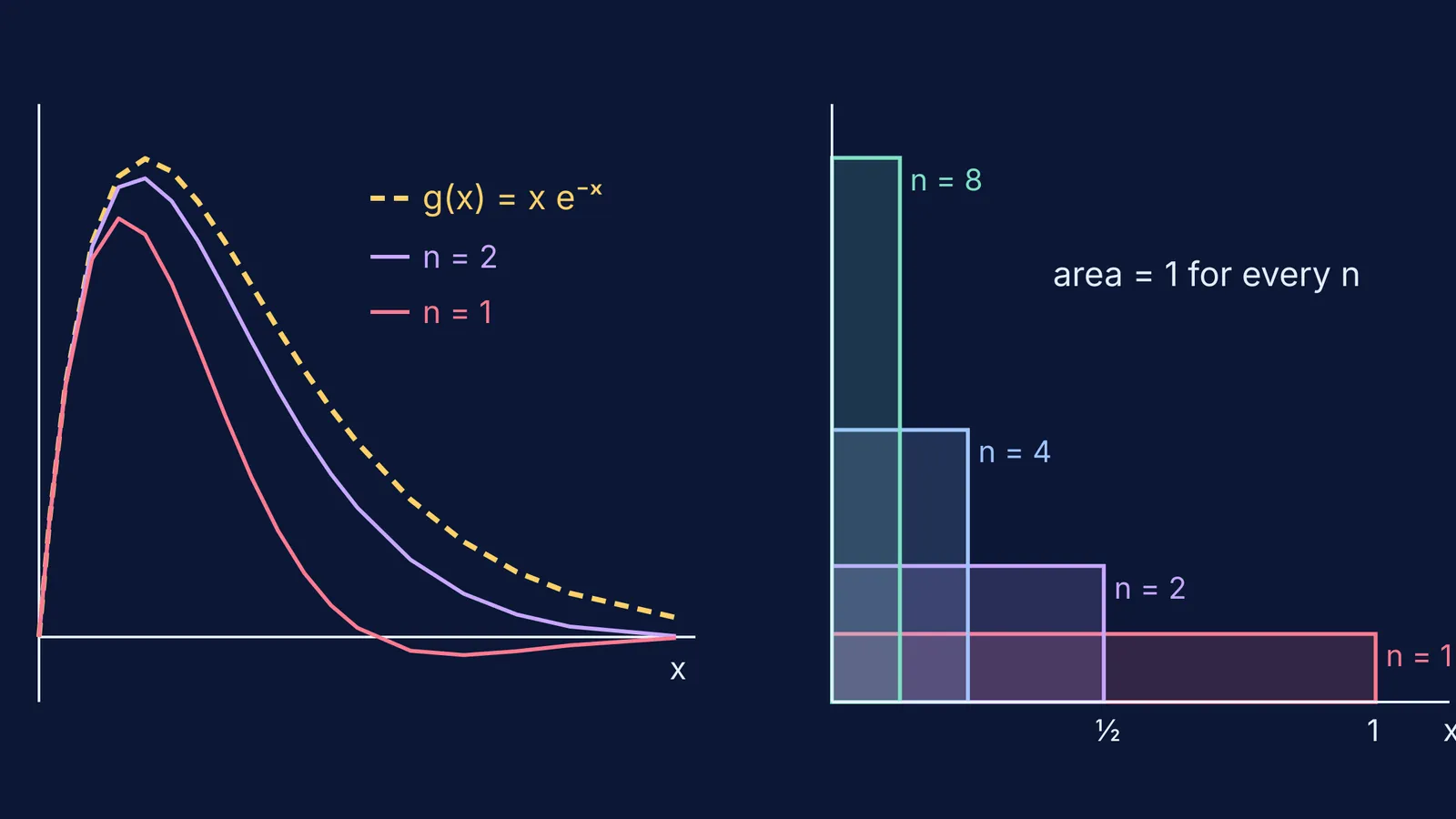
Let fₙ(x) = n when 0 < x < 1/n, and fₙ(x) = 0 everywhere else. Each fₙ is a tall, thin rectangle of height n and width 1/n.
The integrals: ∫fₙ = n × 1/n = 1 for every n, so lim ∫fₙ = 1.
The pointwise limit: for x ≤ 0 or x ≥ 1, fₙ(x) is always 0. For 0 < x < 1, as soon as n > 1/x we have 1/n < x, so fₙ(x) = 0 from then on. The limit is f = 0 at every point, and ∫f = 0.
So lim ∫fₙ = 1 but ∫lim fₙ = 0. The theorem is not broken; its hypothesis fails. Any roof must be at least the largest of the fₙ at each point, which is the largest whole number n below 1/x. That is at least 1/x − 1 on (0, 1), and ∫₀¹ (1/x − 1) dx diverges like a logarithm. No integrable g exists.
This sequence also fails to converge uniformly, since the largest gap between fₙ and 0 is n. If that distinction is hazy, see uniform vs pointwise convergence, explained with xⁿ.
How do you apply the dominated convergence theorem?
Find L = lim as n → ∞ of ∫₀^∞ e^(−x) · n sin(x/n) dx.
Pointwise limit. Fix x and put t = x/n, which tends to 0. Then n sin(x/n) = x · (sin t)/t → x. So fₙ(x) → x e^(−x).
Find a roof. Since |sin t| ≤ |t| for every real t, |n sin(x/n)| ≤ n · x/n = x for x ≥ 0. So |fₙ(x)| ≤ g(x) = x e^(−x), and g is the same for every n.
Check the roof is integrable. ∫₀^∞ x e^(−x) dx = 1, by parts (it is Γ(2) = 1! = 1). Finite, so g qualifies.
Swap. L = ∫₀^∞ x e^(−x) dx = 1.
Cross-check by brute force. Two integrations by parts give ∫₀^∞ e^(−x) sin(ax) dx = a/(1 + a²). With a = 1/n, the integral in the question is n · (1/n)/(1 + 1/n²) = n²/(n² + 1). That is 1/2 for n = 1, 4/5 for n = 2 and 100/101 for n = 10, and it tends to 1.
How do you check whether you can swap a limit and an integral?
Use this check in order, and write each step down in an exam or problem set.
Find the pointwise limit f(x). Ignoring a set of measure zero is allowed.
Find one g with |fₙ(x)| ≤ g(x) for all n at once. A bound like n·x e^(−x) depends on n, so it does not count.
Check that ∫g is finite. Look hardest near points where g blows up and at infinity.
If no such g exists, suspect escaping mass. Compute ∫fₙ for a few values of n and compare with ∫f, as in the rectangle example.
The same question comes up for double integrals; see when you can swap the order of integration with Fubini's rule.
If words like measurable, almost everywhere or Lebesgue integrable are holding you up, the Fermi Concept Library covers every concept in mathematics, each with its own lesson and its place in the map. To practise finding roofs, the Fermi Problem Library has worked problems with a step-by-step solver that explains the reasoning rather than printing an answer.
Next time you move a limit inside an integral, name your g first.