

On this page
NCERT's chapter on carboxylic acids has one line that most students learn by heart without the reason behind it. It says carboxylic acids are reduced to primary alcohols by lithium aluminium hydride "or better with diborane". It adds that diborane does not easily reduce esters, nitro or halo groups, and that sodium borohydride does not reduce the carboxyl group. That looks backwards at first. The COOH group is usually the hardest carbonyl to reduce, so why would a reagent go for it and ignore the ester? The answer is that borane is not a hydride donor in the way LiAlH₄ is. It is an electron-pair acceptor, and that flips the order in which groups react.
What does diborane actually do to a carboxylic acid?
Diborane, B₂H₆, is a gas that behaves as two BH₃ units. Chemists use BH₃·THF or BH₃·SMe₂ (borane–dimethyl sulfide), stable complexes that hand over BH₃. Exam questions still write B₂H₆, and the chemistry is the same.
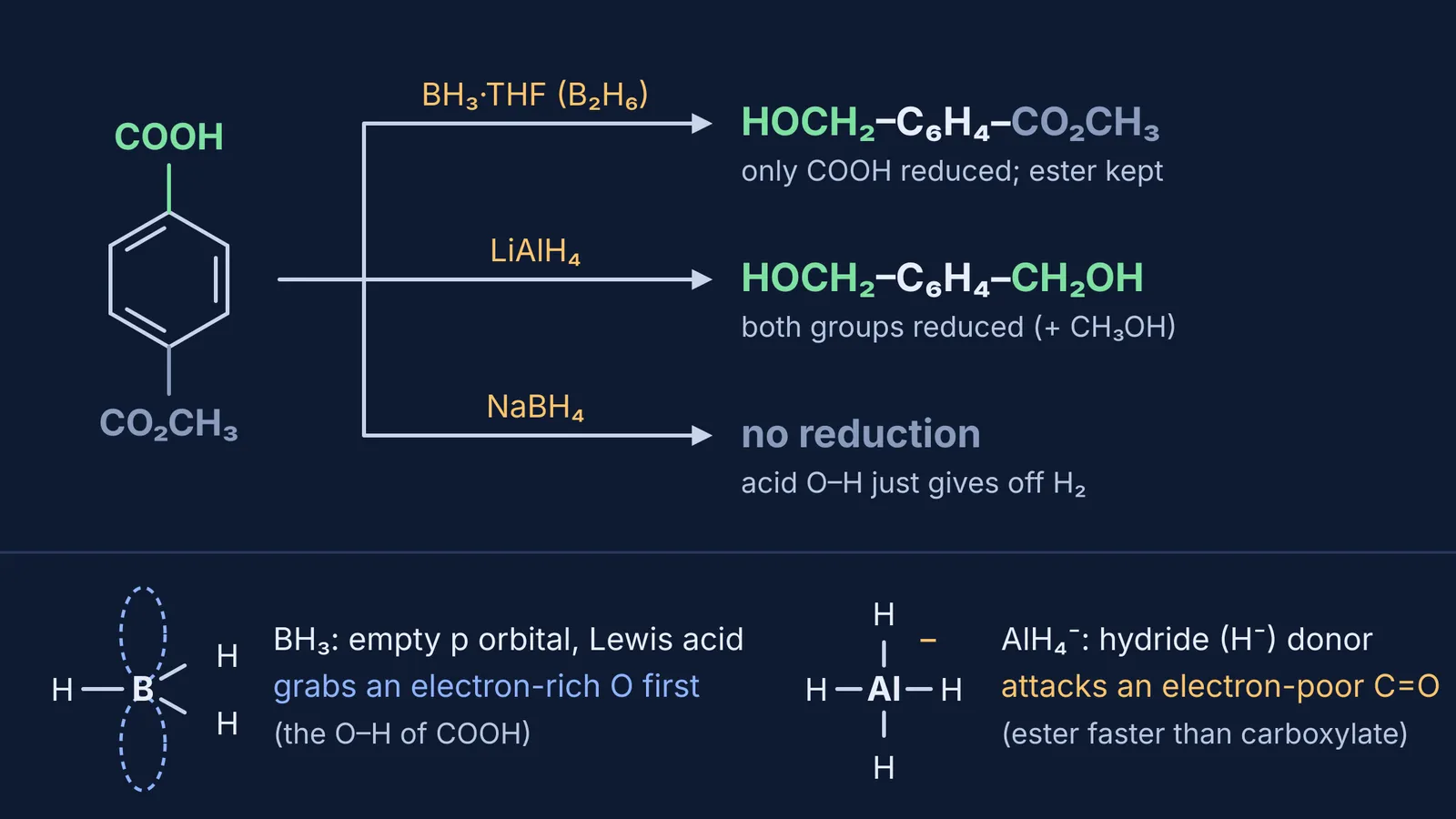
Boron in BH₃ has only six valence electrons and an empty p orbital. So BH₃ is a Lewis acid: it looks for a lone pair to accept. In a carboxylic acid the easiest target is the O–H group, and the reaction goes like this.
The O–H reacts first. The acidic H⁺ meets a hydride on boron and leaves as hydrogen gas: RCOOH + BH₃ → RCOO–BH₂ + H₂. The product is an acyloxyborane, with boron now bonded to the oxygen.
The carbonyl is activated. In an acid or an ester, the lone pair on the single-bonded oxygen donates into the C=O and makes the carbonyl carbon less electrophilic. In the acyloxyborane that lone pair is pulled towards boron's empty orbital instead. The carbonyl now behaves more like that of an anhydride, which is much easier to reduce.
Hydride moves from boron to carbon. Because boron is already attached to the molecule, the hydride does not have to find the carbonyl from solution. Two hydride transfers take the carbon down to the alcohol level, as an RCH₂O–B species.
Water frees the alcohol. Workup hydrolyses the B–O bonds and gives RCH₂OH and boric acid.
Overall, after workup: RCOOH + BH₃ + 2H₂O → RCH₂OH + B(OH)₃ + H₂. Check it: one of the three hydrides on boron ends up in H₂, and the other two end up on carbon. Atoms and charge both balance.
Why does diborane leave an ester alone?
An ester, RCOOR′, has no acidic hydrogen. That removes the first step, and with it the whole activation trick.
No B–O bond forms. Without the O–H, BH₃ can only coordinate weakly and reversibly to the ester oxygen.
The ester carbonyl stays deactivated. The OR′ lone pair keeps donating into the C=O, so the carbonyl carbon is a poor target.
BH₃ is a weak hydride donor on its own. It is neutral, not an anion. Without the help of being bonded to the substrate, hydride transfer is slow.
"Does not easily reduce" means slowly, not never. Esters are reduced by borane if you heat them with excess reagent for long enough. At room temperature, the acid reacts far faster, and that gap in rate is what makes the selective reduction useful.
NCERT's list is also easy to over-read. Borane does not reduce only acids. It reduces aldehydes and ketones readily, reduces amides to amines, and adds across C=C double bonds (hydroboration). So diborane is the selective choice when the other group is an ester, a nitro group or a halide, not when it is an alkene or a ketone.
Why do LiAlH₄ and NaBH₄ show the opposite preference?
AlH₄⁻ and BH₄⁻ are anions. They deliver H⁻ as a nucleophile to an electron-poor carbonyl carbon, so the most electrophilic carbonyl reacts fastest. For the full comparison of the two, see the difference between LiAlH₄ and NaBH₄.
With an acid, the first thing either does is an acid–base reaction. The O–H gives off H₂ and the acid becomes a carboxylate-type species. A negatively charged carboxylate is a poor electrophile.
LiAlH₄ is strong enough to push on. With excess reagent in dry ether or THF, it still reduces the carboxylate to RCH₂OH. It reduces esters even faster, giving two alcohols.
NaBH₄ is not. It stops at the deprotonation step, so the COOH group survives. Most esters also react only slowly with NaBH₄ under ordinary conditions.
So the rule is simple once you see it. Nucleophilic hydrides prefer the electron-poor carbonyl, which makes the ester the easier target. Electrophilic borane prefers the group that can bond to it, which is the acid. DIBAL-H is the mirror case: a reagent chosen to act on esters, covered in why DIBAL-H stops at the aldehyde for esters.
Worked example: one molecule, three reagents
Take 4-(methoxycarbonyl)benzoic acid, HOOC–C₆H₄–COOCH₃, with the two groups para to each other. Predict the product with (a) BH₃·THF, (b) excess LiAlH₄, (c) NaBH₄, each followed by aqueous workup.
List the groups. A COOH (has an acidic H), a methyl ester (no acidic H) and a benzene ring, which none of these reagents touches.
Borane. Only the COOH has the O–H that lets BH₃ in. It becomes CH₂OH and the ester survives. The product is methyl 4-(hydroxymethyl)benzoate, HOCH₂–C₆H₄–COOCH₃. Balanced: C₉H₈O₄ + BH₃ + 2H₂O → C₉H₁₀O₃ + B(OH)₃ + H₂.
LiAlH₄. Both groups are reduced to CH₂OH. The product is the diol HOCH₂–C₆H₄–CH₂OH (benzene-1,4-diyldimethanol), and the ester's OCH₃ leaves as methanol.
NaBH₄. The acid's O–H reacts and gives off H₂, but nothing is reduced to any useful extent. After acidic workup you recover the starting acid-ester.
Sanity check on structure. The para arrangement matters. If the two groups were ortho, the new CH₂OH could reach the ester carbonyl and close a five-membered lactone. Para groups cannot do that.
A second case shows the nitro point. 4-Nitrobenzoic acid with BH₃·THF gives 4-nitrobenzyl alcohol, O₂N–C₆H₄–CH₂OH, with the nitro group untouched. LiAlH₄ would not give a clean answer here. It also attacks aromatic nitro groups, and with nitroarenes it gives azo compounds (Ar–N=N–Ar), not amines.
If you want more chemoselectivity problems worked like this, the Fermi Problem Library has a step-by-step solver that explains the reasoning at each step.
Where does this show up in JEE and NEET questions?
These question types are quick marks once the reason is clear.
Reagent choice. "Reduce 4-nitrobenzoic acid to 4-nitrobenzyl alcohol without touching the nitro group": choose B₂H₆.
Statement questions. "Diborane reduces esters faster than acids" is false. "NaBH₄ reduces RCOOH to RCH₂OH" is false.
Product prediction on molecules with two groups. Mark each group as having an acidic H or not, then apply the reagent's preference.
For the rest of the acid reactions that sit around this one, from acidity order to anhydride and ester formation, see ranking acidity and keeping the carboxylic acid reactions straight.
Quick checklist
B₂H₆ acts as BH₃, a Lewis acid with an empty p orbital; in the lab it is used as BH₃·THF or BH₃·SMe₂.
Step one with an acid: RCOOH + BH₃ → RCOO–BH₂ + H₂. Boron is then bonded to the substrate and reduces it from there.
Esters lack the acidic H, so borane reduces them only slowly.
LiAlH₄ reduces acids and esters; NaBH₄ reduces neither.
Borane still reduces aldehydes, ketones and amides, and hydroborates alkenes.
LiAlH₄ turns aromatic nitro compounds into azo compounds, not amines.


