

On this page
Statement and match-the-list questions appear in recent NEET papers and take time. These eight original questions run easy to hard within Physics Unit 12 of the NMC's NEET (UG)-2026 syllabus and Chapter 3 of NCERT Class 12 Physics Part I. Take e = 1.6 × 10⁻¹⁹ C, m = 9.1 × 10⁻³¹ kg. See our Current Electricity for NEET guide.
What are Current Electricity statement questions?
Options for Q1 and Q3: (1) Both correct. (2) Both incorrect. (3) I correct, II incorrect. (4) I incorrect, II correct.
Q1 (easy, statements). Statement I: Electric current is a scalar, though we draw it with an arrow. Statement II: Currents at a junction add as vectors.
Answer: (3). I is correct: NCERT calls current a scalar, since I = j·ΔS. II is incorrect: NCERT says currents do not obey vector addition.
Trap: (1) treats the arrow as a vector.
Q2 (medium, statements). Which are correct? A. A metal's resistivity rises with temperature because the collision time τ falls. B. A semiconductor's resistivity falls with temperature because its carrier density rises. C. Manganin suits standard resistors as its resistivity barely changes with temperature. D. A metal's free-electron density rises sharply with temperature. E. A wire's resistivity doubles when its length doubles.
(1) A, B, C and D only (2) A, B and C only (3) A, C and E only (4) B, C and D only
Answer: (2). A is true: in ρ = m/(ne²τ), τ falls while n holds. B is true: the rise in n outweighs the fall in τ. C is true (NCERT). D is false: NCERT says a metal's n barely depends on temperature. E is false: length changes resistance, not resistivity.
Trap: (1) gives the metal the semiconductor's reason.
Q3 (medium, statements). Statement I: V = IR can be applied to a diode, with R = V/I at that point. Statement II: Ohm's law says the I-V graph is linear: R does not depend on V.
Answer: (1). I is correct: NCERT says V = IR defines resistance for any conductor. II is correct: it is NCERT's statement of Ohm's law.
Trap: (4) treats V = IR as Ohm's law itself.
Q4 (hard, statements). A 1.0 mm² copper wire carries 1.7 A. Take n = 8.5 × 10²⁸ m⁻³ (NCERT's copper value) and τ = 2.5 × 10⁻¹⁴ s. Which are correct? A. Drift speed is 1.25 × 10⁻⁴ m/s. B. Electron mobility is about 4.4 × 10⁻³ m²/(V s). C. Resistivity is about 1.7 × 10⁻⁸ Ω m. D. Random thermal motion adds to the drift velocity. E. Electron mobility is negative, as the electron's charge is.
(1) A, B, C and E only (2) A, C and D only (3) B, C and D only (4) A, B and C only
Answer: (4). A: v_d = I/(neA) = 1.25 × 10⁻⁴ m/s. B: μ = eτ/m ≈ 4.40 × 10⁻³. C: ρ = 1/(neμ) = 1.67 × 10⁻⁸ Ω m. D is false: NCERT says random motion averages to zero. E is false: NCERT says mobility is positive.
Trap: (1) carries the minus sign into μ.
What are Current Electricity match-the-list questions?
Q5 (easy, match). Match each with its principle.
List-I: A. Meter bridge; B. High-voltage transmission lines; C. Glowing filament of an electric bulb; D. Currents meeting at a junction.
List-II: I. Conservation of charge; II. Wasted power in the cables is P²R_c/V²; III. Null deflection of the galvanometer at balance; IV. Ohmic heating, I²R.
(1) A-III, B-IV, C-II, D-I (2) A-I, B-II, C-IV, D-III (3) A-III, B-II, C-IV, D-I (4) A-III, B-II, C-I, D-IV
Answer: (3). A-III: the meter bridge uses the Wheatstone balance condition. B-II: for fixed power, loss falls as 1/V². C-IV: I²R heats the coil to incandescence. D-I: as much charge flows in as out.
Trap: (1) swaps B and C, as both involve I²R.
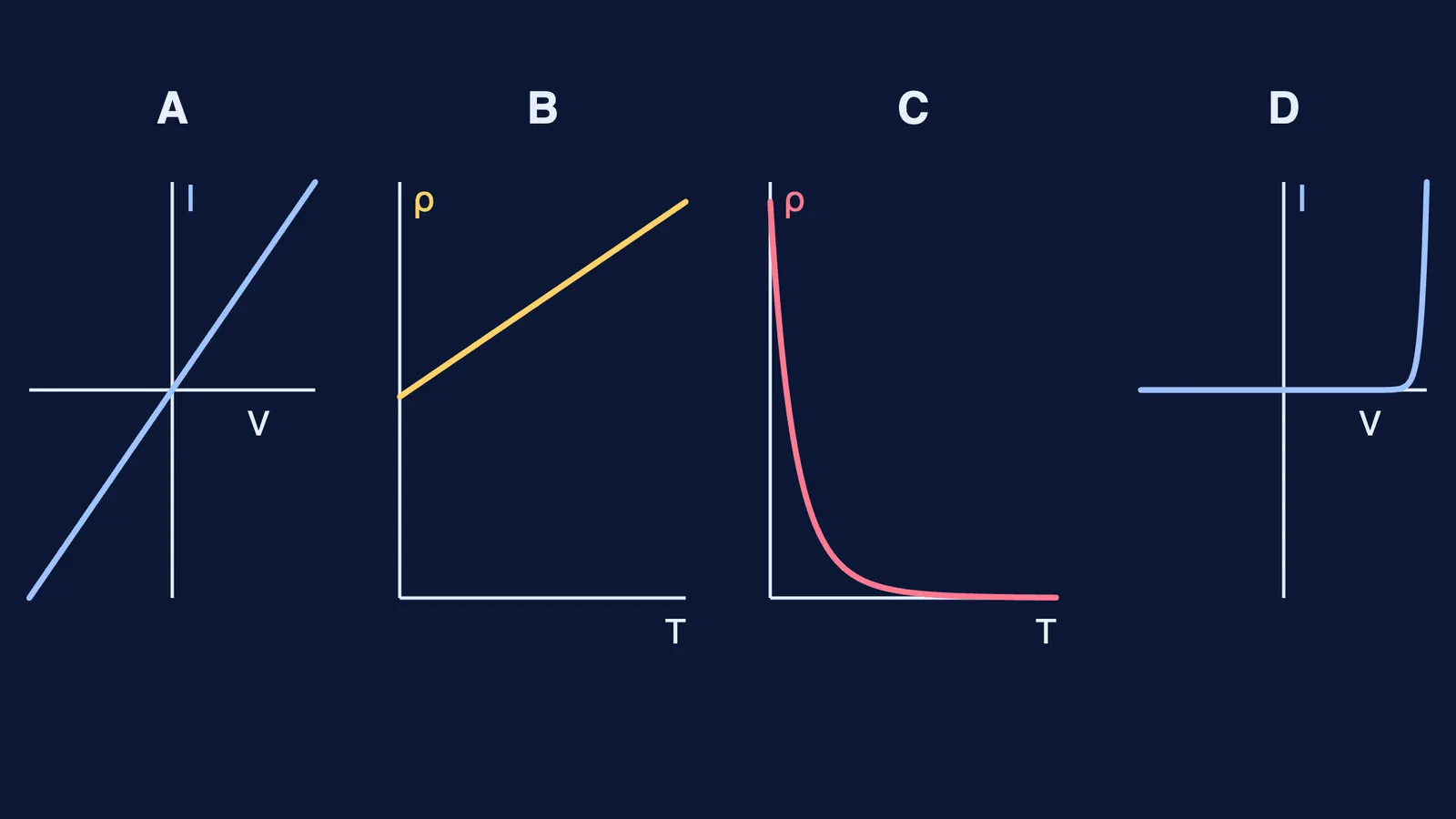
Q6 (medium, match). Match each graph with its cause.
List-I: A. A metal wire's I-V graph at fixed temperature, straight through the origin; B. Copper's resistivity rising with temperature; C. A semiconductor's resistivity falling with temperature; D. A diode's I-V graph, near zero for negative V, steep for positive V.
List-II: I. Carrier density rises, outweighing the fall in τ; II. R does not depend on V; III. The V-I relation depends on the sign of V; IV. τ falls while carrier density stays nearly constant.
(1) A-II, B-I, C-IV, D-III (2) A-II, B-IV, C-I, D-III (3) A-III, B-IV, C-I, D-II (4) A-II, B-IV, C-III, D-I
Answer: (2). A-II: a linear graph is Ohm's law. B-IV and C-I follow from ρ = m/(ne²τ). D-III: NCERT lists sign dependence as one failure of Ohm's law.
Trap: (1) swaps the metal and semiconductor reasons.
Q7 (medium, match). Match each quantity with its dimensions.
List-I: A. Resistivity; B. Conductivity; C. Mobility; D. Current density.
List-II: I. [ML³T⁻³A⁻²]; II. [L⁻²A]; III. [M⁻¹T²A]; IV. [M⁻¹L⁻³T³A²].
(1) A-I, B-IV, C-III, D-II (2) A-IV, B-I, C-III, D-II (3) A-I, B-IV, C-II, D-III (4) A-I, B-III, C-IV, D-II
Answer: (1). A-I: ρ = RA/l. B-IV: σ = 1/ρ. C-III: μ = v_d/E. D-II: j is current per area.
Trap: (2) swaps the reciprocals ρ and σ.
Q8 (hard, match). A cell has emf 6.0 V and internal resistance 0.50 Ω. Match each case with the power.
List-I: A. In an external 2.5 Ω; B. In an external 0.50 Ω; C. In an external 5.5 Ω; D. Inside the cell, with an external 1.0 Ω.
List-II: I. 5.5 W; II. 8.0 W; III. 10 W; IV. 18 W.
(1) A-IV, B-III, C-I, D-II (2) A-III, B-IV, C-II, D-I (3) A-III, B-II, C-I, D-IV (4) A-III, B-IV, C-I, D-II
Answer: (4). A-III: I = 2.0 A; I²R = 10 W. B-IV: I = 6.0 A; I²R = 18 W. C-I: I = 1.0 A; I²R = 5.5 W. D-II: I = 4.0 A; I²r = 8.0 W.
Trap: (1) swaps A and B, giving the larger resistor more power.
How do you work Current Electricity statements faster?
Write ρ = m/(ne²τ); it settles most temperature statements.
With a real cell, find I = ε/(R + r) first, then choose I²R or I²r.
In match questions, lock your surest pair and strike options without it.
Do the Q6 curves blur? The Fermi Simulation Lab has interactive simulations for ideas that are easier to see than to read.
See our method for NEET statement-based questions, or try Current Electricity NEET practice questions with solutions.


