

On this page
Statement and match-the-list questions appear in recent JEE Main papers. These eight original ones run easy to hard, within Unit 12 of NTA's JEE (Main) 2027 Physics syllabus and Chapter 3 of NCERT Class 12 Physics Part I. For theory, see how to prepare Current Electricity for JEE Main.
Statement questions: can you judge each claim?
Options for Q1 and Q3: (1) Both correct (2) Both incorrect (3) I correct, II incorrect (4) I incorrect, II correct
Q1 (easy, statements). Cells ε₁ > ε₂ (internal resistances r₁, r₂) are joined in parallel, like terminals together. Statement I: The pair's emf exceeds ε₁. Statement II: Its internal resistance is below both r₁ and r₂.
Answer: (4). I is incorrect: NCERT's ε_eq = (ε₁r₂ + ε₂r₁)/(r₁ + r₂) is a weighted average of the two. II is correct: 1/r_eq = 1/r₁ + 1/r₂.
Trap: (1) adds the emfs, as in series.
Q2 (medium, statements). Which are correct? A. The junction rule rests on charge conservation. B. The loop rule holds as potential depends only on position. C. A balanced Wheatstone bridge stays balanced if battery and galvanometer swap. D. At balance the galvanometer reads zero because its resistance is large. E. The junction rule fails at a point along one wire.
(1) A, B and C only (2) A, B, C and D only (3) A and C only (4) B, C and E only
Answer: (1). A and B are NCERT's reasons. C: balance P/Q = R/S becomes P/R = Q/S after the swap, which is equivalent. D is false: the condition has no galvanometer resistance. E is false: NCERT applies it to a point in a line.
Trap: (2) credits the null to the meter.
Q3 (medium, statements). Eight 2.0 V, 1.0 Ω cells drive 2.0 Ω, as 8/n parallel rows of n in series. Statement I: n = 4 gives the largest current, 2.0 A. Statement II: n = 8 gives more current than n = 2.
Answer: (3). I = 2n/(2 + n²/8): n = 1, 2, 4, 8 give 0.94, 1.6, 2.0 and 1.6 A. I holds; II fails, as n = 2 and n = 8 tie.
Trap: (4) assumes more series cells always help.
Q4 (hard, statements). A wire is 20.0 Ω at 20 °C; its temperature coefficient, referred to 20 °C, is 4.0 × 10⁻³ per °C. Neglect expansion. Which are correct? A. At 70 °C it is 24.0 Ω. B. It reaches 30.0 Ω at 145 °C. C. On 12 V, its power falls 20% from 20 °C to 70 °C. D. On 12 V, with electron density constant, drift speed at 70 °C is 5/6 of that at 20 °C. E. Doubling its length doubles its coefficient.
(1) A, B, C and D only (2) A, C and D only (3) B, D and E only (4) A, B and D only
Answer: (4). A: 20.0 × 1.2 = 24.0 Ω. B: needs a 125 °C rise. C is false: V²/R falls from 7.2 W to 6.0 W, about 16.7%. D: v_d = eEτ/m, E fixed, τ ∝ 1/ρ, so 20/24. E is false: the coefficient is the material's.
Trap: (1) turns a 20% rise in R into a 20% power drop.
Match-the-list questions: can you pair all four?
Q5 (easy, match). Match each arrangement of four 6 Ω resistors with its resistance.
List-I: A. All in series; B. All in parallel; C. Two series pairs in parallel; D. Three in parallel, in series with the fourth.
List-II: I. 1.5 Ω; II. 6 Ω; III. 8 Ω; IV. 24 Ω.
(1) A-IV, B-I, C-III, D-II (2) A-IV, B-I, C-II, D-III (3) A-I, B-IV, C-II, D-III (4) A-IV, B-II, C-I, D-III
Answer: (2). A-IV: 4 × 6. B-I: 6/4. C-II: 12 Ω parallel 12 Ω. D-III: 2 + 6.
Trap: (1) swaps the mixed arrangements.
Q6 (medium, match). A wire stays across one ideal battery. Match each change with its effect on drift speed.
List-I: A. An identical second wire joined in series; B. Diameter doubled, same length; C. Same volume, half the length; D. Resistivity up 25%, same electron density.
List-II: I. Unchanged; II. 0.8 times; III. Halves; IV. Doubles.
(1) A-III, B-I, C-IV, D-II (2) A-III, B-IV, C-I, D-II (3) A-IV, B-I, C-III, D-II (4) A-III, B-I, C-II, D-IV
Answer: (1). v_d = eEτ/m with E = V/L. A-III: V spans 2L, so E halves. B-I: E is unchanged. C-IV: E doubles. D-II: ρ = m/(ne²τ), so τ falls to 0.8.
Trap: (2) lets the larger current raise drift speed.
Q7 (medium, match). An ideal 14 V battery drives 1 Ω, then 4 Ω parallel 12 Ω, then 3 Ω, in series. Match each resistor with its power.
List-I: A. 1 Ω; B. 4 Ω; C. 12 Ω; D. 3 Ω.
List-II: I. 3 W; II. 4 W; III. 9 W; IV. 12 W.
(1) A-II, B-I, C-III, D-IV (2) A-IV, B-III, C-I, D-II (3) A-II, B-III, C-IV, D-I (4) A-II, B-III, C-I, D-IV
Answer: (4). The pair is 3 Ω, so 7 Ω in all and 2 A: A-II, 2² × 1; D-IV, 2² × 3. The pair has 6 V: B-III, 6²/4; C-I, 6²/12.
Trap: (1) gives the bigger parallel resistor more power.
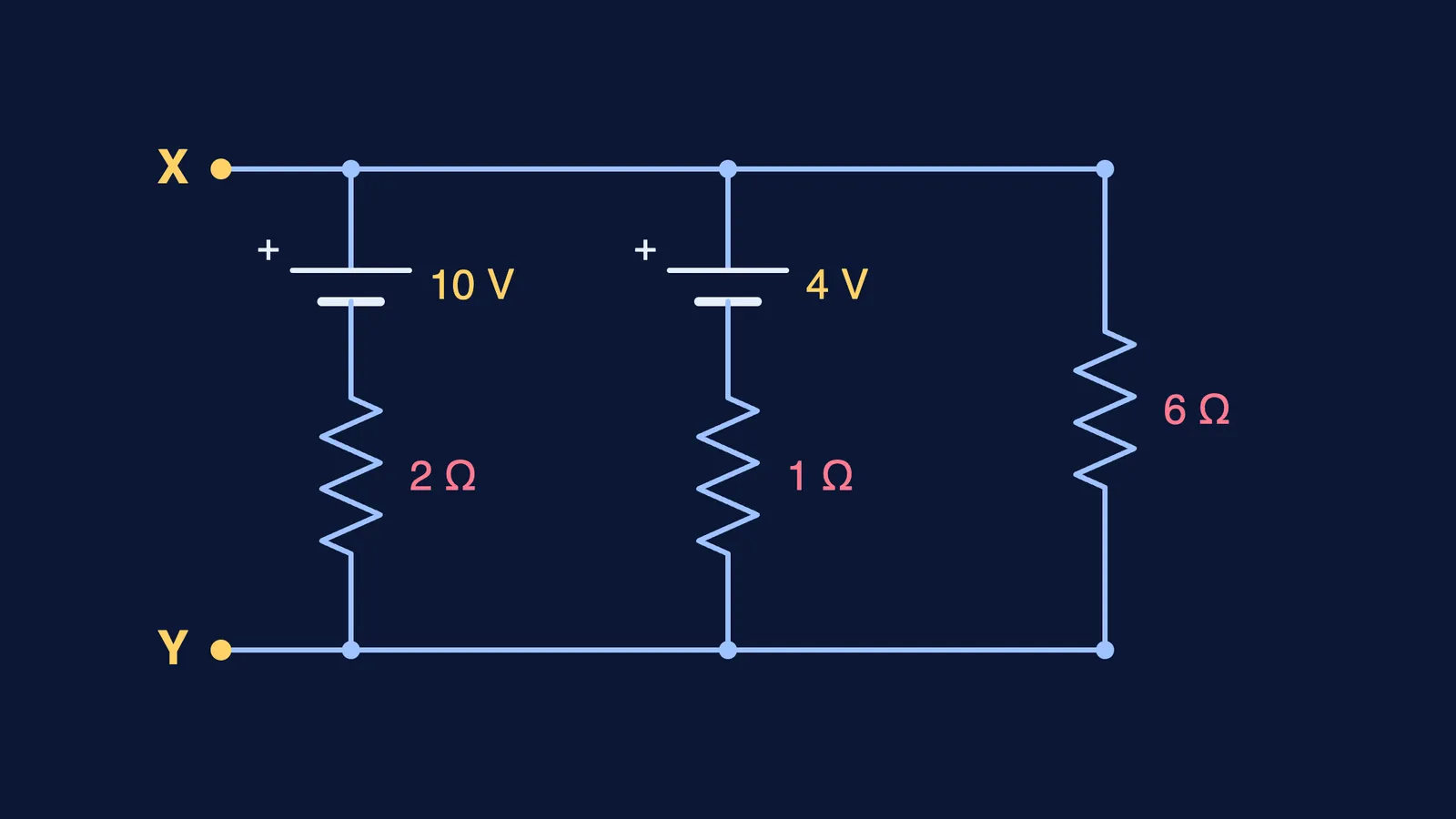
Q8 (hard, match). Three branches join nodes X and Y: a 10 V cell with 2 Ω, a 4 V cell with 1 Ω (both positive toward X), and 6 Ω.
List-I: A. Current in 6 Ω; B. Current in the 10 V cell; C. Current in the 4 V cell; D. Current in 6 Ω with the 4 V branch cut.
List-II: I. 0.9 A; II. 1.25 A; III. 1.4 A; IV. 2.3 A.
(1) A-II, B-IV, C-III, D-I (2) A-I, B-III, C-IV, D-II (3) A-I, B-IV, C-III, D-II (4) A-III, B-IV, C-I, D-II
Answer: (3). With Y at 0 V, the junction rule at X, (10 − V)/2 + (4 − V)/1 = V/6, gives V = 5.4 V. A-I: 5.4/6. B-IV: 4.6/2. C-III: −1.4 A, so that cell charges. D-II: (10 − V)/2 = V/6 now gives 7.5 V.
Trap: (1) swaps A and D.
How do you solve these faster?
Find the current first, then pick I²R, V²/R or εI.
For drift speed, track E = V/L; area often drops out.
With several cells, set one node at 0 V and write one junction equation.
Did a sign slip in Q8 catch you? The Fermi Problem Library has worked problems with a step-by-step solver that explains the reasoning rather than printing an answer.
Next, try Current Electricity JEE Main practice questions with solutions or our method for statement-based questions.


