

On this page
These eight new questions have no options, just a number to type. They run easy to hard, inside Unit 12 of the NTA syllabus for JEE (Main) 2027 and NCERT Class 12 Physics Chapter 3. For theory, see how to prepare current electricity for JEE Main.
What is a JEE Main numerical-value question?
In Paper 1 of JEE (Main) 2027, each subject has Section A with 20 multiple-choice questions and Section B with 5 questions whose answer is a numerical value, according to the NTA Information Bulletin for JEE (Main) 2027. Section B has negative marking: +4 for a correct answer, −1 for a wrong one, 0 if blank. You type the answer on an on-screen keypad, rounded off to the nearest integer.
Easy: can you get the units right?
Q1 (easy). A metal wire 2.5 m long has a potential difference of 5.0 V across its ends. The electron mobility in the metal is 4.5 × 10⁻³ m² V⁻¹ s⁻¹. Find the drift speed of the electrons, in mm/s.
Answer: 9. The field is E = V/L = 5.0/2.5 = 2.0 V/m, and v_d = μE = 4.5 × 10⁻³ × 2.0 = 9.0 × 10⁻³ m/s, which is 9 mm/s.
Trap: 22.5 multiplies μ by the voltage, not the field.
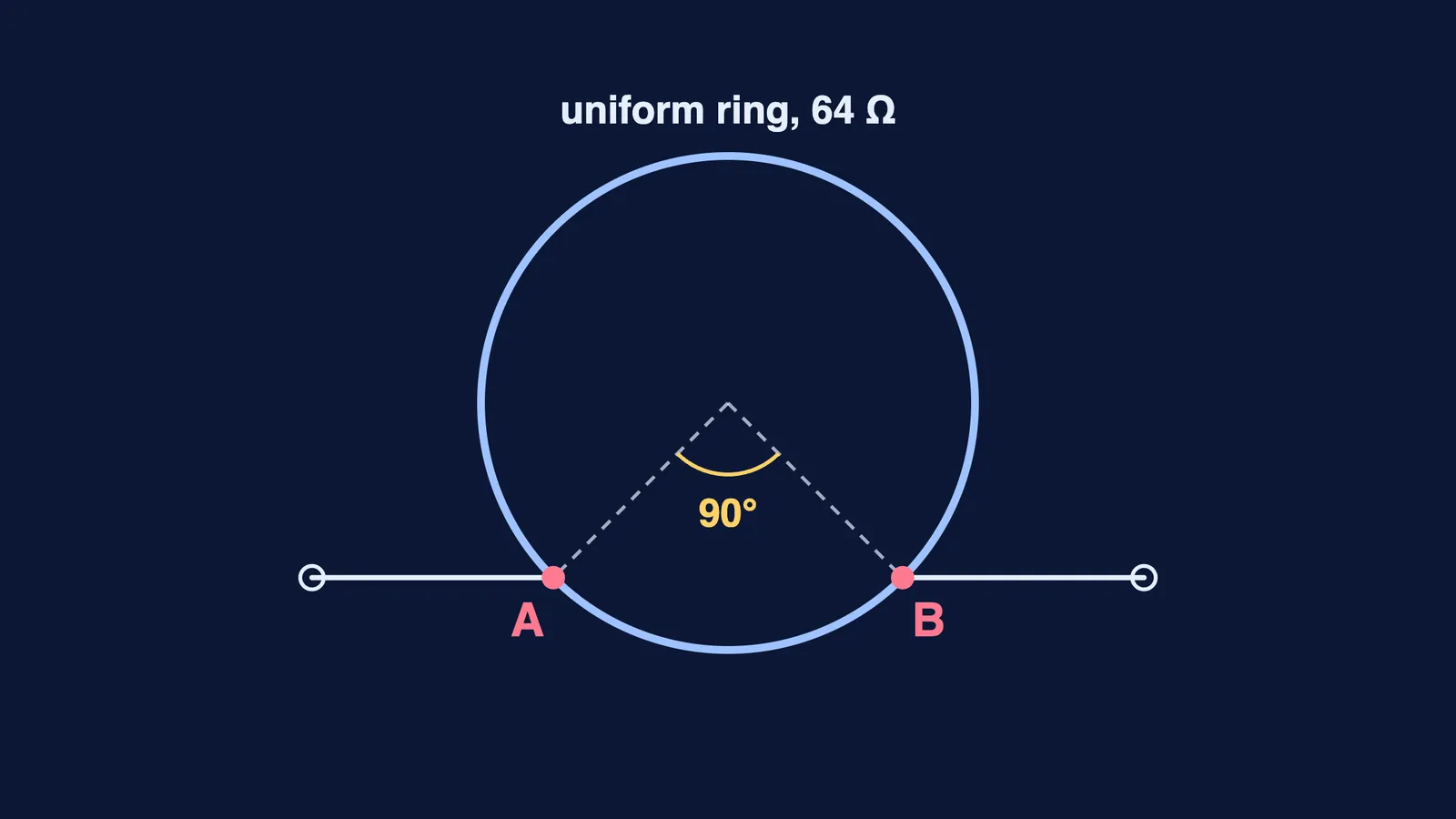
Q2 (easy). A uniform wire of resistance 64 Ω is bent into a circle. Leads are joined at two points A and B such that the shorter arc AB subtends 90° at the centre. Find the resistance between A and B, in ohms.
Answer: 12. The arcs are a quarter and three quarters of the ring: 16 Ω and 48 Ω. They are in parallel: 16 × 48/(16 + 48) = 12 Ω.
Trap: 16 counts only the shorter arc.
Q3 (easy). A 2.0 kW geyser runs for 45 minutes every day for 30 days. Electricity costs ₹8 per kWh. Find the cost of this energy, in rupees.
Answer: 360. Energy = 2.0 kW × 0.75 h × 30 = 45 kWh, and 45 × 8 = ₹360.
Trap: 216 writes 45 minutes as 0.45 h instead of 0.75 h.
Medium: cells, cables and the metre bridge
Q4 (medium). With a 2.0 Ω resistor across a cell, the terminal voltage is 4.0 V. With a 5.0 Ω resistor instead, it is 5.0 V. Find the emf of the cell, in volts.
Answer: 6. The currents are 4.0/2.0 = 2.0 A and 5.0/5.0 = 1.0 A. From E = V + Ir, E = 4.0 + 2.0r = 5.0 + 1.0r, so r = 1.0 Ω and E = 6.0 V.
Trap: 5 takes a terminal voltage as the emf; while current flows, V is below E.
Q5 (medium). An overhead line conductor has a steel core of radius 1.0 mm (resistivity 1.0 × 10⁻⁷ Ω m) inside a tightly fitting aluminium sheath of outer radius 2.0 mm (resistivity 2.7 × 10⁻⁸ Ω m). What percentage of the total current flows in the aluminium, to the nearest integer?
Answer: 92. In parallel with equal length, current divides as A/ρ. The areas are π mm² (steel) and π(2.0² − 1.0²) = 3π mm² (aluminium). Aluminium : steel = (3/2.7 × 10⁻⁸) : (1/1.0 × 10⁻⁷) ≈ 11.1 : 1, so aluminium carries 11.1/12.1 ≈ 91.7%.
Trap: 75 splits the current by area alone.
Q6 (medium). In a metre bridge, an unknown resistor X is in the left gap and a fixed resistor R in the right gap. The null point is 60.0 cm from the left end. A 12 Ω resistor is then joined in parallel with X, and the null point moves to 50.0 cm. Ignoring end corrections, find X, in ohms.
Answer: 6. At balance, left/right = l/(100 − l), so X/R = 60.0/40.0 = 1.5, so R = X/1.5. With the 12 Ω across X, the left gap is 12X/(12 + X) and the ratio is 50.0/50.0 = 1, so 12X/(12 + X) = X/1.5. Then 12 + X = 18 and X = 6 Ω (R = 4 Ω).
Trap: 4 is R, the right-gap resistor; the question asks for X = 1.5R.
Hard: what do power limits and heating change?
Q7 (hard). You have many identical 9 Ω resistors, each safe up to 2 W. What is the smallest number of them that can be combined into a 9 Ω network that safely dissipates 18 W?
Answer: 9. At 2 W each, 18 W needs at least 9. Three parallel rows of three in series give 27/3 = 9 Ω. At 18 W the network carries √(18/9) = √2 A, so √2/3 A per row and (2/9) × 9 = 2 W per resistor: just safe.
Trap: 4 is a 2 × 2 grid: it is 9 Ω, but each resistor takes 18/4 = 4.5 W.
Q8 (hard). A wire has resistance 8.0 Ω at a room temperature of 25 °C and a temperature coefficient of resistance of 5.0 × 10⁻³ °C⁻¹ (referred to 25 °C). It is connected across an ideal 40 V supply. It loses heat to the surroundings at 2.0 W for every °C it is above 25 °C. Ignoring expansion, find its steady temperature rise above 25 °C, in °C, to the nearest integer.
Answer: 73. Let the rise be θ. Then R = 8.0(1 + 5.0 × 10⁻³ θ). At steady state the electrical power equals the heat loss: 40²/R = 2.0θ, so 200 = 2.0θ(1 + 0.005θ), or 0.005θ² + θ − 100 = 0. The positive root is θ = 100(√3 − 1) ≈ 73.2 °C.
Trap: 100 keeps R at 8.0 Ω; the hot wire's larger resistance draws less power.
How to get the number right
Convert first: mm to m, minutes to hours, mm² to m² when a resistivity is in Ω m.
Type the asked unit: Q1 wants mm/s, so 9.0 × 10⁻³ m/s is typed as 9.
Check the sign: a negative resistance from a bridge equation means a length is paired with the wrong gap.
Check the size: a discharging cell's terminal voltage is below its emf, and a hot metal wire has more resistance than a cold one.
Stuck setting up the power balance in Q8? The Fermi Problem Library has worked problems with a step-by-step solver that explains the reasoning rather than printing an answer.
For multiple-choice practice, try our current electricity JEE Main practice questions with solutions.


