

On this page
Burn methane in plenty of air and you get carbon dioxide, water and heat. NCERT's Hydrocarbons chapter lists four reactions in which an alkane is oxidised only part of the way, to an alcohol, an aldehyde or an acid. A catalyst, a limited supply of oxygen and controlled conditions stop the reaction partway. These four equations appear in board exams, NEET and JEE Main, usually as "which product forms with this catalyst". This post explains what each reaction does, tracks the oxidation state of carbon through each one, and shows why KMnO₄ only attacks a tertiary C–H.
What is controlled oxidation of alkanes?
Complete combustion takes carbon all the way to CO₂:
CH₄ + 2O₂ → CO₂ + 2H₂O, ΔcH° ≈ −890 kJ mol⁻¹
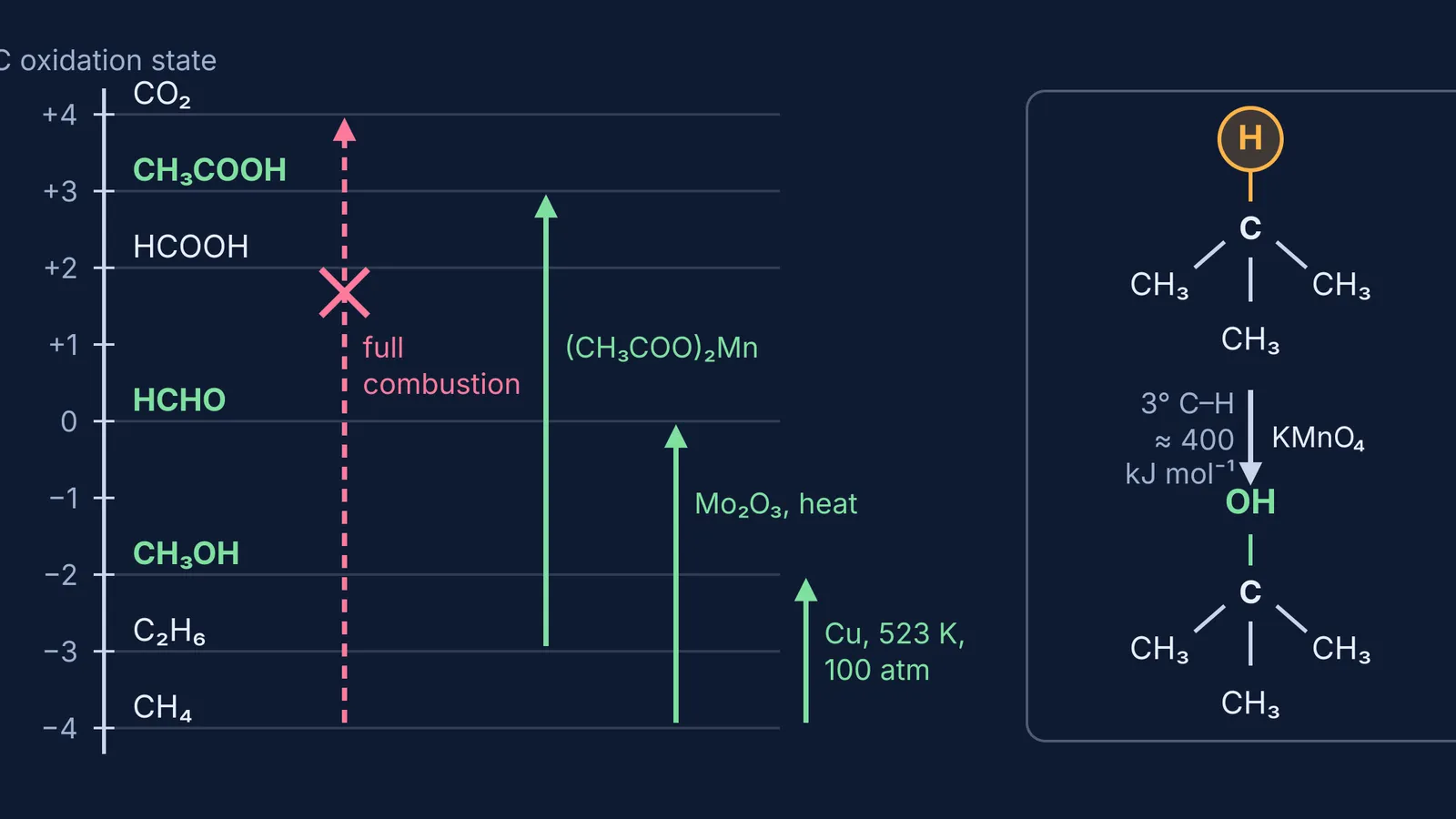
Controlled oxidation stops earlier. NCERT gives these four reactions:
Methane to methanol: 2CH₄ + O₂ → 2CH₃OH, with a copper catalyst at 523 K and 100 atm.
Methane to methanal (formaldehyde): CH₄ + O₂ → HCHO + H₂O, over Mo₂O₃ on heating.
Ethane to ethanoic acid (acetic acid): 2CH₃CH₃ + 3O₂ → 2CH₃COOH + 2H₂O, with manganese acetate, (CH₃COO)₂Mn, as catalyst.
2-Methylpropane to 2-methylpropan-2-ol: (CH₃)₃CH → (CH₃)₃COH, with KMnO₄ as the oxidising agent.
Check each equation yourself. In reaction 3, the left side has 4 C, 12 H and 6 O. The right side has 2 × C₂H₄O₂ plus 2 × H₂O, which is also 4 C, 12 H and 6 O.
Two things keep these reactions from running on to CO₂. First, the oxygen is rationed: one O₂ for every two CH₄ in reaction 1, against two O₂ for every CH₄ in combustion. Second, the catalyst speeds up one particular step so that the product forms and leaves before it is attacked again.
Are these reactions how methanol and formaldehyde are really made?
No. Treat them as textbook illustrations of partial oxidation, not industrial routes.
Methanol is made almost entirely from synthesis gas, CO + 2H₂ → CH₃OH, over a copper-based catalyst. That route is covered in how methanol and ethanol are made industrially.
Formaldehyde is made by oxidising methanol, not methane.
Acetic acid today comes mostly from methanol and carbon monoxide (carbonylation), not from ethane.
There is a chemical reason direct oxidation of methane is so hard to control. The C–H bonds in methanol are weaker than those in methane (about 400 kJ mol⁻¹ against about 439 kJ mol⁻¹). So once a little methanol forms, it is attacked more easily than the methane around it, and it tends to be oxidised further. Stopping cleanly at methanol is a problem chemists are still working on.
How does the oxidation state of carbon change in each step?
Oxidation means carbon gives up bonds to hydrogen and gains bonds to oxygen. To find carbon's oxidation state, count −1 for every bond to H, +1 for every bond to O (a double bond counts twice), and 0 for every bond to another carbon.
CH₄: four C–H bonds, so −4.
CH₃OH: three C–H and one C–O, so −3 + 1 = −2.
HCHO: two C–H and one C=O, so −2 + 2 = 0.
HCOOH: one C–H, one C=O and one C–O, so −1 + 3 = +2.
CO₂: two C=O, so +4.
Each step up the ladder raises carbon's oxidation state by 2 and needs one more O atom. Methanol and methanal sit on the lower rungs. Combustion jumps to the top.
Worked example: tracking carbon in all four reactions
Part A. Methane.
Methane, CH₄: carbon is −4.
Reaction 1 gives CH₃OH: carbon is −2. Change: +2 per carbon, so 2 electrons lost per CH₄.
Reaction 2 gives HCHO: carbon is 0. Change: +4, so 4 electrons lost per CH₄.
Complete combustion would give CO₂ at +4, a change of +8.
Part B. Ethane.
In CH₃CH₃ both carbons are −3 (three C–H bonds and one C–C bond each).
In CH₃COOH the methyl carbon is still −3. Only the other carbon changes. It has one C–C bond, a C=O and a C–O, so it is +3.
Total change: one carbon goes from −3 to +3, which is 6 electrons per molecule of ethane. For 2 C₂H₆ that is 12 electrons, taken up by 3 O₂ (each O₂ accepts 4 electrons, 3 × 4 = 12). The equation balances by electrons as well as by atoms.
Part C. 2-Methylpropane and KMnO₄.
In (CH₃)₃CH the central carbon has three C–C bonds and one C–H, so it is −1.
In (CH₃)₃COH it has three C–C bonds and one C–O, so it is +1. Change: +2.
In neutral or slightly alkaline solution, MnO₄⁻ is reduced to MnO₂ (Mn goes from +7 to +4, gaining 3 electrons). Balance 2 electrons against 3 by taking 3 alkane molecules and 2 MnO₄⁻:
3(CH₃)₃CH + 2KMnO₄ + H₂O → 3(CH₃)₃COH + 2MnO₂ + 2KOH
Count to check: K 2 and 2, Mn 2 and 2, C 12 and 12, H 32 and 32, O 9 and 9. Writing (CH₃)₃CH + [O] → (CH₃)₃COH is acceptable in an answer, but you should be able to balance the full equation too.
Part D. Predict a product. What does 3-ethylpentane, CH(CH₂CH₃)₃, give with KMnO₄?
Find the tertiary C–H. Carbon 3 carries one H and three ethyl groups.
Replace that H with OH: C(OH)(CH₂CH₃)₃.
Name it: the longest chain is still five carbons, with OH and ethyl both on C-3. The product is 3-ethylpentan-3-ol.
If you want more problems of this kind, the Fermi Problem Library has a step-by-step solver that explains the reasoning at each stage.
Why does KMnO₄ attack only the tertiary C–H?
The weakest C–H bond reacts first. Approximate bond dissociation enthalpies (values differ by a few kJ mol⁻¹ between sources):
Methane C–H: about 439 kJ mol⁻¹
Primary C–H (as in ethane): about 420 kJ mol⁻¹
Secondary C–H (the middle carbon of propane): about 410–413 kJ mol⁻¹
Tertiary C–H (2-methylpropane): about 400–404 kJ mol⁻¹
When the C–H bond breaks, the carbon left behind is most stable when it is tertiary, because three alkyl groups support it. This is the same order of radical stability that decides where chlorination happens.
Be careful about how far you take this. KMnO₄ oxidises alkanes slowly, and in practice only when a tertiary C–H is present. It does not oxidise methane, ethane or other straight-chain alkanes under normal conditions. Alkanes are known as paraffins ("little affinity") for exactly this reason. Do not confuse this with the KMnO₄ reaction that cuts an alkyl side chain off a benzene ring. That one depends on a benzylic C–H, and is explained in KMnO₄ oxidation of alkylbenzenes. The other NCERT alkane reactions, isomerisation, aromatisation and pyrolysis, are covered in reactions of alkanes.
Quick checklist
2CH₄ + O₂ → 2CH₃OH with Cu, 523 K, 100 atm.
CH₄ + O₂ → HCHO + H₂O with Mo₂O₃ and heat.
2C₂H₆ + 3O₂ → 2CH₃COOH + 2H₂O with (CH₃COO)₂Mn.
(CH₃)₃CH → (CH₃)₃COH with KMnO₄. Only a tertiary C–H reacts.
Carbon's oxidation state: CH₄ −4, CH₃OH −2, HCHO 0, HCOOH +2, CO₂ +4.
These are textbook routes. Industry makes methanol from syngas and formaldehyde from methanol.


