

On this page
Put one, two, three and then four chlorine atoms on a carbon and the dipole moment does not climb. It falls. Measured in the gas phase, CH₃Cl has the largest dipole moment of the four chloromethanes and CCl₄ has none. NCERT's haloalkanes exercise asks which of CH₂Cl₂, CHCl₃ and CCl₄ has the highest dipole moment, and JEE questions often add CH₃Cl. This post gives the measured order, works through the vector model students are taught, and shows where that model breaks.
What are the dipole moments of CH₃Cl, CH₂Cl₂, CHCl₃ and CCl₄?
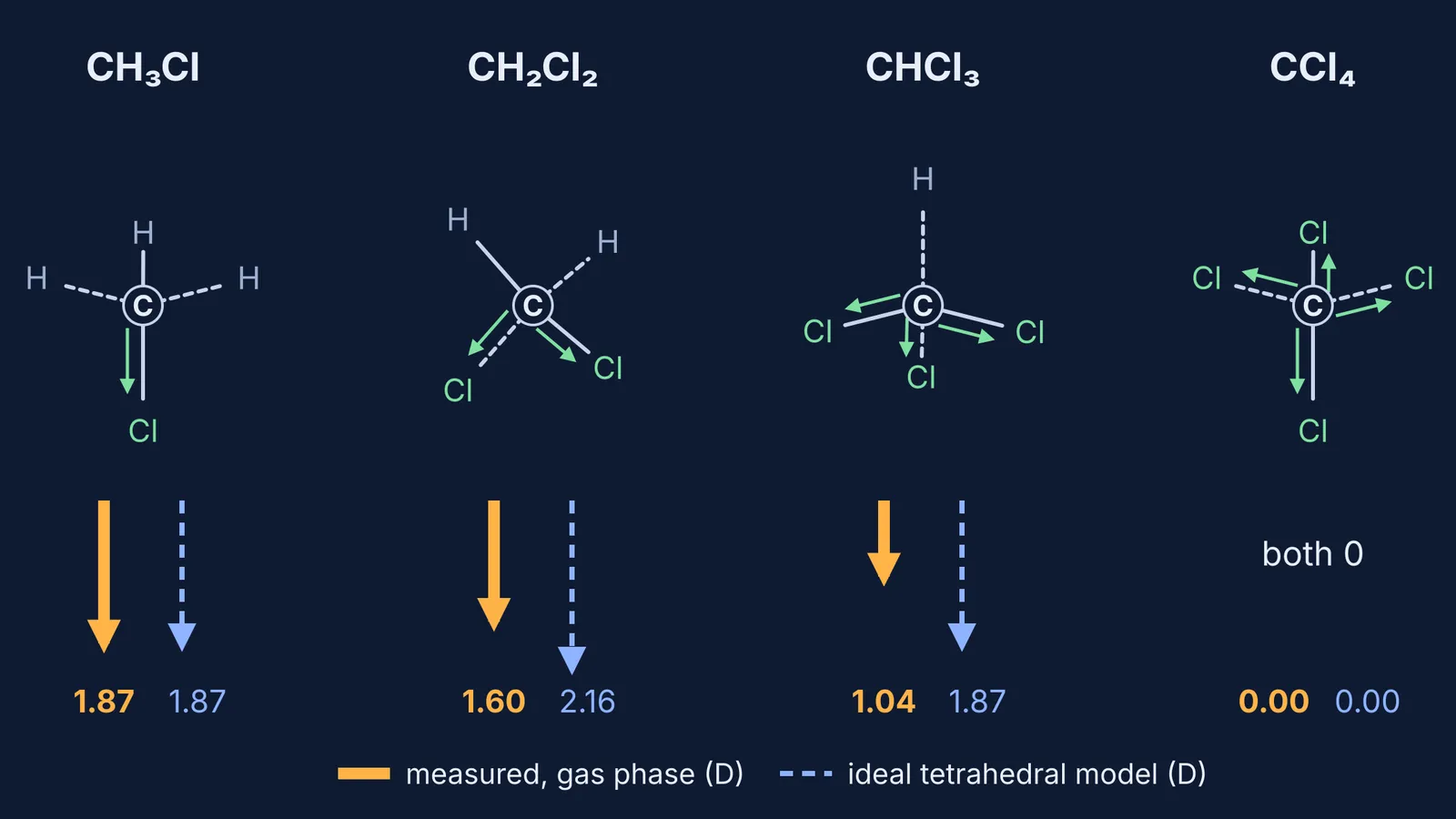
Approximate gas-phase values from standard data tables such as the CRC Handbook of Chemistry and Physics:
CH₃Cl (chloromethane): about 1.87 D
CH₂Cl₂ (dichloromethane): about 1.60 D
CHCl₃ (trichloromethane, chloroform): about 1.04 D
CCl₄ (tetrachloromethane): 0 D
Different tables differ in the second decimal place. CH₃Cl is listed anywhere from 1.87 to 1.89 D, and CHCl₃ from 1.01 to 1.04 D. The order never changes. Values measured in solution are different again, because the solvent is polarised too, so compare gas-phase numbers with each other and do not mix the two.
So the real order is:
CH₃Cl > CH₂Cl₂ > CHCl₃ > CCl₄
Which has the highest dipole moment: CH₂Cl₂, CHCl₃ or CCl₄?
This is the NCERT question, and CH₃Cl is not in it. The answer is CH₂Cl₂. If a question includes CH₃Cl, the answer becomes CH₃Cl. Read the options before you answer, because the two versions of the question have different correct answers.
A common shortcut is "more chlorine means more polar". The data show the opposite, so do not use that reasoning in an answer. It is equally wrong to say "more chlorine means less polar" as a general rule. The falling order here comes from geometry and from how the bond dipoles interact, which the next two sections explain.
How does vector addition predict the order?
Treat each bond as an arrow. Let each C–Cl bond have a bond moment of size m, pointing from C towards Cl. The C–H bond moment is small, a few tenths of a debye, and even its direction is argued over. You do not need to set it to zero, though, because of one property of a regular tetrahedron: the four bond directions add up to zero. That means any three bonds add up to one bond pointing the opposite way.
Use that fact for each molecule. Call the C–H moment h and take it as pointing towards carbon (the argument works the same way with the other sign).
CH₃Cl. The three C–H moments add to one moment of size h along the C–Cl axis, pointing the same way as the C–Cl moment. Total: m + h.
CHCl₃. The three C–Cl moments add to one moment of size m pointing directly away from the H, along the C–H axis. The C–H moment adds h along the same line. Total: m + h, exactly the same as CH₃Cl.
CH₂Cl₂. Two C–Cl moments at the tetrahedral angle of 109.5° add to m × √(4/3) = 1.155m. The two C–H moments add to 1.155h along the same line. Total: 1.155(m + h).
CCl₄. Four equal moments in a regular tetrahedron cancel. Total: 0.
So the ideal model predicts CH₂Cl₂ > CH₃Cl = CHCl₃ > CCl₄, whatever value you choose for h. The same tetrahedral reasoning, applied to a flat ring instead, is in the dipole moments of the dichlorobenzene isomers.
Worked example: how far off is the ideal model?
Use CH₃Cl to calibrate the model, then predict the others.
Calibrate. CH₃Cl is about 1.87 D, so m + h ≈ 1.87 D.
Predict CH₂Cl₂. 1.155 × 1.87 ≈ 2.16 D. Measured: about 1.60 D. The model is too high by about 0.56 D, roughly 35% of the measured value.
Predict CHCl₃. 1.87 D. Measured: about 1.04 D. The model is too high by about 0.83 D, roughly 80% of the measured value.
Predict CCl₄. 0 D. Measured: 0 D. Correct.
Compare the rankings. Model: CH₂Cl₂ > CH₃Cl = CHCl₃ > CCl₄. Measured: CH₃Cl > CH₂Cl₂ > CHCl₃ > CCl₄. The model gets both ends right and the middle wrong.
Why does the vector model fail for the chloromethanes?
Two assumptions in the model are not quite true.
The angles are not exactly 109.5°. In CH₂Cl₂ and CHCl₃ the Cl–C–Cl angle opens to about 111–112°. Wider angles make the C–Cl arrows cancel a little more. But the effect is small. Redo the sums with 112° for CH₂Cl₂ and about 111° for CHCl₃ and the predictions only drop to roughly 2.09 D and 1.69 D. Both are still far above the measured values.
Bond moments are not fixed numbers. This is the larger effect. Each C–Cl dipole sets up an electric field at the neighbouring C–Cl bonds. Chlorine's electron cloud is large and easy to polarise, so the neighbouring bonds respond with induced dipoles that point partly against the resultant. Each extra Cl also draws electron density from the same carbon, so each C–Cl bond in CHCl₃ is less polar than the one in CH₃Cl. The arrows shrink as you add more of them.
Both effects lower the resultant, and both grow as more chlorines crowd onto one carbon. That is why CHCl₃, with three Cl, falls furthest below the prediction. The vector model assumes each bond carries the same moment whatever its neighbours are, and for heavily substituted carbons that assumption breaks.
The same lesson shows up elsewhere. In the CH₃F, CH₃Cl, CH₃Br and CH₃I series, bond length and charge together decide the order, not electronegativity alone. In both cases the measured value is what the examiner expects, and you use the model to explain it.
Where is the vector method still reliable?
Symmetry gives zero. CCl₄, CH₄, BF₃, CO₂ and trans-1,2-dichloroethene have zero dipole moment, because their bond moments cancel exactly by symmetry. No polarisation effect can change that. The general rules are in predicting polarity from molecular shape.
Large differences. Vector addition reliably ranks ortho-dichlorobenzene above para-dichlorobenzene, because the gap is large.
Not for close calls. When the predicted values are close, as they are for CH₃Cl, CH₂Cl₂ and CHCl₃, polarisation can reverse the order. Use data.
If you want to see bond arrows add in three dimensions, the Concept Library covers dipole moments and molecular shape step by step.
Quick checklist
Measured gas-phase order: CH₃Cl (about 1.87 D) > CH₂Cl₂ (about 1.60 D) > CHCl₃ (about 1.04 D) > CCl₄ (0).
NCERT question without CH₃Cl: CH₂Cl₂ is highest. With CH₃Cl: CH₃Cl is highest.
Ideal tetrahedral model: CH₂Cl₂ = 1.155 × CH₃Cl and CHCl₃ = CH₃Cl. Both are wrong.
The C–H moment does not change the model's ranking, because the C–H moments add along the same axis as the C–Cl resultant.
The model fails because neighbouring C–Cl dipoles polarise each other and the angles widen slightly.
Trust vector addition for symmetry zeros and large gaps, not for close calls.


