

On this page
The three dichlorobenzenes share one formula, C₆H₄Cl₂, yet their dipole moments run from about 2.5 debye down to zero. That makes them a standard textbook example of bond moments adding as vectors, and the same method handles two different groups, as in p-nitrotoluene.
What are the dipole moments of ortho, meta and para dichlorobenzene?
The US National Bureau of Standards' tables of gas-phase dipole moments by Nelson, Lide and Maryott (1967) give these selected values:
o-dichlorobenzene (1,2): 2.50 D
m-dichlorobenzene (1,3): 1.72 D
p-dichlorobenzene (1,4): 0 D
chlorobenzene, for comparison: 1.69 D
So the order is ortho > meta > para. Benzene itself has no dipole moment, so chlorobenzene's 1.69 D is the usual value for one C–Cl group moment on the ring. If the debye is new to you, see our walkthrough of percentage ionic character from dipole moment.
How do you add bond moments at 60°, 120° and 180°?
A dipole moment is a vector, so two bond moments μ₁ and μ₂ at an angle θ combine like two forces:
μ = √(μ₁² + μ₂² + 2μ₁μ₂ cos θ)
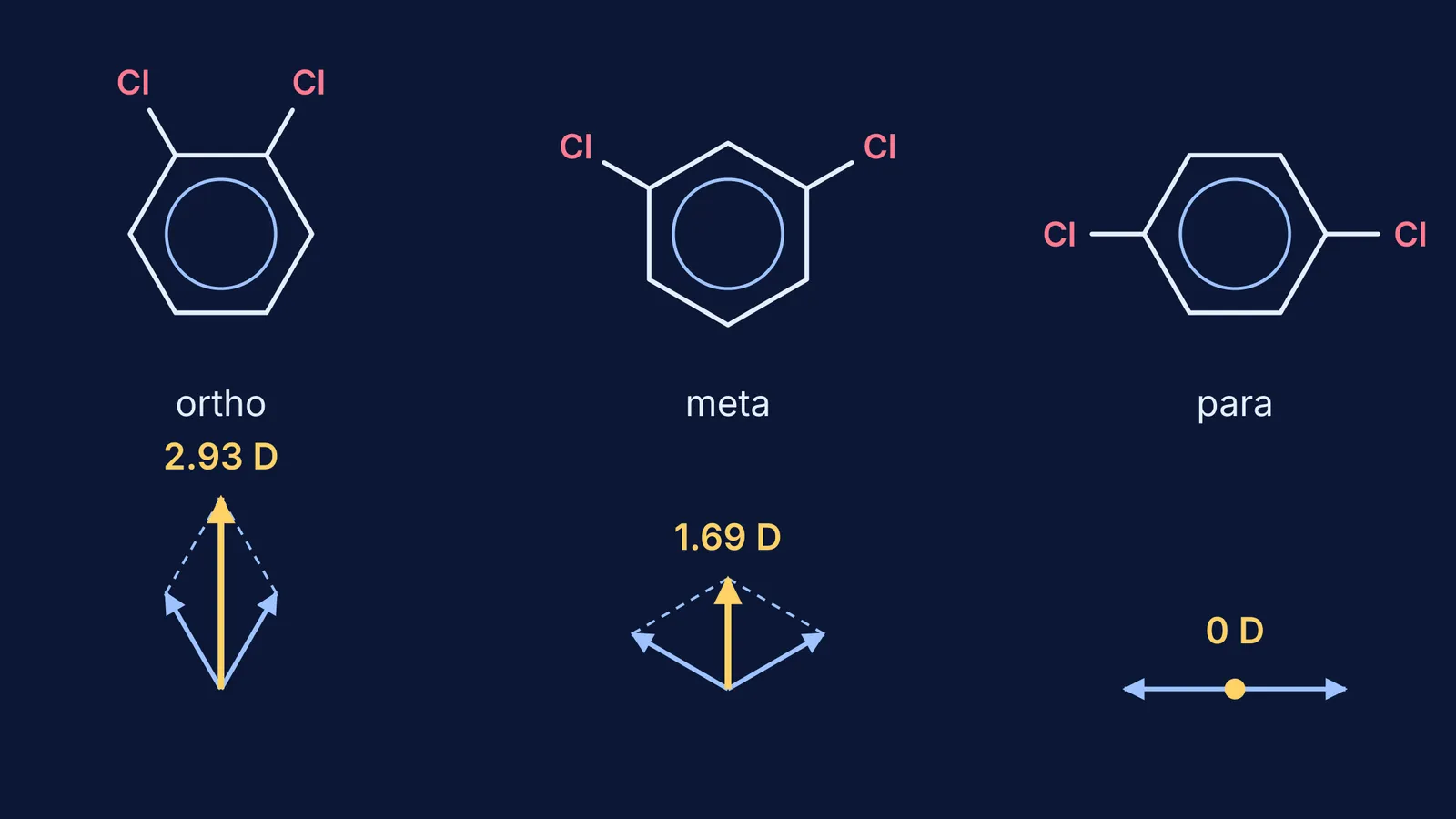
The angles come from the ring. Benzene is a flat, regular hexagon (the story of how Kathleen Lonsdale showed the benzene ring is flat is worth a read), and each substituent bond points outward from the centre. Neighbouring positions are therefore 60° apart, positions 1 and 3 are 120° apart, and positions 1 and 4 point in opposite directions, 180° apart.
When the two moments are equal, the formula shrinks to μ = 2μ₁ cos(θ/2). Here it is with μ₁ = 1.69 D, next to the measured values from the NBS table:
Ortho, θ = 60°: 2 × 1.69 × cos 30° = 1.69 × √3 ≈ 2.93 D. Measured: 2.50 D.
Meta, θ = 120°: 2 × 1.69 × cos 60° = 1.69 D. Measured: 1.72 D.
Para, θ = 180°: 2 × 1.69 × cos 90° = 0. Measured: 0.
Why is the dipole moment of p-dichlorobenzene zero?
In the para isomer the two C–Cl moments are equal in size and point in exactly opposite directions, so they cancel. The molecule has a centre of symmetry: every polar bond has an identical partner on the far side. The same NBS table lists p-dinitrobenzene and p-xylene at 0 D for the same reason.
Two traps follow: a zero dipole moment does not mean the C–Cl bonds are non-polar, and "para means zero" only holds when the two groups are the same.
What changes with two different groups, like p-nitrotoluene?
Now direction matters as well as angle. Using the chemistry convention, with the arrow pointing to the negative end, and values from the NBS table:
The nitro group pulls electron density out of the ring, so its arrow points from ring to NO₂. Nitrobenzene: 4.22 D.
Chlorine also pulls, so its arrow points from ring to Cl. Chlorobenzene: 1.69 D.
The methyl group pushes electron density into the ring, so its arrow points from CH₃ to ring. Toluene: 0.36 D.
The data back up the methyl direction: the same table lists p-chlorotoluene at 2.21 D, more than chlorobenzene's 1.69 D, so methyl adds to chlorine rather than cancelling it.
In p-nitrotoluene the methyl pushes towards the ring and the nitro pulls away on the far side, so both arrows point the same way and add: 4.22 + 0.36 = 4.58 D predicted. Stenutz's Tables for Chemistry list 4.40 D for 4-nitrotoluene, close to the estimate.
In p-chloronitrobenzene both groups pull, in opposite directions, so the moments subtract: 4.22 − 1.69 = 2.53 D, against 2.83 D measured in the NBS table. For the ortho and meta chloronitrobenzenes the general formula gives about 5.27 D and 3.68 D; the table lists 4.64 D and 3.73 D. Once again, ortho strays the most.
A 60-second checklist for dipole moment questions
Draw the ring, mark the positions and write 60°, 120° or 180° between the groups.
Give each group an arrow: towards Cl or NO₂, away from CH₃.
Two identical groups: the order is ortho > meta > para, and para is zero.
Two different groups in para: add for a pusher and a puller, subtract for two pullers.
For any other angle, use μ = √(μ₁² + μ₂² + 2μ₁μ₂ cos θ).
If the options differ by only a few tenths of a debye, trust the order, not the decimals.
If the cos θ step is where you lose marks, the Fermi Problem Library has worked problems with a step-by-step solver that explains the reasoning rather than printing an answer. To revisit bond polarity from the start, the Fermi Concept Library gives each concept its own lesson.
For the history behind the unit, read how Peter Debye used dipole moments to reveal molecular shape.


