

On this page
Fluorine is the most electronegative element, so three fluorines should pull harder on a C–H bond than three chlorines. By that logic fluoroform, CHF₃, ought to give up its proton more easily than chloroform, CHCl₃. Experiment says the opposite. Chloroform loses H⁺ to hydroxide readily, which is how it turns into dichlorocarbene in the Reimer–Tiemann reaction and the carbylamine test. Fluoroform barely reacts with aqueous alkali. This post explains why, and why the old "d-orbital" answer is not the one to rely on.
How do we know chloroform is more acidic than fluoroform?
These C–H acids are far too weak to measure with a pH meter in water. Chemists compare them by how fast the hydrogen swaps for deuterium when the compound is shaken with base in heavy water. Each swap needs the carbanion to form first:
CHX₃ + OD⁻ ⇌ CX₃⁻ + HOD
CX₃⁻ + D₂O → CDX₃ + OD⁻
Chloroform exchanges its hydrogen much faster than fluoroform, so CCl₃⁻ forms more easily. Gas-phase measurements, where there is no solvent at all, point the same way.
Quoted pKa values for both compounds vary a lot between sources and methods, so do not memorise a number. Learn the order: CHCl₃ is the stronger acid.
Why doesn't fluorine's inductive effect win?
Acidity depends on how stable the conjugate base is. So the real question is why CCl₃⁻ is more stable than CF₃⁻. If you need a refresher on what stabilises a carbanion in general, see how carbocations, carbanions and free radicals are ranked for stability.
Three effects act on the carbon lone pair, and they do not all favour fluorine.
Inductive effect. F pulls electron density through the σ bond more strongly than Cl. This alone favours CF₃⁻.
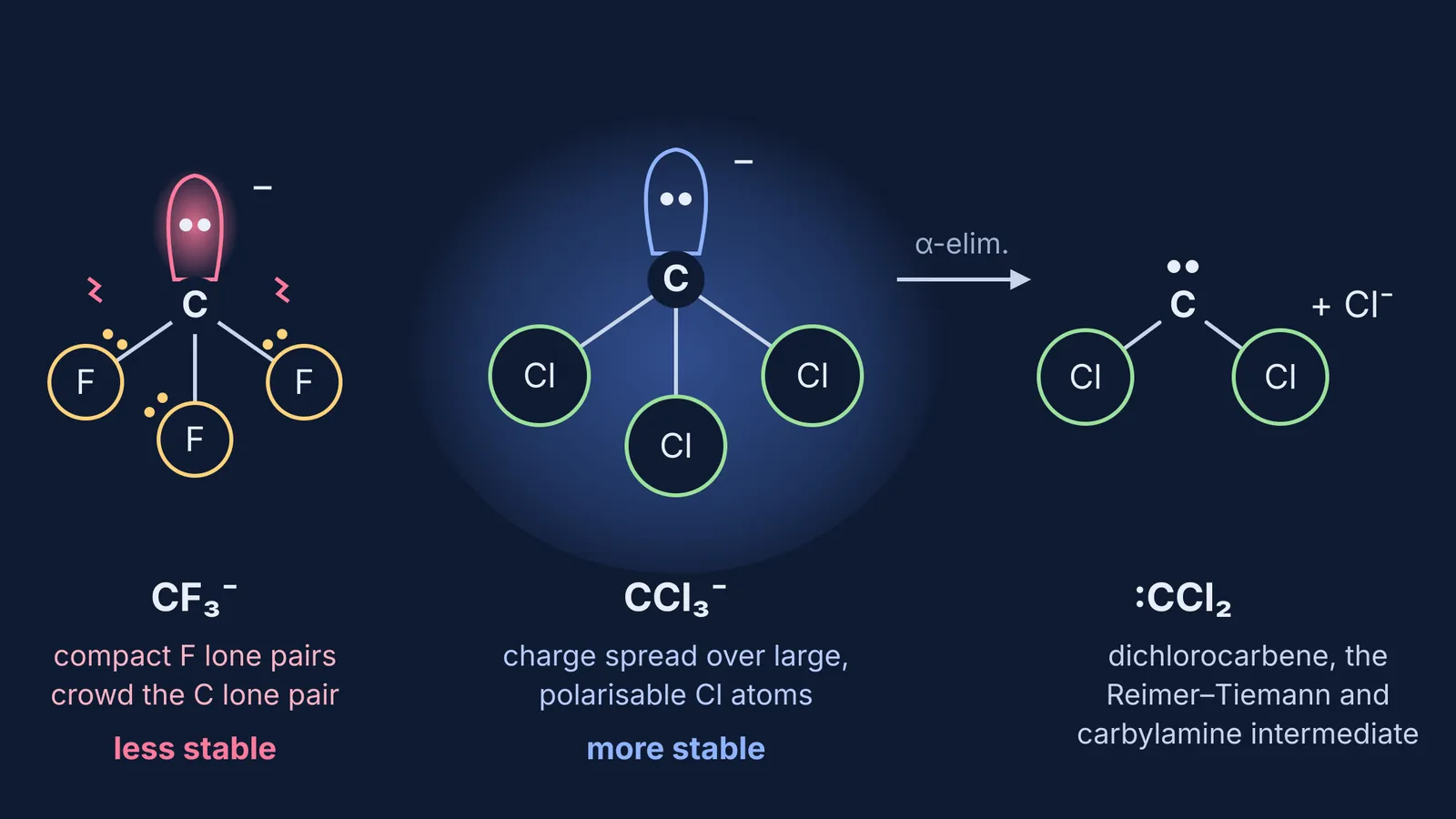
Lone-pair repulsion. Fluorine is small. The C–F bond is about 135 pm long, against about 177 pm for C–Cl. Each F carries three lone pairs in compact 2p orbitals, held close to the carbon. The filled carbon lone pair and the filled fluorine lone pairs repel each other, which raises the energy of CF₃⁻ and cancels much of the inductive gain. Chlorine's lone pairs sit in larger 3p orbitals, farther from carbon, so the repulsion is much weaker.
**Polarisability and σ* acceptance.** Chlorine's big, soft electron cloud can distort to spread out the negative charge. The carbanion lone pair can also leak into the empty σ* orbitals of the C–Cl bonds (this is called negative hyperconjugation). The C–Cl σ* is lower in energy than the C–F σ*, so it accepts electron density more readily.
Add them up and CCl₃⁻ wins. Electronegativity is only one term in the sum.
Is the d-orbital explanation in older textbooks correct?
Many books say CCl₃⁻ is stabilised because its lone pair spreads into the empty 3d orbitals of chlorine (pπ–dπ bonding), and fluorine has no 2d orbitals to offer. It sounds neat, but it is now considered weak. Chlorine's 3d orbitals are high in energy and spread out, so they overlap poorly with a carbon 2p orbital. Calculations find they contribute little as electron acceptors.
The better account is the one above: polarisability of chlorine, donation into C–Cl σ*, and the lack of the strong lone-pair repulsion that fluorine causes. If an older exam option says "d-orbital back-bonding", you may still see it marked correct. Just know that it is a shorthand, not the real mechanism.
Why does chloroform form dichlorocarbene with base?
Once CCl₃⁻ forms, it can lose a chloride ion from the same carbon. This is called α-elimination, because both the H⁺ and the Cl⁻ leave from one carbon.
CHCl₃ + OH⁻ ⇌ CCl₃⁻ + H₂O
CCl₃⁻ → :CCl₂ + Cl⁻
Dichlorocarbene, :CCl₂, is neutral. Its carbon has only six valence electrons: one lone pair and one empty p orbital. The empty orbital makes it an electrophile that grabs electron-rich partners such as amines and phenoxide ions. With nothing else to react with, it is hydrolysed, so chloroform slowly breaks down in hot alkali: CHCl₃ + 4OH⁻ → HCOO⁻ + 3Cl⁻ + 2H₂O.
Worked example: why does CHCl₃ + KOH give dichlorocarbene while CHF₃ does not?
Question. Explain why chloroform with alcoholic KOH generates dichlorocarbene, the intermediate in the carbylamine and Reimer–Tiemann reactions, while fluoroform under the same conditions does not.
Step 1, deprotonation. OH⁻ removes the proton to give CX₃⁻. For CHCl₃ this equilibrium supplies a useful amount of CCl₃⁻ because the anion is stabilised as described above. For CHF₃ the anion is much less stable, so far less forms.
Step 2, loss of halide. CX₃⁻ must throw out X⁻. Cl⁻ is a good leaving group: it is the conjugate base of a strong acid, HCl, and the C–Cl bond is fairly weak (average bond enthalpy about 330 kJ/mol). F⁻ is a poor leaving group: HF is a weak acid, and the C–F bond is much stronger (about 485 kJ/mol). Both values are approximate averages; tables differ slightly.
Step 3, the carbene reacts. In the carbylamine test, a primary amine attacks :CCl₂, and further loss of HCl gives the isocyanide. Overall: RNH₂ + CHCl₃ + 3KOH → RNC + 3KCl + 3H₂O. The smell and the reason only 1° amines work are covered in the carbylamine test for primary amines. In the Reimer–Tiemann reaction, the phenoxide ring attacks the same carbene at the ortho position, and hydrolysis gives salicylaldehyde. The full sequence is in Reimer–Tiemann and Kolbe reactions of phenol.
Verdict for CHF₃. Both steps fail together. Little CF₃⁻ forms with KOH, and what forms holds on to F⁻. No useful carbene means no isocyanide and no aldehyde.
Chemists can make CF₃⁻ from fluoroform using much stronger bases in dry solvents, and that anion does break down to :CF₂. That is far outside KOH conditions and outside the JEE and NEET syllabus.
If you want more questions that mix acidity, intermediates and named reactions like this, the Fermi Problem Library has a step-by-step solver that explains the reasoning at each stage.
Where do exams test this idea?
Assertion–reason questions. "CHCl₃ is more acidic than CHF₃" is true, and the reason is the greater stability of CCl₃⁻, not the inductive effect of F.
Reagent questions. CHCl₃ + KOH (or NaOH) is the standard way to make :CCl₂. You will not see CHF₃ used for this.
Mechanism questions. If asked for the intermediate in the carbylamine or Reimer–Tiemann reaction, write dichlorocarbene and show the two α-elimination steps above.
Stability ranking. CCl₃⁻ is more stable than CF₃⁻, even though F is more electronegative.
Quick checklist
CHCl₃ is a stronger C–H acid than CHF₃.
Reason: CCl₃⁻ is more stable. Chlorine is polarisable and its C–Cl σ* accepts charge; fluorine's compact lone pairs repel the carbanion lone pair.
The d-orbital explanation is a textbook shorthand, now considered weak.
α-elimination: CCl₃⁻ → :CCl₂ + Cl⁻, because Cl⁻ is a good leaving group and F⁻ is not.
Dichlorocarbene has six valence electrons, an empty p orbital, and is an electrophile.
It is the intermediate in the carbylamine test and the Reimer–Tiemann reaction.


