

On this page
Carmoisine and Ponceau 4R are two red food colours with their own Indian Standards: IS 2923:1995 for carmoisine and IS 2558:1994 for Ponceau 4R. Both start from the same diazonium salt. They differ only in the naphthol they couple with, and that one change moves the azo group to a different carbon. Reading their BIS names is good practice for the Class 12 coupling-position question. All numbers below were checked against the scanned standards.
What do IS 2923 and IS 2558 say these dyes are?
IS 2923:1995 (Second Revision, reaffirmed 2001) lists carmoisine as azorubine, E 122, Colour Index No. 14720, class monoazo (one N=N group). The chemical name is the disodium salt of 2-(4-sulpho-1-naphthylazo)-1-naphthol-4-sulphonic acid, C₂₀H₁₂N₂O₇S₂Na₂, with a molecular weight of 502.44.
IS 2558:1994 (Second Revision) lists Ponceau 4R as E 124, Colour Index No. 16255, also monoazo. The chemical name is the trisodium salt of 1-(4-sulpho-1-naphthylazo)-2-naphthol-6,8-disulphonic acid, C₂₀H₁₁N₂O₁₀S₃Na₃, with a molecular weight of 604.5.
Table 1 of each standard sets the purity limits:
Carmoisine: total dye content at least 87%, subsidiary dyes at most 1.0%, dye intermediates at most 0.5%. Amendment No. 1 (September 2016) lowered the lead limit from 10 to 2 mg/kg.
Ponceau 4R: total dye content at least 82% as printed in 1994, with dye intermediates at most 0.5%. The archived copy also carries Amendment No. 1 (May 2008). It raises the dye minimum to 85% and lowers water-insoluble matter and ether extracts from 0.4% to 0.2%.
How are carmoisine and Ponceau 4R made?
IS 2558 says it plainly in Annex C: "Ponceau 4R is prepared by diazotization of 1-naphthylamine-4-sulphonic acid and the diazo so formed is coupled with 2-naphthol 6 : 8 disulphonic acid." Leftover traces of both are checked by paper chromatography.
IS 2923 does not write out a synthesis, but its Annex C tests carmoisine for two intermediates: 1-naphthylamine-4-sulphonic acid (the same amine) and 1-naphthol-4-sulphonic acid. So the two dyes share their diazo half.
Here is the sequence in equation form. The sulphonic acid group stays ionised, so the diazonium salt is an inner salt, ⁻O₃S–C₁₀H₆–N₂⁺:
Diazotisation: C₁₀H₉NO₃S + NaNO₂ + HCl → C₁₀H₆N₂O₃S + NaCl + 2H₂O
Carmoisine: C₁₀H₆N₂O₃S + C₁₀H₆(OH)SO₃Na + NaOH → C₂₀H₁₂N₂O₇S₂Na₂ + H₂O
Ponceau 4R: C₁₀H₆N₂O₃S + C₁₀H₅(OH)(SO₃Na)₂ + NaOH → C₂₀H₁₁N₂O₁₀S₃Na₃ + H₂O
All three balance. Alkali makes the phenoxide ion, the reactive partner; see why coupling with phenol is done in alkaline medium.
One oddity in IS 2923 is worth knowing about. Reagent C-2.3 is printed as "2-Naphthol 3 : 6 Disulphonic Acid". But the reference solution in C-3.1.2(b) and the reporting step in C-3.4 both use 1-naphthol-4-sulphonic acid, and that is the compound the chemical name requires. The page image confirms "3 : 6" is printed, not a scanning error. Read C-2.3 as a slip in the standard.
Why does the azo group go to C2 in carmoisine but C1 in Ponceau 4R?
Start by splitting each name at N=N:
The part before "azo", 4-sulpho-1-naphthyl, came from the amine. The NH₂ was on C1 of 1-naphthylamine-4-sulphonic acid, so N=N sits on C1 of that ring.
The part after "azo" is the coupling partner, and the locant tells you where the diazonium ion attacked.
The weak diazonium electrophile attacks a carbon ortho or para to the –O⁻ group.
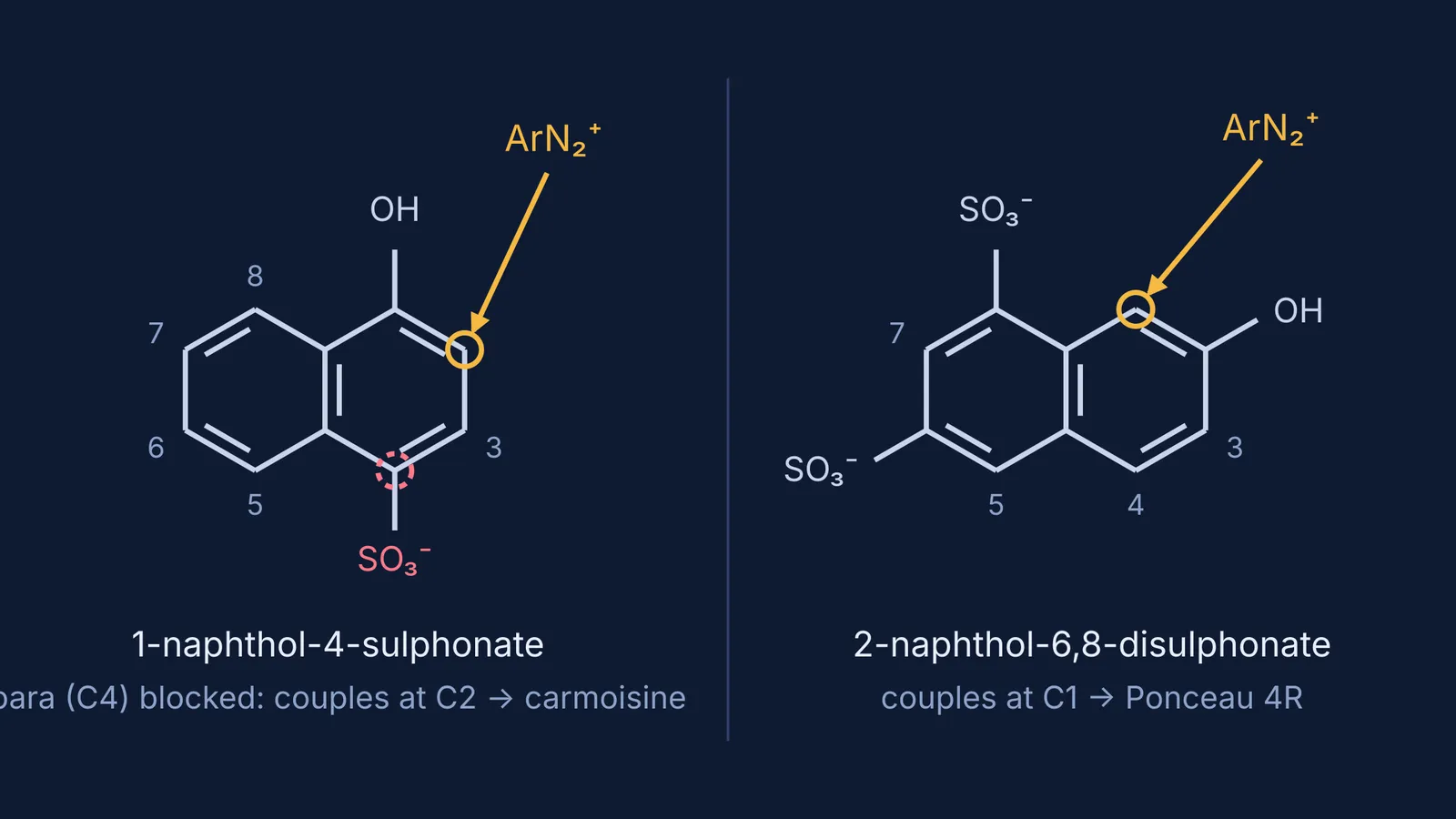
Carmoisine. In 1-naphthol the OH is on C1. The activated ring positions are C2 (ortho) and C4 (para), and an unblocked 1-naphthol couples mainly at C4. In 1-naphthol-4-sulphonic acid, C4 already carries SO₃⁻. The para site is blocked, so the azo group goes ortho, to C2. That is why the name reads "2-(...azo)-1-naphthol-4-sulphonic acid".
Ponceau 4R. In 2-naphthol the OH is on C2. The ortho positions are C1 and C3, and attack goes to C1. Attack at C1 gives a cation that can place its positive charge on C2, where the oxygen's lone pair stabilises it, while the other ring stays a complete benzene ring. Attack at C3 can only do that by breaking the second ring's aromatic sextet. The sulphonates at C6 and C8 sit on the other ring and leave C1 free. This is the same site as in NCERT's orange dye from benzenediazonium chloride and 2-naphthol, 1-phenylazo-2-naphthol; see the azo dye test for aromatic primary amines.
The rule to carry into the exam: para to OH unless blocked, then ortho. For 2-naphthol, C1.
Why do the two dyes absorb almost equally per mole?
Both standards measure dye content with a spectrophotometer in 0.1 N HCl using a specific absorbance, E¹%₁cm. This is the absorbance of a 1 g per 100 mL solution in a 1 cm cell. BIS uses 520 at 516 nm for carmoisine and 440 at 506 nm for Ponceau 4R. Per gram, carmoisine absorbs 520/440 = 1.18 times as strongly, about 18% more. To compare per mole, multiply by molar mass: ε = E¹% × M/10. Our formula masses are 502.42 and 604.46, so ε is about 26,100 L mol⁻¹ cm⁻¹ for carmoisine and about 26,600 for Ponceau 4R, only 1.8% apart. These ε values are ours, not printed by BIS. Both share the naphthyl–azo–naphthol chromophore; Ponceau's extra sulphonate adds mass, not colour.
Worked example: does this carmoisine sample pass?
A lab follows Annex A-1 of IS 2923. It dissolves 0.2500 g of sample in 0.1 N HCl to make 250 mL, then dilutes 1 mL of that to 100 mL. A separate portion loses 10.0% of its mass on drying at 105 °C. The optical density at 516 nm is 0.421. Is the sample at least 87% dye?
Dry mass: 0.2500 × 0.900 = 0.2250 g in 250 mL.
Dry mass in 100 mL of the final solution (M): 0.2250 × (1/250) = 0.000900 g. This matches the procedure's "1 mg/100 ml (approximately)".
What pure dye would read: M × 520 = 0.000900 × 520 = 0.468.
BIS formula: dye % = OD × 100 / (M × 520) = 0.421 × 100 / 0.468 = 90.0%.
Verdict: 90.0 ≥ 87, so it passes. An OD of 0.400 would give 85.5% and fail.
Cross-check by titration. The BIS titanous chloride factors, 0.01256 g of carmoisine and 0.01511 g of Ponceau 4R per mL of 0.1 N TiCl₃, are M/40,000. That means four electrons per azo group. The full method is in titanous chloride titration for azo and nitro groups.
Where does this show up in JEE and NEET?
Class 12, Amines: diazotisation, the need for alkali when coupling with a phenol, and which carbon the azo group lands on.
Naming: splitting a long azo name into amine and coupler.
Class 11, Some basic concepts: molar mass from a formula and purity on a dry basis.
Beer–Lambert: turning E¹% into ε is a short molar-mass exercise.
To revise directing groups, the Concept Library covers every concept in physics, chemistry, biology, mathematics and computing. For JEE-style practice on amines and diazonium salts, Fermi Test Prep is built for JEE Main and Advanced preparation, with an AI tutor.
Quick checklist
Same diazo half for both dyes: 1-naphthylamine-4-sulphonic acid.
Carmoisine couples with 1-naphthol-4-sulphonic acid at C2, because C4 is blocked.
Ponceau 4R couples with 2-naphthol-6,8-disulphonic acid at C1.
E¹% differs by 18% per gram, but ε differs by under 2% per mole.
IS 2923 C-2.3 says "3 : 6" by mistake; the test itself uses 1-naphthol-4-sulphonic acid.


