

On this page
CCl₄ is a liquid at room temperature, yet the NCERT Class 11 Thermodynamics exercise asks for the C–Cl bond enthalpy in CCl₄(g). That one word, gas, is the whole trick. You are given four numbers, and you have to arrange them into a cycle that ends with a gas-phase molecule falling apart into atoms. Get the cycle right and the answer is 326 kJ mol⁻¹. Miss the vaporisation step, double the chlorine term or forget a sign flip, and you land on 334, 447 or 274.
What does the NCERT CCl₄ question ask?
The exercise asks for two things: ΔH for CCl₄(g) → C(g) + 4Cl(g), and the C–Cl bond enthalpy in CCl₄(g). The data, all in kJ mol⁻¹:
ΔvapH(CCl₄) = 30.5
ΔfH(CCl₄, l) = −135.5
ΔaH(C) = 715.0, for C(graphite) → C(g)
ΔaH(Cl₂) = 242, for Cl₂(g) → 2Cl(g)
The first part is an enthalpy of atomisation: the energy to pull one mole of gaseous CCl₄ apart into separate atoms. The second part divides that among the bonds. If the difference between atomisation, sublimation and bond enthalpy feels blurry, enthalpies of atomisation, sublimation and phase change compared sorts them out first.
Why do you need the gas-phase enthalpy of formation?
Bond enthalpies are defined for gases. Breaking a bond in a liquid also means pulling the molecule away from its neighbours, and that intermolecular energy is not part of a C–Cl bond. So before you can talk about bonds, the CCl₄ must be a gas.
The data give ΔfH for the liquid. Add the vaporisation step:
C(graphite) + 2Cl₂(g) → CCl₄(l), ΔH = −135.5
CCl₄(l) → CCl₄(g), ΔH = +30.5
Sum: C(graphite) + 2Cl₂(g) → CCl₄(g), ΔfH(CCl₄, g) = −135.5 + 30.5 = −105.0 kJ mol⁻¹
The gas is 30.5 kJ higher in enthalpy than the liquid, which is why the gas-phase value is less negative.
How do you build the atomisation cycle step by step?
Use Hess's law. Both routes start from CCl₄(g) and end at C(g) + 4Cl(g); the guide to building Hess's law cycles covers the general method.
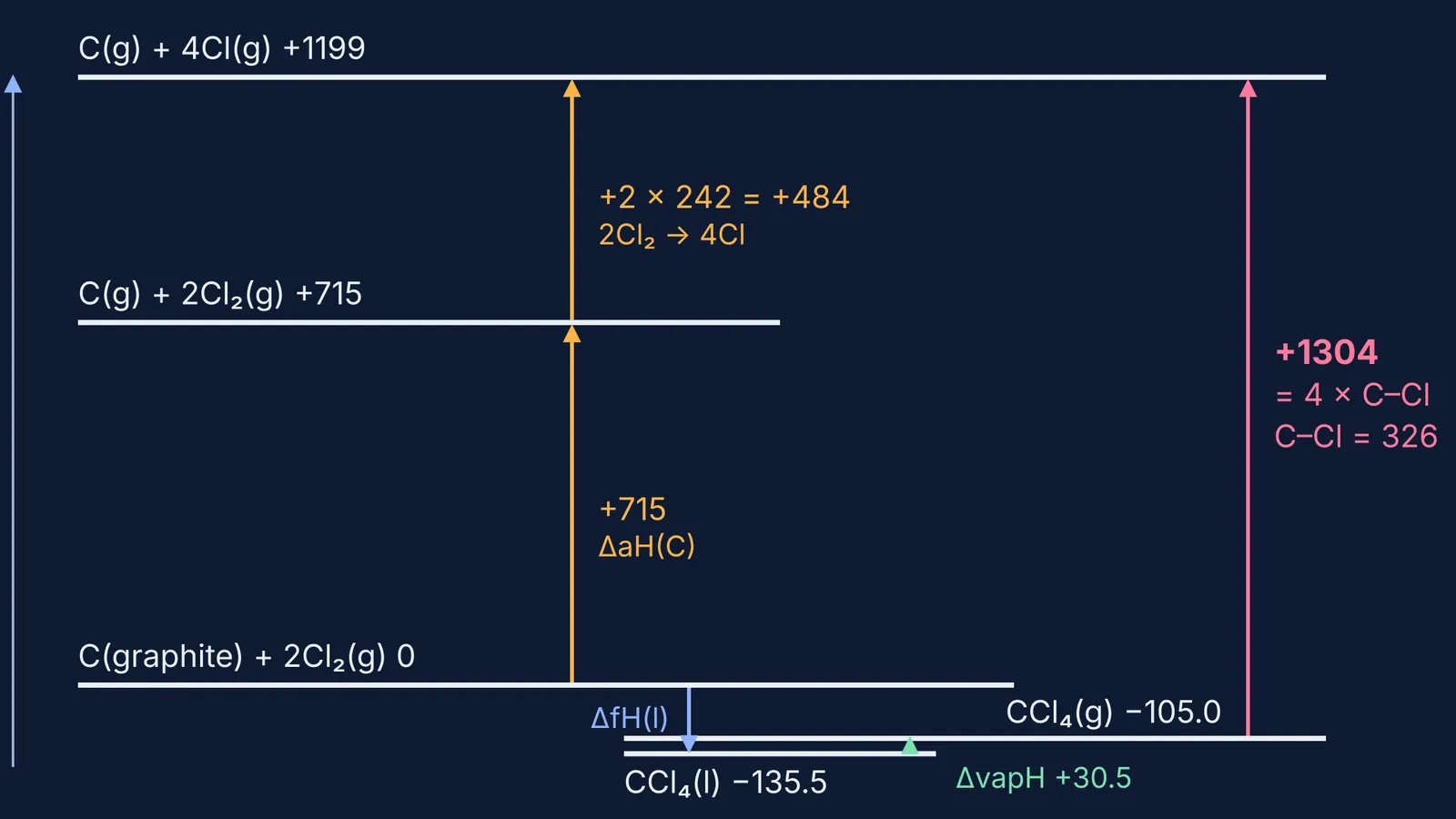
Go from CCl₄(g) back to the elements. This is formation run backwards, so the sign flips: CCl₄(g) → C(graphite) + 2Cl₂(g), ΔH = +105.0 kJ mol⁻¹.
Atomise the carbon. C(graphite) → C(g), ΔH = +715.0 kJ mol⁻¹.
Atomise the chlorine. You have 2Cl₂ and need 4Cl. ΔaH(Cl₂) = 242 is per mole of Cl₂, which already gives 2 Cl atoms. So 2Cl₂(g) → 4Cl(g), ΔH = 2 × 242 = +484 kJ mol⁻¹.
Add the three steps. CCl₄(g) → C(g) + 4Cl(g), ΔH = 105.0 + 715.0 + 484 = +1304 kJ mol⁻¹.
Divide by the number of bonds. CCl₄ has four C–Cl bonds and no other bonds, so the mean C–Cl bond enthalpy = 1304 ÷ 4 = 326 kJ mol⁻¹.
Check the atoms at the end: one C and four Cl on each side of every line. Check the signs: every step breaks something apart, so every step is positive. A negative number anywhere in steps 1 to 3 means a sign has slipped.
The diagram above draws the same cycle to scale. The long arrow from CCl₄(g) to the top level is the 1304 kJ you are after, and it equals the formation drop plus the two atomisation climbs.
What wrong answers do the usual slips give?
Each slip gives its own wrong number, so if your answer matches one below, you know which line to fix.
Forgetting vaporisation. Using −135.5 directly gives 715.0 + 484 + 135.5 = 1334.5, and 1334.5 ÷ 4 ≈ 334 kJ mol⁻¹. This is the most common error. The 30.5 kJ that holds liquid CCl₄ molecules together has been charged to the C–Cl bonds.
Using 4 × 242 for chlorine. 715.0 + 968 + 105.0 = 1788, and 1788 ÷ 4 = 447 kJ mol⁻¹.
Not flipping the sign of ΔfH. 715.0 + 484 − 105.0 = 1094, and 1094 ÷ 4 ≈ 274 kJ mol⁻¹. This happens when ΔfH is copied into the sum without asking which way the step runs.
A quick sense check catches the last two. NCERT's table of mean bond enthalpies lists C–Cl at 330 kJ mol⁻¹. A cycle answer within a few kJ of that is plausible; one that is 50 to 100 kJ away points to a slip.
If you get the method right but keep losing marks on signs and factors, the Fermi Problem Library has a step-by-step solver that explains the reasoning at each line, so you can see exactly where a cycle goes wrong.
Why is 326 not the same as the 330 in NCERT's table?
NCERT's table of mean bond enthalpies lists C–Cl as 330 kJ mol⁻¹. Your answer is 326. Neither is wrong; they are different averages.
326 is a mean over the four bonds of one molecule. The four C–Cl bonds in CCl₄ are identical in the molecule, but breaking them one after another does not cost the same each time. After the first Cl leaves, the fragment left behind is a different species, so the next C–Cl bond is in a different environment. The 1304 kJ total is fixed; how it splits across the four steps is not equal. The same thing happens with methane, where the four steps cost 427, 439, 452 and 347 kJ mol⁻¹, as methane's stepwise C–H bond energies explains.
330 is an average over many compounds. A table value takes C–Cl bonds from CH₃Cl, CH₂Cl₂, CHCl₃, CCl₄ and others. The neighbouring atoms change the bond slightly in each, and the table smooths that out.
The data are rounded. ΔaH(Cl₂) is given as 242 here, while NCERT's bond table lists Cl–Cl as 243. Using 243 would give 326.5. Differences of this size are normal between tables.
So 326 kJ mol⁻¹ is the C–Cl bond enthalpy in CCl₄ specifically, averaged over its four bonds. It is not the energy to remove the first chlorine atom, and it is not a universal C–Cl value. When a question gives you a mean bond enthalpy table, use the table; when it gives you formation data for one compound, build the cycle. How mean values behave when you plug them into reaction estimates is covered in bond enthalpies: estimating reaction enthalpy and knowing its limits.
Quick checklist
Bond enthalpies are for gases: turn ΔfH(l) into ΔfH(g) with ΔvapH first.
ΔfH(CCl₄, g) = −135.5 + 30.5 = −105.0 kJ mol⁻¹.
Reverse formation: +105.0. Atomise C: +715.0. Atomise 2Cl₂: 2 × 242 = +484.
ΔaH(CCl₄, g) = +1304 kJ mol⁻¹; mean C–Cl = 1304 ÷ 4 = 326 kJ mol⁻¹.
334 means you skipped vaporisation; 447 means 4 × 242; 274 means a missed sign flip.
326 is a mean for CCl₄; the table's 330 is an average across many compounds.


