

On this page
Take a rectangle and a point anywhere. Square the point's distances to the four corners, and the four numbers always split into two pairs with equal sums. Here is a four-line proof and the problems where that saves you a page of algebra.
What is the British flag theorem?
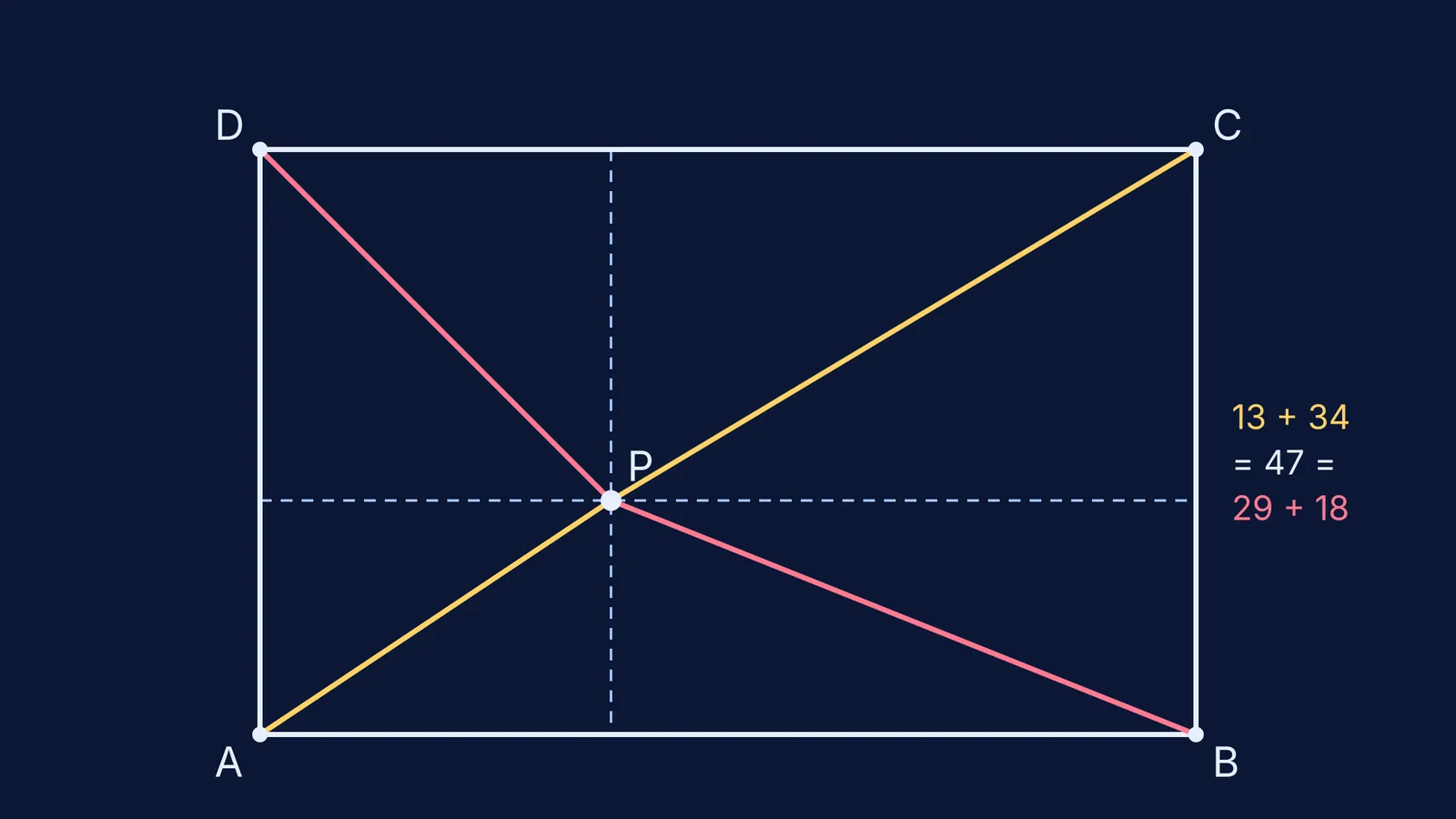
In Euclidean geometry, the British flag theorem says that for a point P and a rectangle ABCD, the sum of the squared distances from P to two opposite corners equals the sum of the squared distances to the other two opposite corners.
As an equation: PA² + PC² = PB² + PD².
The theorem holds for points inside the rectangle, outside it, and even for points in space that are off the rectangle's plane, as the Wikipedia article on the theorem notes. The name comes from the picture: the segments from P to the corners, drawn with the perpendiculars from P to the four sides, look like the Union Flag.
It is also Pythagoras' theorem in disguise. Put P on corner A. Then PA is 0, PC is the diagonal, and PB and PD are the two sides, so the theorem reads diagonal² = length² + width².
How do you prove the British flag theorem with coordinates?
Place the rectangle on axes with A = (0, 0), B = (a, 0), C = (a, b) and D = (0, b), and let P = (x, y). The distance formula gives:
PA² = x² + y²
PC² = (x − a)² + (y − b)²
PB² = (x − a)² + y²
PD² = x² + (y − b)²
Add the first two: x² + y² + (x − a)² + (y − b)². Add the last two: the same four terms in a different order. That is the whole proof; opposite corners just share the same pieces out differently.
For a point in space at height z above the rectangle, each squared distance gains z², so both sides grow by 2z² and stay equal.
If the distance formula feels rusty, see our coordinate geometry Class 10 formulas with worked examples.
How is the British flag theorem used in problems?
Its main job: given three of the four distances, it gives the fourth in one line. Because it holds for any point, even one off the rectangle's plane (statement and generalisations), this works in two and three dimensions.
Example 1: three distances, find the fourth
P lies inside rectangle ABCD with PA = 3, PB = 4 and PC = 5. Find PD.
PD² = PA² + PC² − PB² = 9 + 25 − 16 = 18, so PD = 3√2.
You never needed the rectangle's length or width. Setting up coordinates with two unknown sides leaves more unknowns than equations; the theorem skips that.
Example 2: a point inside a square
P lies inside square ABCD with PA = 1, PB = 2 and PC = 3. Then PD² = 1 + 9 − 4 = 6, so PD = √6. If the question also asks for the side of the square, the theorem alone is not enough; you need coordinates for that part.
Example 3: a drone above a field
A drone hovers above a rectangular field, 30 m from corner A, 40 m from B and 50 m from C (A and C diagonally opposite). Its distance to D is √(900 + 2500 − 1600) = √1800, about 42.4 m. Neither its height nor the field's size enters the calculation.
Where does the British flag theorem stop working?
It needs a rectangle (a square counts). For a general parallelogram the two sums are usually not equal, but their difference depends only on the shape of the parallelogram, not on where P is. The same source gives a version for isosceles trapezoids, where the squared distances to C and D are scaled by the ratio of the parallel sides.
If you enjoy results that hold wherever a point sits, Viviani's theorem on distances inside an equilateral triangle is a close cousin, and Stewart's theorem for the length of a cevian is another squared-length identity worth having ready.
A checklist for spotting a British flag problem
A rectangle or square, or a rectangular room, field or box face.
Distances from one point to three corners, with the fourth asked for.
No information about where the point sits: a hint the answer does not depend on it.
Two sums of squared distances to be shown equal wherever a point sits.
Then write the two diagonal pairs, substitute, and take the square root last.
For practice, the Fermi Problem Library has worked problems with a step-by-step solver that explains the reasoning rather than printing an answer, which helps when you know a theorem but are not sure it applies. If Pythagoras feels shaky, the Fermi Concept Library gives each mathematics concept its own lesson.
Next time you see a point and a rectangle, pair the diagonals before you reach for coordinates.


