

On this page
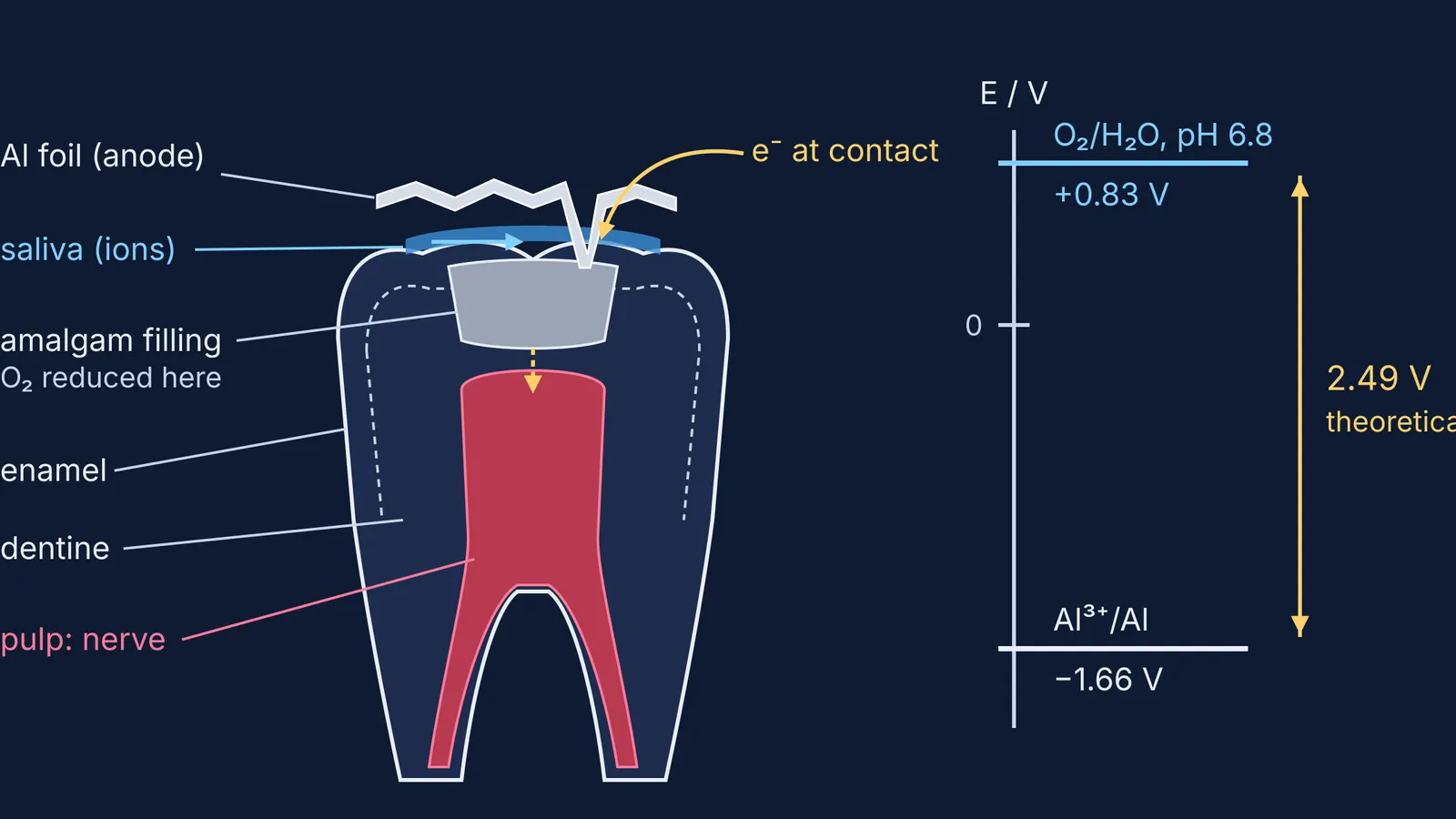
Bite on a scrap of aluminium foil with a tooth that has a silver-coloured filling, and you may feel a sharp jolt and taste metal. Nothing is wrong with the foil, and it is not your imagination. For a moment your mouth is a working galvanic cell, the same kind of cell you study in Class 12 electrochemistry. The foil is the anode, saliva is the electrolyte, and a small current flows through a tooth that has nerves inside it.
Why does biting aluminium foil hurt a tooth with a filling?
A galvanic cell needs three things: two different conductors, an electrolyte that carries ions between them, and an electrical connection that carries electrons. Bite on foil and your mouth supplies all three.
Anode: the aluminium foil. Aluminium is oxidised: Al → Al³⁺ + 3e⁻.
Cathode surface: the amalgam filling. Dissolved oxygen in saliva picks up electrons on the metal surface: O₂ + 4H⁺ + 4e⁻ → 2H₂O.
Electron path: the point where the foil touches the filling. Electrons flow straight from metal to metal.
Electrolyte: saliva. It contains Na⁺, K⁺, Cl⁻ and other ions, so the circuit closes through it.
Because the foil touches the filling directly, the cell is short-circuited. All of its driving force goes into pushing current around a tiny loop, and part of that current passes through the tooth tissue under the filling, near the pulp. The pulp holds the tooth's nerve, and nerves respond to electric current. That is the jolt. A 2023 review of oral galvanism in Maxillofacial Plastic and Reconstructive Surgery lists contact with silver foil or a spoon while biting as a known trigger for this kind of pain.
Note what the cathode does. It is not a metal ion being deposited, as in a Daniell cell. The filling only provides a surface where oxygen is reduced, just like the iron surface in rusting.
What is a silver amalgam filling made of?
Dental amalgam is mercury mixed with an alloy powder of mainly silver, tin and copper. Our post on common alloys and their uses gives the composition in one line. After it sets, the filling is not one metal. It is a mixture of phases, such as Ag–Hg and Sn–Hg compounds with leftover Ag₃Sn particles.
So there is no single "E° of amalgam" to look up in a table. That does not matter here. The filling is an inert conducting surface, and the cathode reaction is oxygen reduction. What sets the cathode potential is the O₂/H₂O couple at the pH of saliva.
How do you calculate the voltage of the foil–filling cell?
Here is the full working with standard data. Saliva pH usually lies between about 6.2 and 7.6. We use 6.8.
Cathode at pH 6.8. For O₂ + 4H⁺ + 4e⁻ → 2H₂O, E° = +1.23 V. The Nernst equation at 25 °C with 1 bar O₂ gives E = 1.23 − 0.059 × pH. So E = 1.23 − 0.059 × 6.8 = 1.23 − 0.40 = +0.83 V.
Anode. Al³⁺ + 3e⁻ → Al has E° = −1.66 V.
Cell potential. E(cell) = E(cathode) − E(anode) = 0.83 − (−1.66) = 2.49 V.
Balance the electrons. Four Al give 12e⁻, and three O₂ take 12e⁻. Overall: 4Al + 3O₂ + 12H⁺ → 4Al³⁺ + 6H₂O. Check: 4 Al, 6 O and 12 H on each side; charge +12 on both sides.
Free energy. ΔG = −nFE. Per mole of O₂, n = 4, so ΔG = −4 × 96 485 × 2.49 ≈ −961 kJ. Per mole of Al, n = 3, so ΔG ≈ −720 kJ. The large negative value tells you the reaction is strongly spontaneous.
Two small corrections are worth knowing. Air contains only about 0.21 bar of O₂, which lowers the cathode potential by about 0.01 V. Body temperature (37 °C) changes the 0.059 slope to about 0.062, which lowers it by roughly another 0.02 V. Neither changes the picture: the theoretical voltage is about 2.5 V.
Why is the real voltage in your mouth much lower than 2.49 V?
2.49 V is a theoretical maximum. The voltage you could actually measure is much smaller, for three reasons.
The oxide film. Aluminium is always covered by a thin layer of Al₂O₃. It blocks the metal from the electrolyte, so the foil behaves as if it were a much less reactive metal. This is why aluminium cookware does not dissolve in water, even though its E° is very negative.
Polarisation. Oxygen reduction is slow, and saliva holds only a little dissolved O₂. As soon as current flows, the region near the filling runs short of O₂ and the cathode potential drops.
IR drop. Saliva and tooth tissue have resistance. Part of the voltage is used up just pushing ions through them.
The dental literature reports differences of up to about 950 mV between different dental alloys in the mouth, according to the same 2023 review, with typical currents of a few microamperes to a few tens of microamperes. That is far below 2.49 V, yet still enough to stimulate a nerve. The cell is weak, but the nerve is very close.
Does a single filling or a gold crown do the same thing?
A single amalgam filling on its own does not give you this jolt. A galvanic cell needs two different electrode materials, so one metal in saliva has nothing to pair with. The foil supplies the second electrode.
Two different dental metals can pair up, though. A gold crown touching an amalgam filling on the opposite tooth forms a cell in the same way, with the less noble amalgam acting as the anode. The difference in potential is smaller than with aluminium, so any effect is usually much milder. Questions about specific fillings or symptoms belong with a dentist; this post covers only the chemistry.
How is this cell like cleaning silver with aluminium foil?
The same aluminium anode does useful work in the kitchen. In how aluminium foil and baking soda clean tarnished silver, the foil gives electrons to Ag₂S on a spoon, and the tarnish is reduced back to silver. In your mouth, the foil gives electrons to oxygen instead.
The oxygen half is the one that drives rusting. Iron in damp air uses the same O₂ cathode at near-neutral pH, as explained in corrosion as electrochemistry. Comparing the three cells is a good way to see that the anode and the cathode can be swapped in and out like parts.
If you want to see how electron flow, mass change and voltage depend on the pair of metals, try the galvanic cell experiments in the Simulation Lab.
Quick checklist
Foil on a filling makes a short-circuited galvanic cell: Al is the anode and the filling is the cathode surface.
The cathode reaction is O₂ + 4H⁺ + 4e⁻ → 2H₂O, not metal deposition.
Use E = 1.23 − 0.059 pH: at pH 6.8 it is about +0.83 V.
Theoretical E(cell) = 0.83 − (−1.66) = 2.49 V; ΔG ≈ −961 kJ per mole of O₂.
Real voltages are far lower because of the Al₂O₃ film, polarisation and IR drop.
One filling alone cannot make a cell; you need two different conductors.


