On this page
Rub a black silver spoon with polish and you wipe off a little silver along with the tarnish. Lay the same spoon on aluminium foil in hot baking-soda water and the black fades with no scrubbing, because the tarnish is turned back into metal. The Canadian Conservation Institute (CCI) describes the conservator's version: silver touching aluminium, both in a warm washing-soda (sodium carbonate) solution, slowly loses its tarnish. Kitchen versions use baking soda and salt instead.
This is the redox chemistry from your Class 10 and Class 12 textbooks, running in a kitchen bowl.
What is the black layer on silver?
Tarnish is silver sulphide, Ag₂S. The Journal of Chemical Education classroom activity Silver to Black – and Back writes its formation as 2Ag + ½O₂ + H₂S → Ag₂S + H₂O. Traces of hydrogen sulphide in air and sulphur-rich foods such as egg yolk supply the sulphur. We cover where that sulphur comes from in why silver turns black.
The silver in tarnish is not lost. It sits in the sulphide as Ag⁺ ions, and anything that gives those ions electrons turns them back into silver atoms.
How do aluminium foil and baking soda clean silver?
The overall reaction, from the same JCE activity, is 3Ag₂S + 2Al → Al₂S₃ + 6Ag. Aluminium is the reducing agent; silver sulphide is reduced.
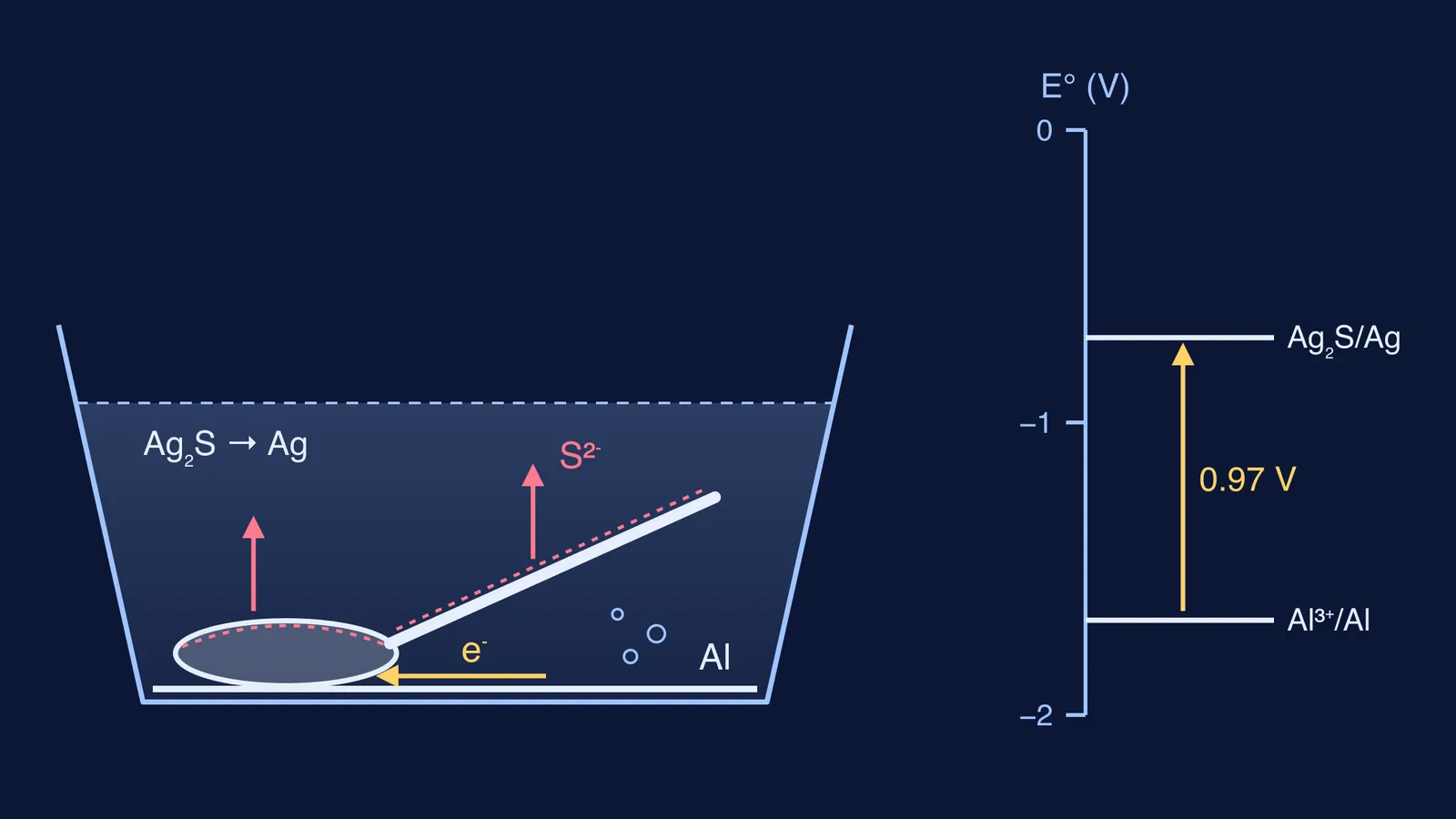
The University of Wisconsin chemistry demo lab describes the setup as an electrochemical cell formed between the silver sulphide and the aluminium. Map it onto the galvanic cell you know:
Anode (the foil): Al → Al³⁺ + 3e⁻. Aluminium is oxidised.
Cathode (the silver item): Ag₂S + 2e⁻ → 2Ag + S²⁻. The Ag⁺ in tarnish takes the electrons.
Wire: the spot where the silver touches the foil. Electrons flow through that metal contact.
Electrolyte: the hot soda or salt water, which lets ions move and completes the circuit.
That is why contact matters. In a 2001 post archived at yarchive.net, Barry Ornitz stressed that the silver must make electrical contact with the aluminium for the reaction to run.
Baking soda has a second job. Compound Interest explains that it clears the thin aluminium hydroxide layer on the foil, so fresh aluminium can keep reacting. The same source says the rotten-egg smell is hydrogen sulphide, released when aluminium sulphide reacts with water.
If galvanic and electrolytic cells blur together for you, read electrolytic vs galvanic cells next.
Worked example: will the cell really run?
Take standard reduction potentials from the LibreTexts table:
Ag₂S + 2e⁻ → 2Ag + S²⁻, E° = −0.71 V
Al³⁺ + 3e⁻ → Al, E° = −1.676 V
The cathode is the couple with the higher (less negative) E°, so Ag₂S/Ag.
E°cell = E°cathode − E°anode = −0.71 − (−1.676) = +0.97 V.
A positive E°cell makes ΔG° = −nFE°cell negative, so the reaction is spontaneous under standard conditions.
Balance electrons: 2Al gives 6e⁻ and 3Ag₂S takes 6e⁻, which matches 3Ag₂S + 2Al → Al₂S₃ + 6Ag.
Both potentials are negative. Silver sulphide is hard to reduce, so you need a metal whose E° is even more negative. A hot soda bath is not at standard conditions, so +0.97 V shows direction, not a measured voltage.
Now test yourself with the same table. Copper (Cu²⁺/Cu, E° = +0.34 V) gives E°cell = −0.71 − 0.34 = −1.05 V, so copper foil will not work. Zinc (E° = −0.76 V) gives only about +0.05 V. Aluminium wins by a wide margin, and the same logic explains zinc and magnesium in sacrificial protection against rusting.
If signs in E°cell questions keep tripping you up, the Fermi Concept Library gives every chemistry concept its own lesson and its place in the map.
Is it safe for every silver item?
The CCI note lists points to know before you try it on a family piece, such as a puja thali or old anklets:
Silver from the tarnish stays on the surface as rough particles, leaving a dull, matte finish that a silver cloth can then polish.
Objects cleaned this way may tarnish more quickly than polished silver.
Objects with sealed hollow parts should not go into water-based solutions.
For valuable or antique pieces, ask a jeweller or a conservator first. Let an adult handle the hot water, and keep the room ventilated because of the smell.
A home experiment with a control
Line a glass or ceramic bowl with foil and add hot water, a spoonful of baking soda and a pinch of salt.
Lay one tarnished spoon so it touches the foil.
Rest a second tarnished spoon on a plastic lid in the same water, so it does not touch the foil.
Before you look, predict which spoon will brighten, using the half-reactions above.
Note what you see and smell, then write the anode, cathode and overall equations from memory.
The spoon off the foil is your control: same water, same heat, no circuit. For more cell-potential practice, the Fermi Problem Library has worked problems with a step-by-step solver that explains the reasoning rather than printing an answer.