

On this page
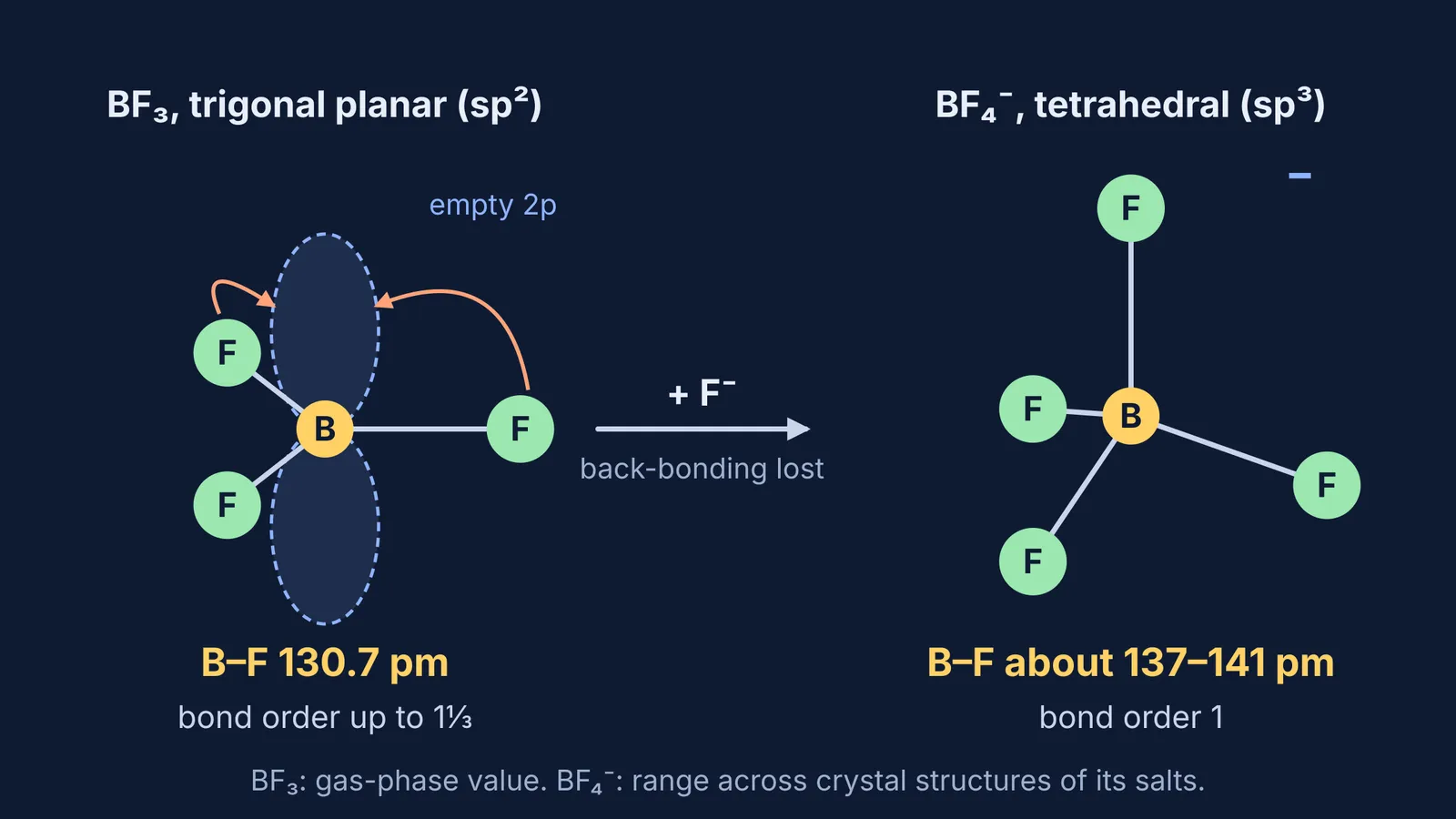
In a molecule of BF₃, each boron–fluorine bond is about 130.7 pm long. Add a fluoride ion to make BF₄⁻ and every B–F bond stretches to roughly 137–141 pm. Nothing seems to have attacked those bonds, so why do they get longer? The answer is the clearest piece of measured evidence for the back-bonding that JEE uses to explain the chemistry of boron halides.
What is back-bonding in BF₃?
Boron has three valence electrons. In BF₃ it forms three σ bonds and ends up with six electrons around it, one pair short of an octet. The molecule is flat, and boron is sp² hybridised. That leaves one 2p orbital on boron, perpendicular to the plane, completely empty.
Each fluorine has filled 2p orbitals, and one of them is parallel to boron's empty 2p. A fluorine lone pair can spread into that empty orbital. This sideways overlap is called pπ–pπ back-bonding. It gives the B–F bonds some double-bond character and partly fills the gap in boron's octet.
The flat shape of BF₃ itself is covered in why BF₃ is planar but NH₃ is pyramidal. Here the focus is what happens to the bonds when the empty orbital gets used.
What is the B–F bond order in BF₃ and in BF₄⁻?
You can write four resonance structures for BF₃: three with one B=F double bond, and one with three single bonds. If you take the structures with a double bond seriously, there is one π bond shared between three B–F links. Each bond then has a bond order of 1 + 1/3 = 1⅓.
Fluorine is very electronegative and gives up its lone pair reluctantly, so the real π contribution is smaller. A fair statement is that the B–F bond order in BF₃ lies between 1 and 1⅓.
Now add F⁻. Boron uses its empty 2p orbital to accept the fluoride's lone pair. It becomes sp³, with four σ bonds and a full octet. There is no empty orbital left for back-bonding, so each B–F bond has a bond order of 1. The same thing happens when NH₃ adds to give the neutral adduct F₃B·NH₃.
Lower bond order means a longer bond. This is the same link you use for C–C against C=C, explained in the relation between bond order and bond length.
How much longer is the B–F bond in BF₄⁻?
The measured values are:
BF₃ (gas): 130.7 pm, from the NIST Computational Chemistry Comparison and Benchmark Database.
BF₄⁻ (in salts such as NaBF₄ and KBF₄): about 137–141 pm. The exact value depends on the cation and the crystal, because the anion's surroundings tug on it slightly.
F₃B·NH₃ (crystal): about 138 pm, close to the BF₄⁻ values.
Treat the BF₄⁻ and adduct values as approximate. Different crystal structures give different numbers, but every one of them is clearly longer than 130.7 pm.
Worked example: how big is the change, and what does it tell you?
Question. The B–F bond is 130.7 pm in BF₃ and about 139 pm in BF₄⁻. Find the percentage increase, and explain why it supports back-bonding in BF₃.
Find the change. 139 − 130.7 = 8.3 pm.
Turn it into a percentage. 8.3 ÷ 130.7 × 100 ≈ 6.4%.
Check the range. At the ends of the 137–141 pm range, the increase is 4.8% and 7.9%. So the bond lengthens by roughly 5–8%, whichever crystal you pick.
Sense check with carbon. A full π bond makes a big difference: C=C is about 134 pm and C–C about 154 pm, a gap of about 20 pm. Losing about one third of a π bond should cost something of the order of a third of that, 6–7 pm. The B–F change is the same size. This is only a rough comparison, since B–F is not C–C, but it shows the change is the size you would expect from losing partial π bonding.
Conclude. The bonds lengthen as soon as boron's empty 2p orbital is used up. That fits the idea that, in free BF₃, the empty orbital was taking part in B–F bonding.
Is lost back-bonding the only reason the bond lengthens?
No. Two other effects push in the same direction, and a complete answer mentions them.
Less s-character. Boron's bonding orbitals change from sp² (one third s) to sp³ (one quarter s). Orbitals with less s-character are larger and form slightly longer bonds.
More ligands and more charge. Boron's bonding is now shared among four groups instead of three. In BF₄⁻ the fluorines also carry extra negative charge, so they repel each other more.
The NH₃ adduct helps separate these effects. F₃B·NH₃ is neutral, yet its B–F bonds are about as long as those in BF₄⁻. So the extra negative charge cannot be the main reason. Loss of π bonding and the change to sp³ boron are present in both, and the usual exam answer leads with back-bonding.
Why does this matter for BF₃ as a Lewis acid?
Back-bonding has a cost when BF₃ accepts a lone pair. Before the new bond can form, BF₃ has to bend from flat to pyramidal and give up the π bonding that was stabilising it. The energy released when the adduct forms is the energy of the new bond minus this reorganisation cost.
That is why BF₃ binds bases less strongly than a simple "boron has an empty orbital" picture suggests. Its back-bonding is the strongest of the boron trihalides, so it pays the largest price. This is the basis of the order BF₃ < BCl₃ < BBr₃ in Lewis acidity, worked through in Lewis acidity of boron trihalides and back-bonding. The bond lengths in this post are the measured evidence behind that argument.
If you want to practise questions that mix bond order, hybridisation and Lewis acidity, the Fermi Problem Library has a step-by-step solver that explains the reasoning at each stage.
Quick checklist
BF₃: boron sp², one empty 2p orbital, B–F 130.7 pm.
Fluorine lone pairs back-bond into that orbital, giving a B–F bond order between 1 and 1⅓.
BF₄⁻ and F₃B·NH₃: boron sp³, octet complete, bond order 1, B–F about 137–141 pm.
The bond lengthens by roughly 5–8%.
Lost π bonding leads the explanation; less s-character and crowding also contribute.
Boron never uses d orbitals.
Breaking back-bonding costs energy, which weakens BF₃ as a Lewis acid.


