

On this page
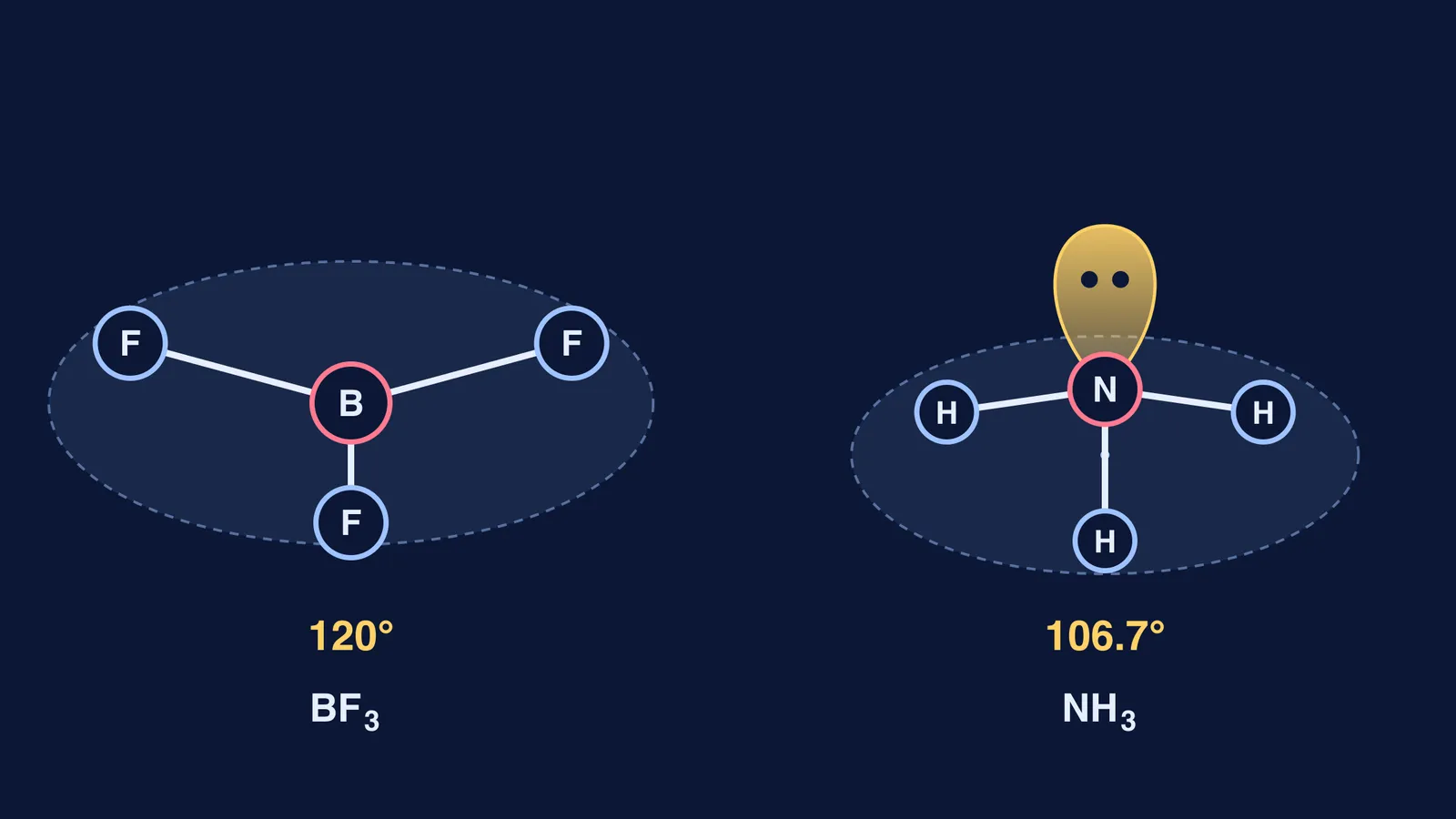
Both molecules have a central atom joined to three other atoms, so you might expect them to look the same. They don't, and the reason appears once you count every electron pair on the central atom, including those that are not bonds.
How many electron pairs do boron and nitrogen have?
Boron has three valence electrons and nitrogen has five, as the NCERT Class 11 chapter on chemical bonding shows in their electron configurations. In BF3, each of boron's three electrons pairs with one from a fluorine, so boron ends up with three bond pairs and nothing left over. In NH3, nitrogen uses three of its five electrons to bond with three hydrogens, and the other two stay on nitrogen as a lone pair.
The same chapter explains both cases with hybridisation. Boron mixes one 2s and two 2p orbitals into three sp2 hybrid orbitals that lie in a trigonal planar arrangement at 120° (NCERT works through BCl3, which has the same boron). Nitrogen mixes one 2s and three 2p orbitals into four sp3 hybrids. Three of them hold one electron each and bond with hydrogen, and the fourth holds the lone pair.
NCERT credits valence bond theory to Heitler and London in 1927, and we tell that story in how Heitler and London explained the covalent bond.
Why is BF3 planar?
VSEPR theory says electron pairs around a central atom repel each other and settle as far apart as they can, according to the NCERT chapter. The farthest apart three pairs can get is 120°, all in one flat plane. NCERT's Table 4.6 lists BF3 as its example of a trigonal planar molecule.
The NIST experimental geometry for BF3 gives an F–B–F angle of 120° and a B–F bond length of 1.307 Å, with all four atoms in one plane.
Why is NH3 pyramidal and not planar?
Four electron pairs get farthest apart by pointing to the corners of a tetrahedron, at 109.5° (NCERT). In NH3, one of those corners holds the lone pair instead of an atom. A shape is named by where the atoms are, so if you look only at N and the three H atoms, you see a pyramid with nitrogen at the top.
The angle is also smaller than 109.5°. NCERT says lone pair–bond pair repulsion is stronger than bond pair–bond pair repulsion, so the lone pair pushes the three N–H bonds together and the H–N–H angle drops to 107° (NCERT, Table 4.8). The NIST experimental geometry for NH3 gives 106.67° and an N–H bond length of 1.012 Å.
If ammonia picks up a proton, the lone pair becomes a fourth bond and the shape becomes a regular tetrahedron. We cover that in why all four N–H bonds in ammonium are identical.
How do the shapes show up in dipole moments?
NCERT's Table 4.5 lists BF3 at 0 D and NH3 at 1.47 D (NCERT). In flat BF3, the three B–F bond dipoles are 120° apart, and the resultant of any two is equal and opposite to the third. In NH3, the three N–H dipoles add up along the pyramid's axis, and NCERT notes that the lone pair's orbital dipole points the same way, which makes the total larger.
The same idea explains a classic exam pair, in why CO2 is linear but SO2 is bent.
A four-step check for any central atom
Use this whenever a question asks for a shape, hybridisation or bond angle. The angles are those in the NCERT chapter.
Write down the central atom's valence electrons. Boron has 3. Nitrogen has 5.
Subtract one for each single bond it forms, then halve what is left to get its lone pairs. Boron: 3 − 3 = 0, so no lone pairs. Nitrogen: 5 − 3 = 2, so one lone pair.
Add bond pairs and lone pairs. A total of 3 means sp2 and a trigonal planar arrangement. A total of 4 means sp3 and a tetrahedral arrangement.
Name the shape from the atoms only, then shrink the angle for each lone pair. BF3 is trigonal planar at 120°. NH3 is trigonal pyramidal at about 107°.
Try four more from the same chapter:
BCl3: three bond pairs and no lone pair, so it is sp2 and trigonal planar at 120°.
NF3: three bond pairs and one lone pair, so it is pyramidal, like NH3.
H2O: two bond pairs and two lone pairs, so it is bent, at 104.5°.
CH4: four bond pairs and no lone pair, so it is tetrahedral at 109.5°.
If you keep getting step 2 wrong, try worked bonding problems in the Fermi Problem Library, whose step-by-step solver explains the reasoning rather than printing an answer. If hybridisation itself feels shaky, the Fermi Concept Library gives every chemistry concept its own lesson and its place in the map.


