

On this page
Put boron trichloride in water and you get boric acid and hydrochloric acid, as you would expect. Put boron trifluoride in water and you do not get boric acid and plain hydrofluoric acid. Most of the fluorine ends up in a new strong acid, fluoroboric acid, HBF₄. JEE Main questions on group 13 test exactly this difference. This post explains both reactions, why only fluorine forms the extra acid, and how to count the moles of each product.
What does BCl₃ give when it reacts with water?
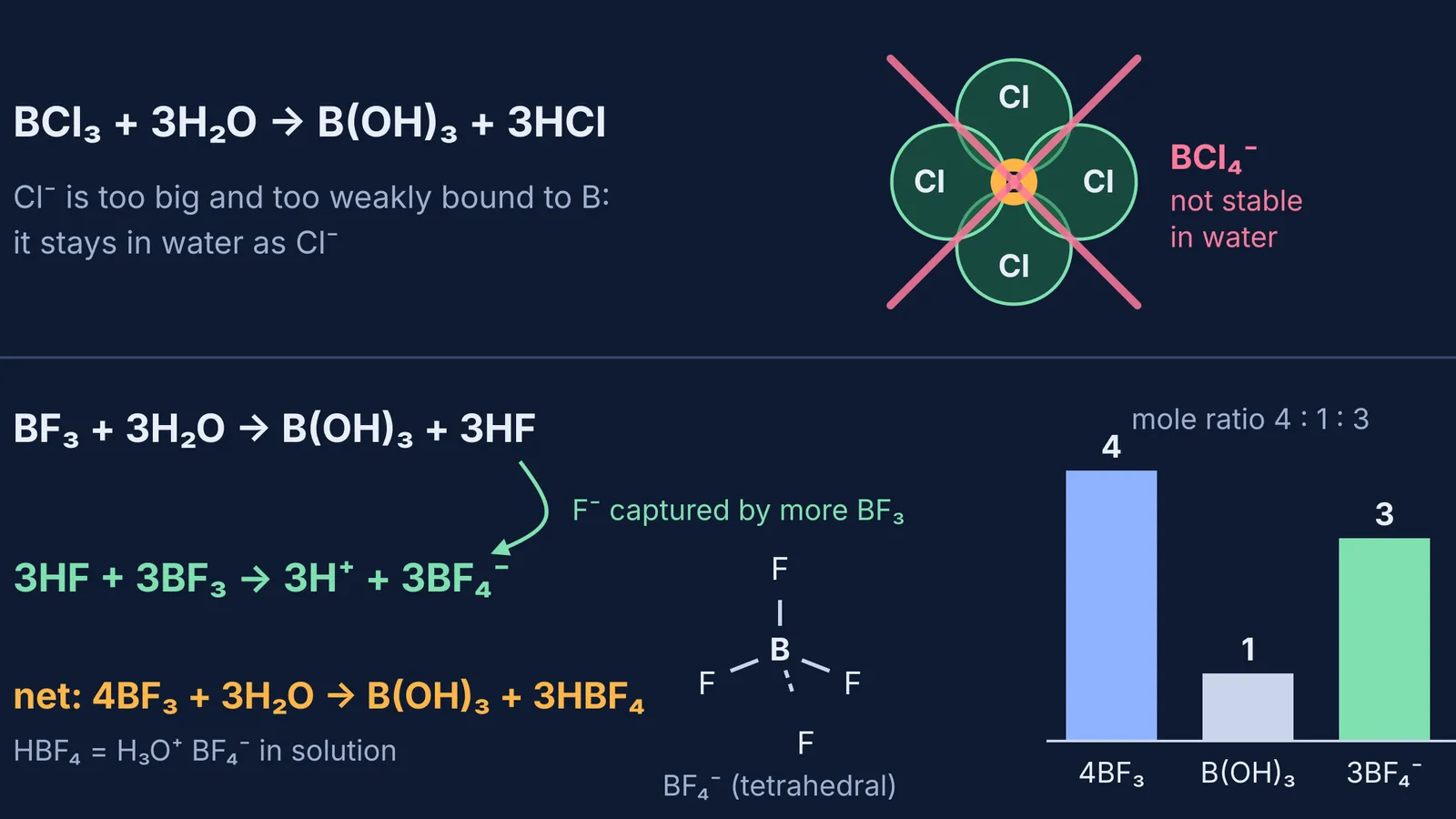
BCl₃ hydrolyses quickly and completely. It fumes in moist air because the HCl it releases picks up water vapour.
BCl₃ + 3H₂O → H₃BO₃ + 3HCl
The equation balances: one B, three Cl, six H and three O on each side. H₃BO₃ is boric acid, often written B(OH)₃.
The reaction works because boron in BCl₃ has only six valence electrons and an empty p orbital. A water molecule donates a lone pair into that orbital, an H–Cl unit is lost, and the step repeats until all three chlorines are replaced by OH groups. BBr₃ and BI₃ hydrolyse the same way, giving boric acid and HBr or HI.
What does BF₃ give when it reacts with water?
Think of BF₃ hydrolysis in two stages.
Some BF₃ is hydrolysed like BCl₃: BF₃ + 3H₂O → H₃BO₃ + 3HF.
The HF is captured by more BF₃: HF + BF₃ → H⁺ + BF₄⁻. This happens three times, once for each HF.
Add the two stages, with the second taken three times, and the three HF cancel:
4BF₃ + 3H₂O → H₃BO₃ + 3HBF₄
Check the balance: four B, twelve F, six H and three O on each side. The ratio to learn is 4 : 3 → 1 : 3.
So only one BF₃ in four is actually hydrolysed to boric acid. The other three each take up a fluoride ion and become the tetrahedral fluoroborate ion, BF₄⁻.
Three points keep your answer accurate:
HBF₄ exists only in solution. It is a strong acid, present in water as H₃O⁺ and BF₄⁻. It has not been isolated as a pure compound, and it is sold as an aqueous solution.
BF₃ hydrolysis is slower and less complete than BCl₃ hydrolysis. The B–F bonds are strong, and back-bonding from fluorine partly fills boron's empty p orbital. Real solutions also contain hydroxyfluoroborate ions such as [BF₃(OH)]⁻. The 4 : 3 equation is the net textbook result.
BF₄⁻ is not completely inert. It hydrolyses slowly in water, especially when heated, so call it stable, not unreactive.
Why does fluoride form BF₄⁻ but chloride does not form BCl₄⁻ in water?
The difference is in the stability of the four-coordinate ion, not in how strongly the trihalide attracts electrons.
Size. Boron is a very small atom. Four small F atoms fit comfortably around it in a tetrahedron. Four large Cl atoms would be crowded against each other.
Bond strength. The B–F bond is one of the strongest single bonds there is. Average bond enthalpies are roughly 645 kJ mol⁻¹ for B–F in BF₃ and roughly 445 kJ mol⁻¹ for B–Cl in BCl₃ (tables differ slightly). Adding a fourth fluorine still gives four strong B–F bonds in BF₄⁻.
What the halide prefers in water. HF is a weak acid, and F⁻ is a small ion that bonds strongly to boron, so fluoride is readily handed on to BF₃. Cl⁻ is large, weakly bound to boron and well hydrated, so it stays in solution as Cl⁻.
Salts of BCl₄⁻ can be made with large cations under dry conditions, but water destroys them at once, giving boric acid and HCl. That is why BCl₃ hydrolysis stops at HCl.
Do not explain this with Lewis acidity. BF₃ is the weakest Lewis acid of the boron trihalides towards a base such as NH₃. The order is BF₃ < BCl₃ < BBr₃, as explained in Lewis acidity of boron trihalides and back bonding. The reason HBF₄ forms is that BF₄⁻ is a very stable ion. How the B–F bond changes when BF₃ becomes BF₄⁻ is covered in why the B–F bond gets longer in BF₄⁻.
How much acid do equal moles of BF₃ and BCl₃ give? Worked example
Question. 0.0400 mol of BF₃ and 0.0400 mol of BCl₃ are each hydrolysed completely in separate flasks. Find the moles of boric acid and of strong acid in each, and the volume of 0.500 M NaOH needed to neutralise the strong acid.
Step 1. Masses (optional check). M(BF₃) = 10.81 + 3 × 19.00 = 67.81 g mol⁻¹, so 0.0400 mol is 2.71 g. M(BCl₃) = 10.81 + 3 × 35.45 = 117.16 g mol⁻¹, so 0.0400 mol is 4.69 g.
Step 2. BF₃ with the 4 : 3 → 1 : 3 equation.
Boric acid: 0.0400 × 1/4 = 0.0100 mol.
HBF₄: 0.0400 × 3/4 = 0.0300 mol.
Water used: 0.0400 × 3/4 = 0.0300 mol.
Step 3. BCl₃ with the 1 : 3 → 1 : 3 equation.
Boric acid: 0.0400 mol.
HCl: 0.0400 × 3 = 0.120 mol.
Water used: 0.120 mol.
Step 4. Count only the strong acid. HBF₄ and HCl are strong acids. Boric acid is a very weak monobasic acid (pKa about 9.2) that acts by accepting OH⁻, not by giving away its own protons, as explained in why boric acid is a monobasic Lewis acid. It does not count as strong acid.
Step 5. NaOH volume.
BF₃ flask: 0.0300 mol ÷ 0.500 mol L⁻¹ = 0.0600 L = 60.0 mL.
BCl₃ flask: 0.120 mol ÷ 0.500 mol L⁻¹ = 0.240 L = 240 mL.
Answer. Equal moles of the two halides give a 1 : 4 ratio of strong acid (0.0300 vs 0.120 mol). BF₃ gives a quarter as much boric acid as BCl₃. If you had assumed BF₃ hydrolyses like BCl₃, you would have predicted 0.120 mol of HF, a weak acid, and missed the HBF₄ completely.
For more stoichiometry problems of this kind, the Fermi Problem Library has a step-by-step solver that explains the reasoning.
What mistakes cost marks on boron trihalide hydrolysis?
Writing BF₃ + 3H₂O → H₃BO₃ + 3HF as the final answer. The HF is taken up by more BF₃.
Using a 1 : 3 ratio for BF₃ in mole questions instead of 4 : 3.
Counting boric acid as a strong acid, or as tribasic because it has three H atoms.
Saying BF₃ forms BF₄⁻ because it is the strongest Lewis acid. It is the weakest of the three.
Writing HBF₄ as an isolated pure liquid or solid. It exists as H₃O⁺ BF₄⁻ in solution.
Calling BF₄⁻ completely inert to water.
Quick checklist
BCl₃ + 3H₂O → H₃BO₃ + 3HCl: fast and complete.
4BF₃ + 3H₂O → H₃BO₃ + 3HBF₄: only one BF₃ in four becomes boric acid.
BF₄⁻ forms because F is small and B–F bonds are very strong; Cl⁻ is too large and too weakly bound.
Lewis acidity runs BF₃ < BCl₃ < BBr₃, so it does not explain the difference.
HBF₄ is a strong acid that exists only in solution.
Equal moles: BF₃ gives a quarter of the strong acid that BCl₃ gives.


