

On this page
Soluble barium compounds are poisonous. Yet in a barium meal, a patient drinks a white slurry of barium sulphate so that the stomach and intestines show up on an X-ray. Barium carbonate, which looks almost the same and is also "insoluble in water", would be dangerous in the same place. The difference is not how insoluble each salt is in pure water. It is what happens to each salt in stomach acid, and you can work it out with a solubility product and one acid dissociation constant.
What is a barium meal, and why is barium used?
A barium meal (or barium swallow, depending on which part of the gut is being looked at) is an X-ray examination in which the patient swallows a suspension of barium sulphate. The suspension coats the inside of the oesophagus, stomach or intestine, so their outline appears clearly on the X-ray image. This post is only about the chemistry.
Barium is used because it has a high atomic number (Z = 56), and heavy atoms absorb X-rays much more strongly than the light atoms in soft tissue.
Why is BaSO₄ insoluble in the first place?
Barium sulphate has a very small solubility product. Using the NCERT value:
BaSO₄(s) ⇌ Ba²⁺(aq) + SO₄²⁻(aq), Ksp = 1.1 × 10⁻¹⁰
Why it is so low is a matter of lattice and hydration enthalpies, covered in why Group 2 sulphates get less soluble but hydroxides more. Here the question is different: does acid change it?
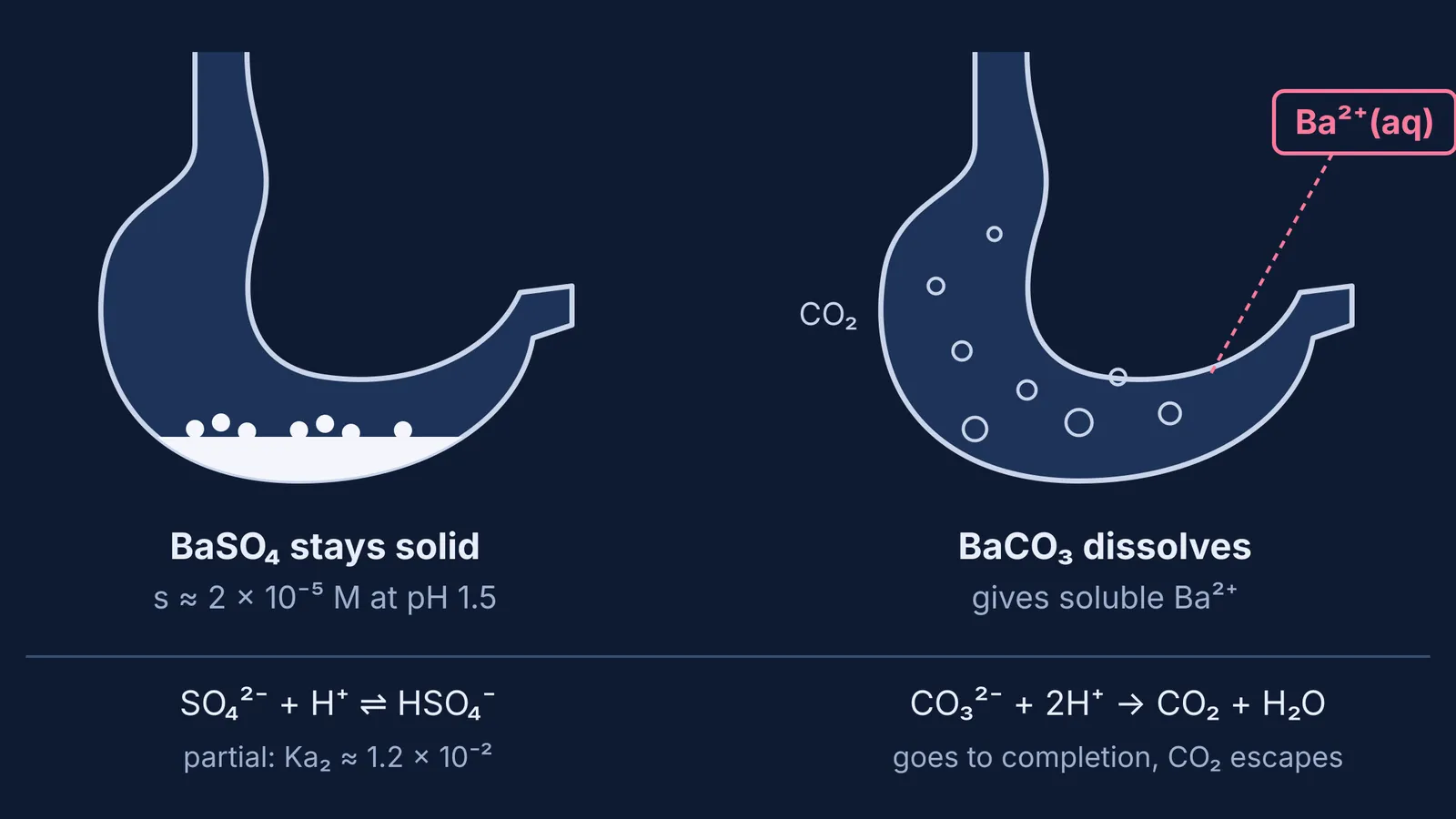
Why doesn't stomach acid dissolve BaSO₄?
Acid raises the solubility of a salt only when the salt's anion is a base that can pick up H⁺. The general idea, worked on CaF₂, is in why salts of weak acids dissolve more in acid.
Sulphate is the conjugate base of HSO₄⁻, and HSO₄⁻ is a fairly strong acid. Its dissociation constant, Ka₂ of sulphuric acid, is about 1.0–1.2 × 10⁻² depending on the table. So sulphate is a very weak base, and in acid only a modest fraction of it becomes HSO₄⁻:
SO₄²⁻ + H⁺ ⇌ HSO₄⁻
That small shift is all the help acid can give.
Worked example: how much BaSO₄ dissolves in stomach acid?
Assumptions: Ksp(BaSO₄) = 1.1 × 10⁻¹⁰, Ka₂(H₂SO₄) = 1.2 × 10⁻², and stomach acid at [H⁺] = 0.03 M (pH about 1.5). Stomach pH varies, roughly 1.5 to 3.5, so this is the acidic end, which gives the largest solubility.
Solubility in pure water. s = √Ksp = √(1.1 × 10⁻¹⁰) = 1.05 × 10⁻⁵ M.
Set up the balance in acid. Let s′ be the solubility in acid. All the dissolved barium is Ba²⁺, so [Ba²⁺] = s′. The dissolved sulphate is shared between two forms: s′ = [SO₄²⁻] + [HSO₄⁻].
Use Ka₂. [HSO₄⁻] = [H⁺][SO₄²⁻] / Ka₂. So s′ = [SO₄²⁻](1 + [H⁺]/Ka₂).
Find the factor. [H⁺]/Ka₂ = 0.03 / 0.012 = 2.5, so 1 + [H⁺]/Ka₂ = 3.5. Only the free SO₄²⁻ counts in Ksp, and [SO₄²⁻] = s′ / 3.5.
Apply Ksp. Ksp = [Ba²⁺][SO₄²⁻] = s′ × s′/3.5. So s′ = √(Ksp × 3.5) = √(3.85 × 10⁻¹⁰) = 1.96 × 10⁻⁵ M, about 2.0 × 10⁻⁵ M.
Convert to mass. With Ba = 137.3 g mol⁻¹, 1.96 × 10⁻⁵ mol L⁻¹ × 137.3 g mol⁻¹ = 2.7 × 10⁻³ g L⁻¹, or about 2.7 mg of Ba²⁺ per litre.
Acid has raised the solubility by a factor of √3.5, about 1.9. It is still roughly 2 × 10⁻⁵ M. With Ka₂ = 1.0 × 10⁻² instead, the answer is 2.1 × 10⁻⁵ M, so the conclusion does not depend on which table you use: almost all the barium sulphate stays solid and passes through the gut.
Why does BaCO₃ dissolve in stomach acid?
Barium carbonate has Ksp = 5.1 × 10⁻⁹ (NCERT value), which in pure water gives s = √(5.1 × 10⁻⁹) = 7.1 × 10⁻⁵ M. That is only about seven times BaSO₄'s solubility in water, so on Ksp alone the two look similar.
Acid changes everything. Carbonate is a strong base, the conjugate base of the very weak acid HCO₃⁻. It takes up two protons and becomes carbonic acid, which breaks down to carbon dioxide and water:
CO₃²⁻ + 2H⁺ → CO₂ + H₂O
Overall, with hydrochloric acid:
BaCO₃ + 2HCl → BaCl₂ + H₂O + CO₂
Check: Ba 1 = 1, C 1 = 1, O 3 = 1 + 2, H 2 = 2, Cl 2 = 2.
You can put a number on how far this goes. For BaCO₃(s) + 2H⁺ ⇌ Ba²⁺ + H₂CO₃, K = Ksp / (Ka₁ × Ka₂) of carbonic acid. With Ka₁ ≈ 4.3 × 10⁻⁷ and Ka₂ ≈ 4.7 × 10⁻¹¹ (approximate textbook values), K ≈ 5.1 × 10⁻⁹ / (2.0 × 10⁻¹⁷) ≈ 2.5 × 10⁸. Compare BaSO₄ + H⁺ ⇌ Ba²⁺ + HSO₄⁻, where K = Ksp / Ka₂ = 1.1 × 10⁻¹⁰ / 1.2 × 10⁻² ≈ 9 × 10⁻⁹. On top of the large K, CO₂ escapes as gas, which keeps pulling the reaction forward. So barium carbonate in excess acid dissolves completely, and the barium ends up as soluble Ba²⁺, the form that is poisonous.
The same contrast is the basis of the lab test in how to test for a sulphate ion with barium chloride: a white precipitate that stays in dilute HCl is BaSO₄, while BaCO₃ dissolves with fizzing.
Why does the purity of medical BaSO₄ matter?
The safety argument holds only for barium sulphate itself. A soluble impurity such as BaCl₂, or an acid-soluble one such as BaCO₃, would release Ba²⁺ in the stomach. That is why medical barium sulphate is made to a strict pharmaceutical standard and tested for soluble barium. The low solubility belongs to the compound, not to the element.
Which other salts dissolve more in acid?
The "is the anion basic?" test sorts salts quickly:
AgCl, AgBr: no change in dilute acid. Cl⁻ and Br⁻ are conjugate bases of strong acids.
BaSO₄: a small increase, as worked above.
CaF₂: a large increase, because HF is a weak acid.
CaCO₃, BaCO₃: dissolve completely with fizzing, because CO₂ escapes.
Mg(OH)₂: dissolves, because OH⁻ is a strong base; this is how a hydroxide antacid neutralises acid.
Ksp still matters at the extremes. CuS has such a tiny Ksp that it stays insoluble even in dilute acid, while ZnS dissolves, and that difference is used to separate the two in salt analysis.
To practise more solubility-in-acid and Ksp problems, the Fermi Problem Library has a step-by-step solver that explains the reasoning at each stage.
Quick checklist
Barium meal: a BaSO₄ suspension that makes the gut visible on X-ray, because barium (Z = 56) absorbs X-rays strongly.
Soluble Ba²⁺ is poisonous; the low solubility of BaSO₄ is what keeps the barium out of the body.
Solubility of BaSO₄ in water: 1.05 × 10⁻⁵ M. In acid at [H⁺] = 0.03 M: s′ = √(Ksp(1 + [H⁺]/Ka₂)) ≈ 2.0 × 10⁻⁵ M.
BaCO₃ + 2HCl → BaCl₂ + H₂O + CO₂ goes to completion, releasing Ba²⁺.
Judge acid solubility by asking whether the anion is a base, not by Ksp alone.
State your assumptions for Ka₂ and stomach pH; both vary.


