

On this page
Statement and match-the-list questions appear in recent NEET papers and are slow. These eight original questions run easy to hard within Physics Unit 18 of the NMC's NEET (UG)-2026 syllabus, checked against NCERT Class 12 Physics Part II (Reprint 2026-27), Atoms and Nuclei. The unit omits radioactivity, so nothing tests decay. Start with our Atoms and Nuclei for NEET guide.
Which atoms and nuclei statements are correct?
Options for Q1 and Q3: (1) Both correct. (2) Both incorrect. (3) I correct, II incorrect. (4) I incorrect, II correct.
Q1 (easy, statements). Statement I: In the Geiger-Marsden experiment, only about 0.14% of alpha particles scattered by more than 1°. Statement II: A thick foil made each alpha particle scatter many times.
Answer: (3). I is correct, per NCERT. II is incorrect: the foil was very thin, so each alpha particle is scattered at most once.
Trap: (1) trusts the thick foil.
Q2 (medium, statements). Which are correct for the Bohr model? A. It applies to singly ionised helium. B. Above E = 0, the electron can have only discrete energies. C. Hydrogen's levels crowd together as n rises. D. It works for neutral helium too. E. Ionising an excited hydrogen atom needs less than 13.6 eV.
(1) A, B and C only (2) A, C and E only (3) C, D and E only (4) A, B, C and E only
Answer: (2). A is true: He⁺ has one electron. B is false: above 0 eV energies form a continuum. C is true: −13.6/n² bunches near zero. D is false: the model ignores electron-electron forces. E is true: excited electrons are less bound.
Trap: (4) extends discrete levels above zero.
Q3 (medium, statements). Statement I: Electron and alpha-particle scattering give exactly the same nuclear radius. Statement II: Uranium-235 fission releases energy because its fragments have a higher binding energy per nucleon.
Answer: (4). I is incorrect: NCERT says they differ slightly, as electrons sense charge and alpha particles sense nuclear matter. II is correct.
Trap: (1) assumes one radius for every probe.
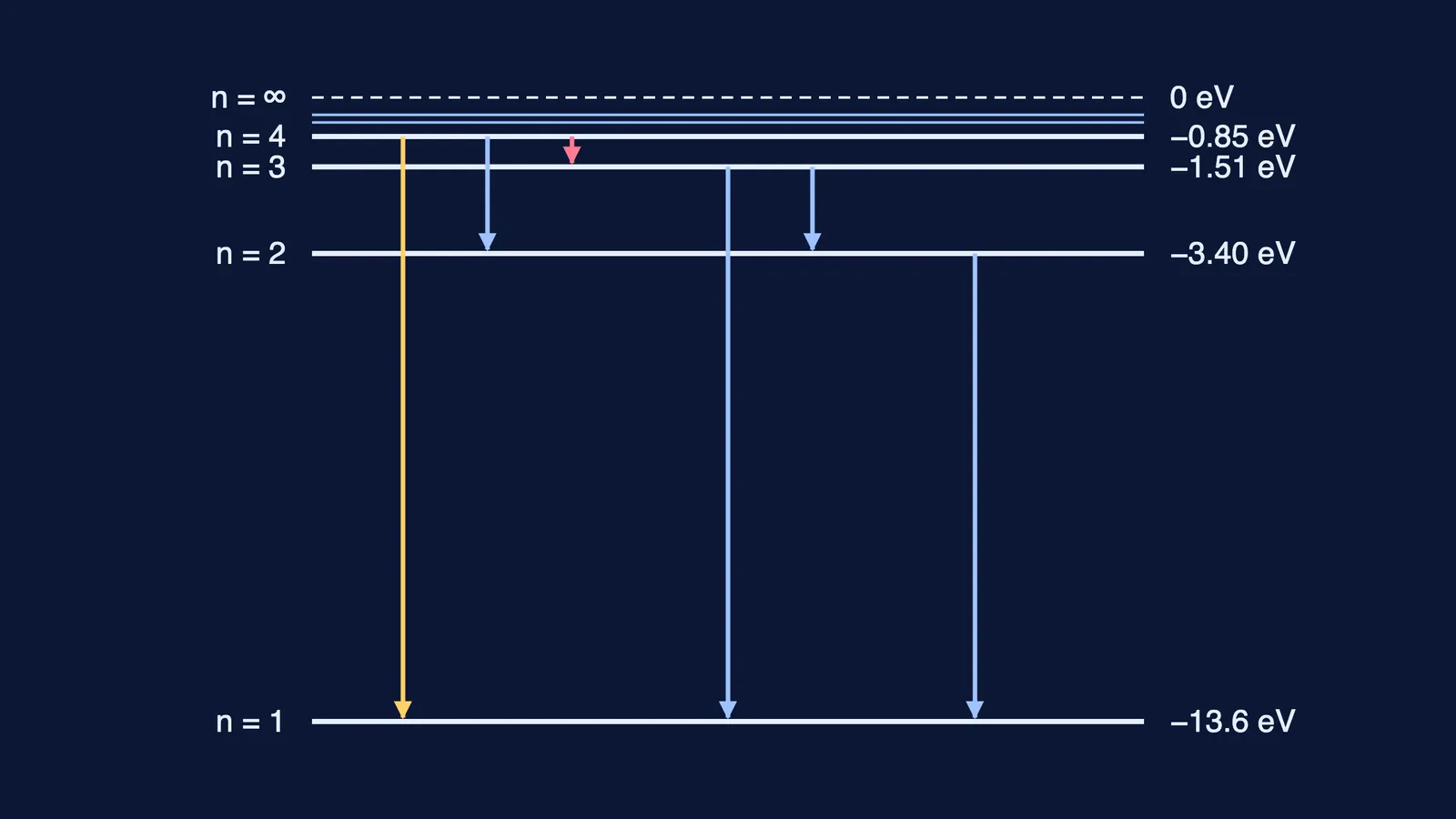
Q4 (hard, statements). For a Bohr hydrogen atom in n = 4, which are correct? A. Total energy is −0.85 eV. B. Angular momentum is 2h/π. C. Kinetic energy is 1.70 eV. D. A sample can emit up to six wavelengths returning to n = 1. E. The 4 → 3 photon belongs to the Balmer series.
(1) A, B and D only (2) A, C and D only (3) A, B, D and E only (4) B, C and E only
Answer: (1). A: −13.6/16 = −0.85 eV. B: 4h/2π = 2h/π. C is false: K = −E = 0.85 eV. D: four levels give six pairs. E is false: 4 → 3 is Paschen; Balmer lines end on n = 2.
Trap: (2) doubles K; |U|, not K, equals 2|E|.
How do you match atoms and nuclei lists?
Q5 (easy, match). Match model and feature.
List-I: A. Thomson's model; B. Rutherford's model; C. Bohr's model; D. de Broglie's explanation of Bohr orbits.
List-II: I. A whole number of wavelengths fits each orbit; II. Positive charge spread uniformly through the whole atom; III. Its electrons should radiate and spiral inward; IV. Cannot explain relative line intensities.
(1) A-III, B-II, C-IV, D-I (2) A-II, B-III, C-I, D-IV (3) A-II, B-IV, C-III, D-I (4) A-II, B-III, C-IV, D-I
Answer: (4). A-II: Thomson's plum pudding. B-III: classical radiation. C-IV: Bohr predicts frequencies, not intensities. D-I: 2πrₙ = nλ.
Trap: (1) swaps Thomson's and Rutherford's pictures.
Q6 (medium, match). Match each observation with its conclusion.
List-I: A. Most alpha particles cross a thin gold foil almost undeviated; B. Alpha-bombarded beryllium emits neutral radiation that ejects protons, which photons of the available energy could not; C. Chlorine's atomic mass is 35.46 u; D. The Sun's 1.5 × 10⁷ K core fuses hydrogen, though average protons need about 3 × 10⁹ K.
List-II: I. The element is an isotope mixture; II. Most of an atom is empty; III. Fusing protons have far above-average energies; IV. Nuclei hold neutral particles of about proton mass.
(1) A-II, B-IV, C-I, D-III (2) A-II, B-I, C-IV, D-III (3) A-III, B-IV, C-I, D-II (4) A-II, B-IV, C-III, D-I
Answer: (1). A-II: the atom is 10⁴ to 10⁵ times the nucleus's size. B-IV: Chadwick's neutron. C-I: 34.98 u and 36.98 u isotopes average 35.47 u. D-III: NCERT's explanation for the Sun.
Trap: (2) ties "neutral" to isotopes.
Q7 (medium, match). Match each length to its value.
List-I: A. Closest head-on approach of a 9.1 MeV alpha particle to gold; B. Radius of a nucleus with A = 91; C. Hydrogen's ground-state orbit radius; D. Nucleon separation of lowest potential energy.
List-II: I. 8 × 10⁻¹⁶ m; II. 5.3 × 10⁻¹¹ m; III. 5.4 × 10⁻¹⁵ m; IV. 2.5 × 10⁻¹⁴ m.
(1) A-III, B-IV, C-II, D-I (2) A-IV, B-I, C-II, D-III (3) A-IV, B-III, C-II, D-I (4) A-IV, B-III, C-I, D-II
Answer: (3). A-IV: 2 × 79 × 1.44 MeV fm / 9.1 MeV ≈ 25 fm. B-III: 1.2 × 91^(1/3) ≈ 5.4 fm. C-II: the Bohr radius. D-I: about 0.8 fm, per NCERT.
Trap: (1) mistakes closest approach, an upper limit, for the radius.
Q8 (hard, match). A hydrogen electron moves from n = 2 to n = 4. Match each quantity with its change factor.
List-I: A. Orbit radius; B. Angular momentum; C. Magnitude of total energy; D. Time for one revolution.
List-II: I. 1/4; II. 2; III. 4; IV. 8.
(1) A-III, B-I, C-II, D-IV (2) A-III, B-II, C-I, D-IV (3) A-IV, B-II, C-I, D-III (4) A-III, B-II, C-IV, D-I
Answer: (2). A-III: r ∝ n². B-II: L = nh/2π ∝ n. C-I: |E| ∝ 1/n². D-IV: T = 2πr/v ∝ n³.
Trap: (3) swaps radius and period.
How do you work these atoms and nuclei questions faster?
Write each Bohr power of n first: r ∝ n², v ∝ 1/n, E ∝ 1/n², L ∝ n, T ∝ n³.
Anchor −13.6, −3.4 and −1.51 eV for n = 1, 2 and 3.
Think in fermi: nuclear radii 1.2A^(1/3), alpha closest approach tens of fm.
Lock your surest pair and strike options without it.
Struggling to picture the levels crowding together? The Fermi Simulation Lab has interactive simulations for the ideas that are easier to see than to read.
Next, see our method for NEET statement-based questions or try Atoms and Nuclei NEET practice questions.


