

On this page
These eight original NEET-style questions follow our first atoms and nuclei NEET practice set and test what it skipped: isobars, why Rutherford's model fails, nuclear radius, mass-energy, absorption spectra, fusion, fission fuel and the deuteron's binding energy.
Unit 18 of the NMC syllabus for NEET (UG)-2026 lists alpha-particle scattering, Rutherford's and Bohr's models, the hydrogen spectrum, nuclear composition and size, mass-energy relation, mass defect, binding energy per nucleon, fission and fusion. Radioactivity is not listed, so no question uses decay.
How should you use this practice set?
Give yourself 10 minutes for all eight, solutions covered.
Mark each choice "sure" or "guess" before you check.
For each miss, write the trap in your own words.
New to the chapter? Read how to prepare atoms and nuclei for NEET first.
You need NCERT Class 12 Physics Part II (Reprint 2026-27). Chapter 12, Atoms gives En = −13.6/n² eV. Chapter 13, Nuclei gives R = R0A^(1/3) with R0 = 1.2 fm, 1 u = 931.5 MeV/c² and about 200 MeV per uranium fission. Constants are rounded from NIST: speed of light, Planck constant in eV (so hc ≈ 1240 MeV fm), Avogadro constant and electron volt.
Easy: do you know the definitions?
Q1 (easy). Which quantity is the same for ¹⁴C (Z = 6) and ¹⁴N (Z = 7)?
(A) number of nucleons (B) number of neutrons (C) number of protons (D) number of electrons in the neutral atom
Answer: (A). Both have A = 14, so they are isobars. Trap: (B). Carbon-14 has 14 − 6 = 8 neutrons and nitrogen-14 has 7.
Q2 (easy). By classical electromagnetic theory, the electron in Rutherford's atom should
(A) radiate continuously, spiral into the nucleus and give a continuous spectrum (B) radiate only when it jumps between allowed orbits (C) orbit forever, because the Coulomb force supplies the centripetal force (D) be pushed out of the atom
Answer: (A). NCERT section 12.4: a circling electron is accelerating, and an accelerating charge radiates, so it loses energy and spirals inward while its frequency changes continuously. Trap: (C). Force balance gives the circle, but it does not stop the radiation.
Q3 (easy). Taking R0 = 1.2 fm, a nucleus has radius 3.6 fm. Its mass number is
(A) 3 (B) 9 (C) 27 (D) 47
Answer: (C). R/R0 = 3.6/1.2 = 3, and A = (R/R0)³ = 27. Trap: (A) treats A as growing with R; it is the volume, R³, that grows with A.
Medium: can you turn mass into energy?
Q4 (medium). A 2 kW heater runs for 5 hours. Taking c = 3 × 10⁸ m/s, the mass equivalent of the energy it uses is
(A) 4 × 10⁻¹⁰ kg (B) 0.12 kg (C) 1.1 × 10⁻¹³ kg (D) 4 × 10⁻¹³ kg
Answer: (A). E = 2000 W × 18,000 s = 3.6 × 10⁷ J, so m = E/c² = 3.6 × 10⁷/(9 × 10¹⁶) = 4 × 10⁻¹⁰ kg. Trap: (B) divides by c instead of c²; (C) leaves the time in hours.
Q5 (medium). White light covering 400 nm to 700 nm passes through cold hydrogen gas with every atom in n = 1. In that range, the transmitted spectrum shows
(A) dark lines at 656, 486, 434 and 410 nm (B) no dark lines (C) a dark line at 656 nm only (D) bright lines at 656 and 486 nm
Answer: (B). From n = 1, the smallest jump is to n = 2: 13.6(1 − 1/4) = 10.2 eV, about 122 nm, in the ultraviolet. Every Lyman line is shorter still. Trap: (A). Those Balmer wavelengths are absorbed only by atoms already in n = 2. See emission and absorption spectra for the difference.
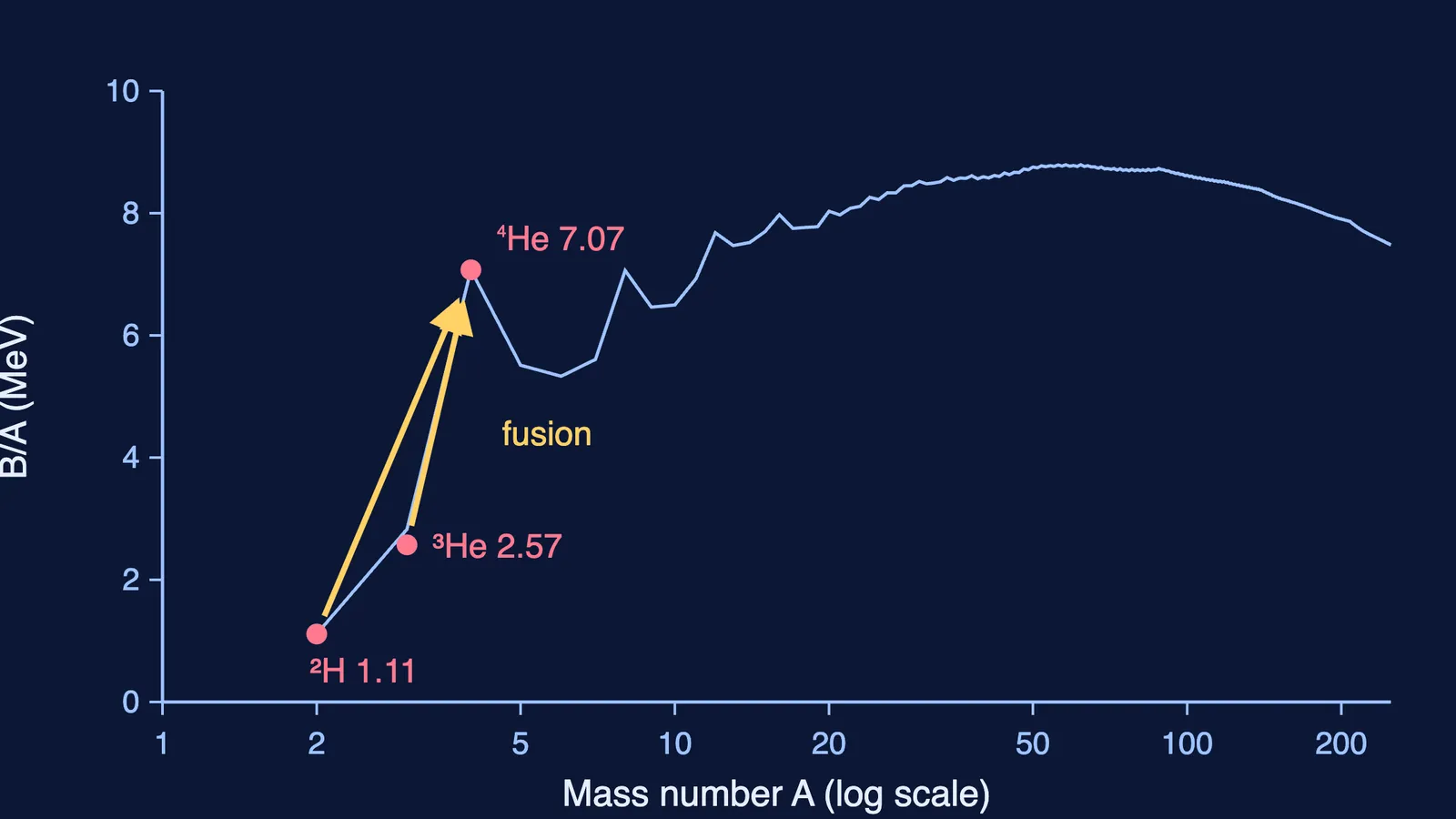
Q6 (medium). Binding energy per nucleon is 1.11 MeV for ²H, 2.57 MeV for ³He and 7.07 MeV for ⁴He. In the fusion ³He + ²H → ⁴He + ¹H, the energy released is about
(A) 3.39 MeV (B) 18.3 MeV (C) 19.5 MeV (D) 38.2 MeV
Answer: (B). The free proton has no binding energy. Total binding energy goes from 3 × 2.57 + 2 × 1.11 = 9.93 MeV to 4 × 7.07 = 28.28 MeV, so about 18.3 MeV is released. These values match the AME2020 atomic mass evaluation. Trap: (A) subtracts the per-nucleon values directly; (C) counts the deuteron's 1.11 MeV once instead of twice.
Hard: can you chain two steps?
Q7 (hard). A reactor produces 300 MW of thermal power, all from fission of uranium-235, at 200 MeV per fission. Take 1 MeV = 1.6 × 10⁻¹³ J and N_A = 6.0 × 10²³ mol⁻¹. About how much uranium-235 does it use in one day?
(A) 3.7 mg (B) 1.35 g (C) 320 g (D) 3.2 × 10⁵ kg
Answer: (C). Fissions per second = 3 × 10⁸/(200 × 1.6 × 10⁻¹³) = 9.4 × 10¹⁸. In 86,400 s that is 8.1 × 10²³ nuclei, or 1.35 mol, and 1.35 × 235 g ≈ 317 g. Trap: (A) is the mass used per second, not per day.
Q8 (hard). Atomic masses: ¹H 1.007825 u, neutron 1.008665 u, ²H 2.014102 u. With 1 u = 931.5 MeV/c² and hc = 1240 MeV fm, the longest-wavelength gamma photon that can split a deuteron into a proton and a neutron has wavelength about
(A) 5.6 × 10⁻¹³ m (B) 1.1 × 10⁻¹² m (C) 2.8 × 10⁻¹³ m (D) 5.6 × 10⁻⁷ m
Answer: (A). Mass defect = 1.007825 + 1.008665 − 2.014102 = 0.002388 u, so the binding energy is 0.002388 × 931.5 ≈ 2.22 MeV. The photon must carry at least that: λ = 1240/2.22 ≈ 558 fm = 5.6 × 10⁻¹³ m. Trap: (B) uses the binding energy per nucleon, 1.11 MeV, but the whole bond must break.
What should you do after this set?
Sort your misses: definitions and size (Q1 to Q3), one-step energy reasoning (Q4 to Q6) or two-step chains (Q7, Q8). Rework that kind for two days, then retry both sets.
If you choose the right formula but the wrong method, the Fermi Problem Library has worked problems with a step-by-step solver that explains the reasoning rather than printing an answer.


