

On this page
Statement and match-the-list questions appear in recent JEE Main papers. Here are eight original Atoms and Nuclei ones, easy to hard.
What do these Atoms and Nuclei questions cover?
All fit Unit 18 of the NTA's Syllabus for JEE (Main) 2027. It omits radioactivity, so nothing tests decay law. All follow NCERT Atoms and Nuclei (Reprint 2026-27). The JEE (Main) 2027 information bulletin marks MCQs +4 or −1. New to the chapter? Read how to prepare Atoms and Nuclei for JEE Main.
Take En = −13.6Z²/n² eV and hc = 1240 eV nm. Binding energies per nucleon (MeV), rounded from the AME2020 mass evaluation: ²H 1.112, ³H 2.827, ⁴He 7.074, ¹²C 7.680, ¹⁶O 7.976, ³²S 8.493.
Statement questions
Options for Q1 and Q3: (1) Both correct (2) Both incorrect (3) I correct, II incorrect (4) I incorrect, II correct.
Q1 (easy, Statement I/II). Statement I: Every hydrogen line ending on n = 2 lies between 400 and 700 nm. Statement II: Every line ending on n = 3 is longer than every line ending on n = 2.
Answer: (4). I is incorrect: the n = 2 limit is 1240/3.4 ≈ 365 nm, ultraviolet. II is correct: the shortest n = 3 line, 1240/1.51 ≈ 821 nm, beats the longest n = 2 line, 656 nm.
Trap: (1) equates "ends on n = 2" with "visible".
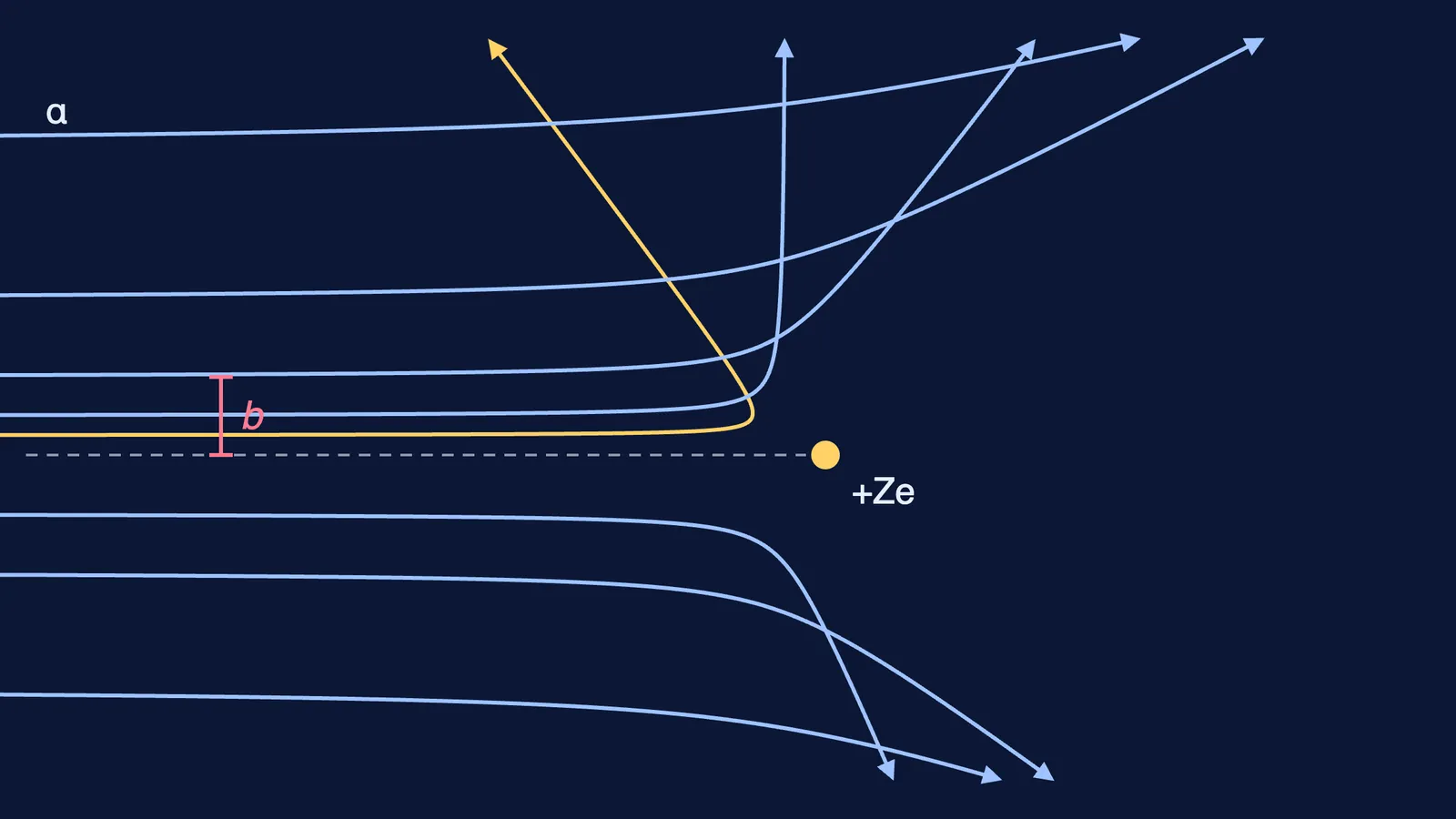
Q2 (medium, statements). In the Geiger-Marsden experiment, which are correct? A. A smaller impact parameter gives a larger scattering angle. B. At equal impact parameter, a larger-Z nucleus deflects it through a larger angle. C. Atomic electrons noticeably deflect the alpha particles. D. An alpha particle's angular momentum about the nucleus stays constant. E. Off-centre, the alpha particle is momentarily at rest at closest approach.
(1) A, B, D and E only (2) A, B and D only (3) A, C and D only (4) B, D and E only
Answer: (2). A: NCERT's trajectories. B: stronger repulsion bends the path more. C is false: electrons are too light. D: the Coulomb force points at the nucleus, so no torque. E is false: by D, it still moves sideways.
Trap: (1) stops every particle, not just head-on ones.
Q3 (medium, Statement I/II). Statement I: D + T → ⁴He + n releases about 17.6 MeV. Statement II: Per kilogram of fuel (masses 2.014 u, 3.016 u, 235.04 u), this gives about four times the energy of uranium-235 fission (200 MeV each).
Answer: (1). I: 4 × 7.074 − 2 × 1.112 − 3 × 2.827 = 17.59 MeV. II: 17.59/5.030 = 3.50 MeV per u against 200/235.04 = 0.85; ratio 4.1.
Trap: (3) compares per reaction.
Q4 (hard, statements). 50 eV electrons strike ground-state He⁺ (Z = 2), each ion at most once. Which are correct? A. Some ions reach n = 3; none reach n = 4. B. Exactly two emitted lines end on n = 1. C. The 3 → 2 line is visible, like hydrogen's. D. Photons of 50 eV would also raise ions to n = 3. E. An electron exciting n = 3 keeps about 1.6 eV.
(1) A, B, C and E only (2) A, D and E only (3) A, B and E only (4) B, C and D only
Answer: (3). Eₙ = −54.4/n² eV. A: E₃ − E₁ = 48.4 eV; E₄ − E₁ = 51.0 eV. B: 3 → 1 and 2 → 1; 3 → 2 ends on n = 2. C is false: 1240/7.56 ≈ 164 nm, ultraviolet. D is false: 50 eV matches no gap and cannot ionise (54.4 eV). E: 50 − 48.4, neglecting recoil.
Trap: (1) forgets Z² = 4 shrinks every wavelength.
Match-the-list questions
Q5 (easy, match). Hydrogen. List-I: A. Energy to excite n = 2 to n = 5; B. Energy to ionise from n = 5; C. Photon from 4 → 3; D. Photon from 3 → 2. List-II: I. 1.89 eV; II. 0.661 eV; III. 2.86 eV; IV. 0.544 eV.
(1) A-III, B-IV, C-I, D-II (2) A-III, B-IV, C-II, D-I (3) A-I, B-IV, C-III, D-II (4) A-III, B-II, C-IV, D-I
Answer: (2). A-III: 13.6(1/4 − 1/25). B-IV: 13.6/25. C-II: 13.6(1/9 − 1/16). D-I: 13.6(1/4 − 1/9).
Trap: (1) gives the higher jump the bigger photon.
Q6 (medium, match). Hydrogen transitions. List-I: A. 5 → 4; B. 4 → 1; C. 6 → 3; D. 7 → 4. List-II: I. 1094 nm; II. 97.3 nm; III. 2166 nm; IV. 4052 nm.
(1) A-IV, B-II, C-III, D-I (2) A-II, B-IV, C-I, D-III (3) A-IV, B-II, C-I, D-III (4) A-IV, B-I, C-II, D-III
Answer: (3). ΔE: A 13.6(1/16 − 1/25) = 0.306 eV, B 12.75 eV, C 13.6(1/9 − 1/36) = 1.13 eV, D 13.6(1/16 − 1/49) = 0.572 eV; then λ = 1240/ΔE.
Trap: (1) assumes a higher start means a shorter wavelength.
Q7 (hard, match). With the binding energies above: List-I: A. ²H + ²H → ⁴He; B. ¹⁶O → 4 ⁴He; C. ³²S → 2 ¹⁶O; D. ¹²C + ⁴He → ¹⁶O. List-II: I. Absorbs 16.5 MeV; II. Releases 7.16 MeV; III. Releases 23.8 MeV; IV. Absorbs 14.4 MeV.
(1) A-III, B-I, C-IV, D-II (2) A-II, B-IV, C-I, D-III (3) A-III, B-II, C-I, D-IV (4) A-III, B-IV, C-I, D-II
Answer: (4). Energy released = binding energy after − before. A-III: 28.30 − 4.45. B-IV: 113.18 − 127.62. C-I: 255.23 − 271.78. D-II: 127.62 − 92.16 − 28.30.
Trap: (1) swaps the absorptions.
Q8 (hard, match). Ratio Li²⁺ (Z = 3, n = 2) : hydrogen (n = 1). List-I: A. Orbit radius; B. Orbital speed; C. Magnitude of total energy; D. Revolution frequency. List-II: I. 9/8; II. 4/3; III. 9/4; IV. 3/2.
(1) A-II, B-IV, C-III, D-I (2) A-IV, B-II, C-III, D-I (3) A-II, B-IV, C-I, D-III (4) A-III, B-IV, C-II, D-I
Answer: (1). A-II: r ∝ n²/Z. B-IV: v ∝ Z/n. C-III: |E| ∝ Z²/n². D-I: f = v/2πr ∝ Z²/n³.
Trap: (3) scales frequency like energy, as Z²/n².
How do you work these Atoms and Nuclei questions faster?
Keep the powers ready: r ∝ n²/Z, v ∝ Z/n, |E| ∝ Z²/n², f ∝ Z²/n³.
For wavelengths, divide 1240 by ΔE in eV.
Multiply each binding energy per nucleon by A before subtracting.
Can't picture Q2's paths? The Fermi Simulation Lab has interactive simulations for the ideas that are easier to see than to read.
For longer numericals, try our Atoms and Nuclei JEE Main practice questions.


