

On this page
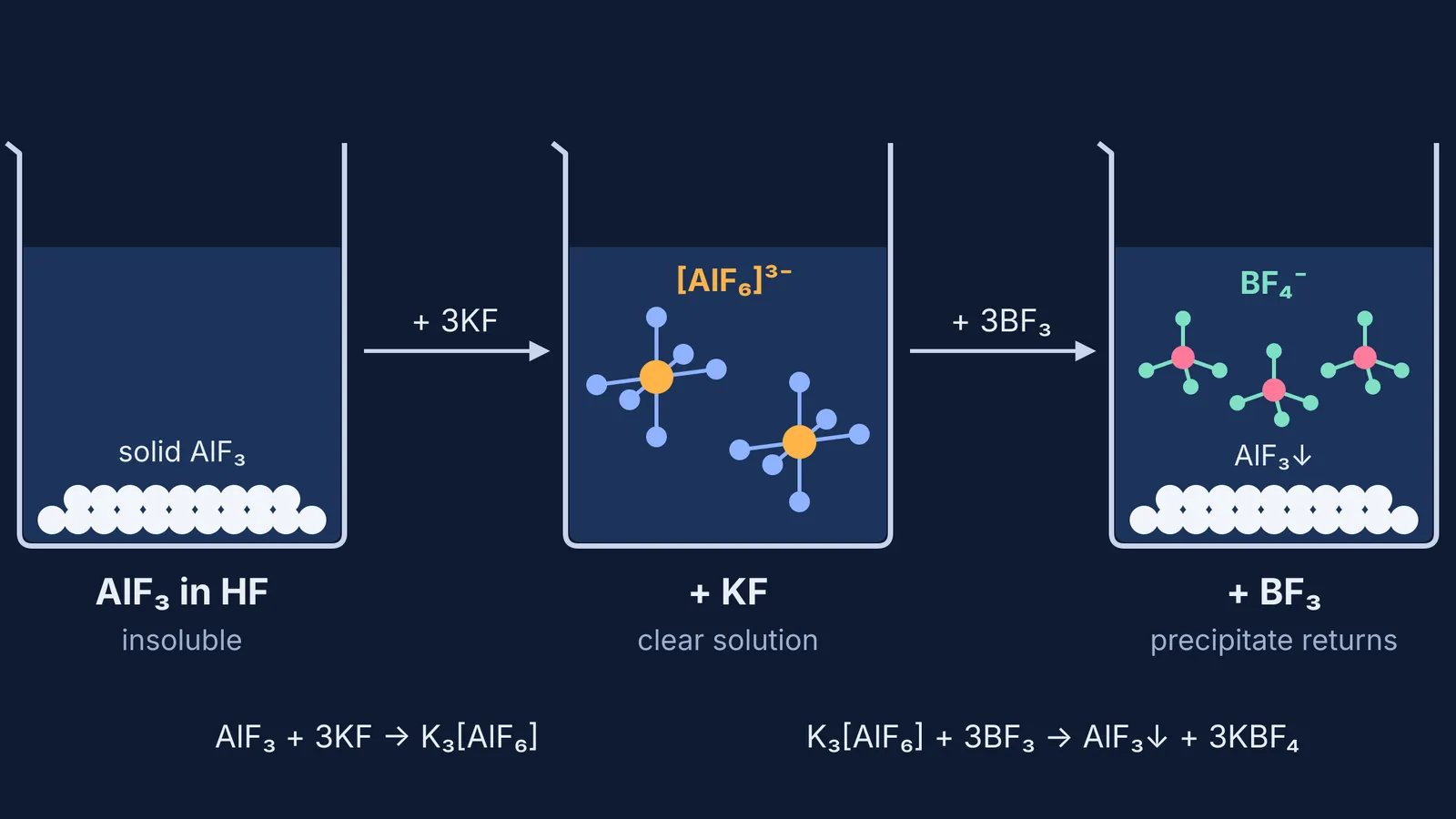
Aluminium fluoride is a white solid that will not dissolve in anhydrous liquid HF, even though HF is full of fluorine. Add potassium fluoride and it dissolves at once. Now bubble boron trifluoride through that clear solution, and the AlF₃ comes straight back out as a precipitate. Each step is a contest for fluoride ions, and the two steps together make a favourite JEE assertion–reason question.
Why doesn't AlF₃ dissolve in anhydrous HF?
Solid AlF₃ is not made of separate AlF₃ molecules. It is a three-dimensional network in which every Al³⁺ sits at the centre of an octahedron of six F atoms, and every F bridges two Al atoms. So Al is already six-coordinate in the solid, and breaking the network means breaking many strong Al–F bonds at once. Do not draw solid AlF₃ as a flat trigonal molecule like BF₃.
To dissolve, the network has to be broken into separate ions, and the only way to do that here is to hand each Al extra fluoride so it becomes a discrete [AlF₆]³⁻ ion. Pure HF cannot do this. It is a covalent liquid that ionises only very slightly:
3HF ⇌ H₂F⁺ + HF₂⁻
The concentration of fluoride donor (HF₂⁻) in pure HF is tiny, so there is nothing to pull F⁻ onto the aluminium. HF is a poor fluoride donor, and AlF₃ stays put.
What does KF do to AlF₃ in liquid HF?
KF is an ionic fluoride, and in liquid HF it behaves as a base. It dissolves and raises the concentration of the fluoride donor:
KF + HF → K⁺ + HF₂⁻
Strictly, the fluoride is carried as HF₂⁻, not as free F⁻ coming from HF itself. That HF₂⁻ attacks the AlF₃ network:
AlF₃ + 3HF₂⁻ → [AlF₆]³⁻ + 3HF
Check: 1 Al, 9 F and 3 H on each side, and a charge of −3 on both sides. Adding K⁺ back in, the overall equation is the one you write in an exam:
AlF₃ + 3KF → K₃[AlF₆]
The coordination number of Al does not change. It is 6 in the solid and 6 in [AlF₆]³⁻. What changes is that the six fluorides now belong to one aluminium each instead of being shared, so the network falls apart into soluble ions.
Aluminium can hold six fluorides around it because it is a larger atom than boron, which stops at four. That covalency contrast is summarised in why the first member of each group behaves anomalously.
Why does BF₃ bring the AlF₃ back?
BF₃ is a fluoride acceptor. Boron has an empty 2p orbital and forms very strong B–F bonds, so BF₃ grabs F⁻ to become the tetrahedral BF₄⁻ ion. When BF₃ is passed into the solution, it pulls fluoride away from [AlF₆]³⁻:
[AlF₆]³⁻ + 3BF₃ → AlF₃↓ + 3BF₄⁻
Or, with the potassium ions:
K₃[AlF₆] + 3BF₃ → AlF₃↓ + 3KBF₄
Check: 3 K, 1 Al, 3 B and 15 F on each side.
The usual exam reason is "BF₃ is a stronger Lewis acid than AlF₃". In this system that is fair if you read it narrowly: BF₃ is the stronger fluoride acceptor under these conditions. Two things push the reaction forward together. First, three B–F bonds form in BF₄⁻, and B–F bonds are among the strongest single bonds. Second, AlF₃ that loses its extra fluorides does not stay in solution: it falls back into its stable polymeric lattice, which removes it from the equilibrium. Do not stretch the statement into a general ranking such as "BF₃ is a stronger Lewis acid than AlCl₃" for every reaction. Lewis acid strength depends on which base you test with.
Notice the coordination changes. Aluminium is six-coordinate at every stage: in solid AlF₃, in [AlF₆]³⁻, and again in the precipitate. Boron goes from 3 in BF₃ to 4 in BF₄⁻, which is the most it can manage, since it has only one s and three p orbitals in its valence shell. For why BF₃ is electron-poor in the first place, see Lewis acidity of boron trihalides.
Worked example: amounts and the assertion–reason pair
Question. 4.20 g of AlF₃ is suspended in anhydrous HF. (a) What mass of KF is needed to dissolve it completely? (b) What mass of BF₃ then re-precipitates all the AlF₃, and what mass of KBF₄ forms? Use approximate molar masses: Al 26.98, F 19.00, K 39.10, B 10.81 g/mol.
Step 1: moles of AlF₃. Molar mass of AlF₃ = 26.98 + 3 × 19.00 ≈ 83.98 g/mol. Moles = 4.20 ÷ 83.98 ≈ 0.0500 mol.
Step 2: moles of KF. AlF₃ + 3KF → K₃[AlF₆], so 3 mol KF per mol AlF₃. Moles of KF = 3 × 0.0500 = 0.150 mol.
Step 3: mass of KF. Molar mass of KF ≈ 58.10 g/mol. Mass = 0.150 × 58.10 ≈ 8.72 g. This forms 0.0500 mol K₃[AlF₆], about 12.9 g.
Step 4: moles of BF₃. K₃[AlF₆] + 3BF₃ → AlF₃ + 3KBF₄, so again 3 mol per mol of complex: 0.150 mol BF₃.
Step 5: mass of BF₃. Molar mass ≈ 10.81 + 57.00 = 67.81 g/mol. Mass = 0.150 × 67.81 ≈ 10.2 g.
Step 6: products. All 4.20 g of AlF₃ comes back. KBF₄ (≈ 125.9 g/mol) formed = 0.150 × 125.9 ≈ 18.9 g.
Step 7: coordination check. Al: 6 → 6 → 6. B: 3 → 4.
The assertion–reason pair built from these steps usually reads like this:
Assertion: AlF₃ is insoluble in anhydrous HF but dissolves when KF is added. Reason: KF supplies fluoride, which converts the polymeric AlF₃ into the soluble complex K₃[AlF₆]. Both are true, and the reason explains the assertion.
Assertion: Passing BF₃ through the solution precipitates AlF₃. Reason: BF₃ is the stronger fluoride acceptor here and takes fluoride from [AlF₆]³⁻ to form BF₄⁻. Again both true, and the reason is the correct explanation.
If a version says the reason is "HF is a strong acid", mark that reason false. HF is a weak fluoride donor, which is the whole point.
How does this link to cryolite in aluminium extraction?
Cryolite is Na₃[AlF₆], the sodium version of the same hexafluoroaluminate complex. In the Hall–Héroult process, alumina is dissolved in molten cryolite, which lowers the melting point of the mixture and makes it conduct. The [AlF₆]³⁻ ion you met in HF solution is the same one that does this job industrially. The electrolysis itself is covered in why aluminium is extracted by electrolysis.
If the octahedron and tetrahedron are hard to picture, the Concept Library covers coordination numbers and shapes concept by concept.
Quick checklist
Solid AlF₃ is polymeric with six-coordinate Al, not a trigonal molecule.
Pure HF is a poor fluoride donor, so AlF₃ does not dissolve.
KF in HF supplies HF₂⁻; AlF₃ + 3KF → K₃[AlF₆] dissolves.
BF₃ takes fluoride back: K₃[AlF₆] + 3BF₃ → AlF₃↓ + 3KBF₄.
Al stays 6-coordinate; B goes from 3 to 4.
3 mol KF and 3 mol BF₃ per mol of AlF₃.


