

On this page
Your s-block chapter says lithium chloride dissolves in organic solvents and sodium chloride does not. In 1913 William Ernest Stephen Turner and Crellyn Colgrave Bissett, of the Chemistry Department at the University of Sheffield, put numbers on it. At 25 °C, 100 g of ethanol dissolved 25.83 g of LiCl but only 0.065 g of NaCl: about 400 times more by mass. They also found that below 17.4 °C lithium chloride comes out of ethanol not as LiCl but as crystals of LiCl·4C₂H₅OH, an alcohol version of a hydrate (Turner and Bissett, J. Chem. Soc. Trans. 1913, 103, 1904).
What did Turner and Bissett measure?
They studied eight alkali halides: LiCl, LiI, NaCl, NaI, KCl, KBr, KI and RbCl. They dried the alcohols carefully, shook excess salt with each at 25 °C, usually for nine or ten days, and found the dissolved halide by titration with standard silver and thiocyanate solutions.
Their table, in grams of anhydrous salt per 100 g of solvent at 25 °C (the water column they took from earlier workers):
LiCl: water 83.37, methanol 42.36, ethanol 25.83, propanol 16.22, isoamyl alcohol 9.03.
NaCl: water 36.05, methanol 1.31, ethanol 0.065, propanol 0.012, isoamyl alcohol 0.002.
KCl: water 39.90, methanol 0.53, ethanol 0.022, propanol 0.004, isoamyl alcohol 0.0008.
RbCl: water 94.35, methanol 1.41, ethanol 0.078, propanol 0.015, isoamyl alcohol 0.0025.
They drew three regularities:
Solubility falls from water along the alcohol series. The only breaks are for lithium iodide, and they point out that those values belong to different solids (LiI·3H₂O in water, LiI·4C₃H₇OH in propanol).
In every solvent, chloride < bromide < iodide.
LiCl > NaCl > RbCl > KCl in all five solvents. Rubidium chloride sits out of the simple size order.
How much more soluble is LiCl than NaCl in alcohol?
Divide the rows. By mass, LiCl is more soluble than NaCl by:
2.3 times in water;
32 times in methanol;
397 times in ethanol.
In water the two are close. The gap opens as the solvent becomes less like water, and any explanation has to fit that.
Why does LiCl dissolve in alcohol when NaCl does not?
The textbook answer is covalent character. Li⁺ is the smallest alkali metal ion (ionic radius about 76 pm, against about 102 pm for Na⁺), so it polarises the chloride ion's electron cloud more. By Fajans' rules, LiCl has more covalent character than NaCl, and a less ionic compound is expected to suit a less polar solvent. The idea itself came ten years after this paper, as told in Kazimierz Fajans and his 1923 polarisation rules.
That is half the story. The other half is in Turner and Bissett's own solids:
The small Li⁺ ion binds solvent oxygen strongly. Ethanol's O atom has lone pairs, just like water's. A small ion with a high charge density (z/r is about 1.3 times that of Na⁺) is solvated strongly by those lone pairs. The energy released helps pay for breaking the lattice.
The proof is the alcoholate. LiCl·4C₂H₅OH is a crystal in which four ethanol molecules are held per LiCl, just as water is held in a hydrate. No solvate of NaCl turned up in their work. They also noted that "considerable heat was disengaged by the lithium salts and sodium iodide on solution in the various alcohols", which fits strong solvation.
Turner and Bissett offered neither explanation; they reported the data. In an exam, write covalent character, the expected answer, and add strong solvation of small Li⁺ if there is space. Only solvation explains why a solid alcoholate exists. For the same small-ion solvation showing up in water, see why lithium has anomalous properties.
What is LiCl·4C₂H₅OH?
It is the solid that crystallises from ethanol below 17.4 °C. A solution saturated at 25 °C dropped crystals at the laboratory temperature of about 14–15 °C. Analysis gave 18.73% LiCl at 0 °C and 18.48% at 17.1 °C; the formula LiCl,4C₂H₆O needs 18.71%.
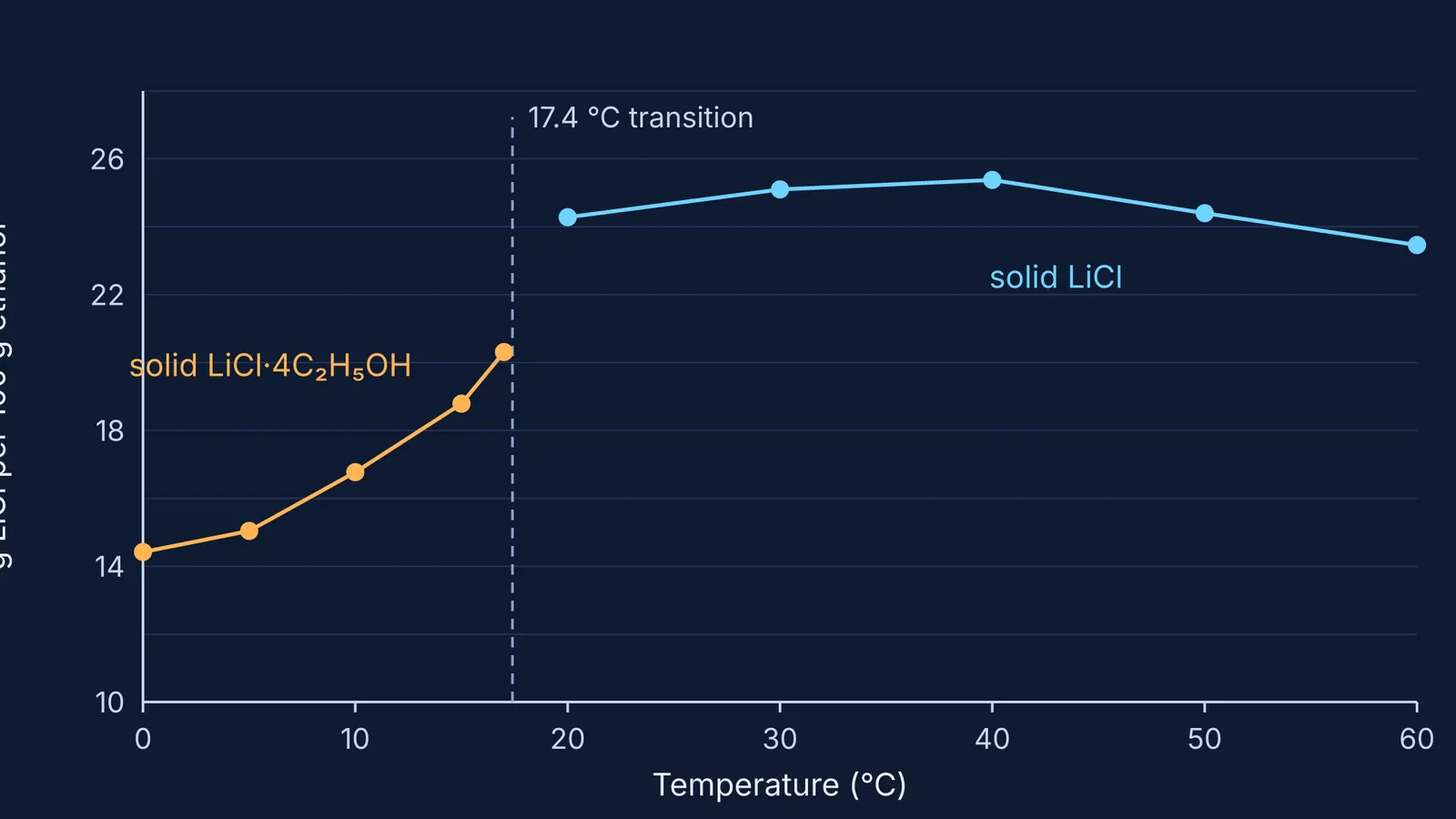
They traced the solubility of LiCl in ethanol from 0 to 60 °C (grams per 100 g ethanol):
Solid LiCl·4C₂H₅OH: 14.42 at 0 °C, 15.04 at 5 °C, 16.77 at 10 °C, 18.79 at 15 °C, 20.31 at 17 °C.
Solid anhydrous LiCl: 24.28 at 20 °C, 25.10 at 30 °C, 25.38 at 40 °C, 24.40 at 50 °C, 23.46 at 60 °C.
The two branches meet at the transition point. At 17.1 °C the solid in the flask was the alcoholate; at 17.6 °C anhydrous LiCl grew at its expense. So LiCl·4C₂H₅OH ⇌ LiCl + 4C₂H₅OH turns over at about 17.4 °C. This has the same shape as the curve for Glauber's salt, Na₂SO₄·10H₂O, which loses its water to anhydrous Na₂SO₄ at about 32 °C.
Note that their curve, read by straight line between 20 and 30 °C, gives about 24.7 g at 25 °C, about 4% below the 25.83 g of their 25 °C table, which was measured by a different method.
Worked example: finding the solvate formula from % composition
A solid from ethanol contains 18.73% LiCl. Find n in LiCl·nC₂H₅OH. (M: LiCl 42.39, C₂H₅OH 46.07.)
Take 100 g of solid. 18.73 g LiCl and 81.27 g ethanol.
Moles. LiCl: 18.73 ÷ 42.39 = 0.4419 mol. Ethanol: 81.27 ÷ 46.07 = 1.764 mol.
Ratio. 1.764 ÷ 0.4419 = 3.99, so n = 4.
Check backwards. LiCl·4C₂H₅OH: 42.39 ÷ (42.39 + 4 × 46.07) × 100 = 18.70% LiCl (their figure: 18.71). LiCl·3C₂H₅OH would need 23.47%.
The same check works for their other two solvates:
LiI·4C₃H₇OH: calculated 35.77% LiI (they give 35.78); found 35.52.
NaI·3CH₃OH: calculated 60.93% NaI (they give 60.95); found 61.96. It is high because, as they say, the crystals effloresce quickly in air, and lost methanol raises the share of NaI.
Worked example: from grams per 100 g to molality
LiCl in ethanol at 25 °C: 25.83 g per 100 g ethanol is 25.83 ÷ 42.39 = 0.6093 mol per 100 g, so 6.09 mol kg⁻¹. NaCl: 0.065 ÷ 58.44 = 0.00111 mol per 100 g, or 0.0111 mol kg⁻¹. By moles the ratio is about 550. The mole fraction of LiCl in the saturated solution is 0.609 ÷ (0.609 + 2.171) = 0.22.
Where is this on the JEE and NEET syllabus?
Class 11, s-block elements: the anomalous behaviour of lithium, including LiCl's solubility in organic solvents and its tendency to form hydrates.
Class 11, Some basic concepts: % composition and formula of a hydrate or solvate.
Class 12, Solutions: converting g per 100 g solvent to molality, mole fraction and mass percent. Their own check: 9.03 g LiCl in 100 g isoamyl alcohol is 9.03 ÷ 109.03 = 8.28%, which matches the 8.29% they quote when comparing with an earlier study.
To see how ion size, charge density and polarisation fit together, the Concept Library covers every concept in chemistry.
Quick checklist
At 25 °C, LiCl is about 400 times more soluble than NaCl in ethanol by mass, but only 2.3 times in water.
Below 17.4 °C, LiCl crystallises from ethanol as LiCl·4C₂H₅OH (18.70% LiCl).
Covalent character (Fajans) is the textbook reason; strong solvation of small Li⁺ explains the alcoholate too.
Solvate formula: take 100 g, find moles, divide, then check the % backwards.
Solubility falls from water to methanol to ethanol to propanol, and chloride < bromide < iodide.


