

On this page
In 1909 two chemists at the Public Analyst's Office in Swansea, C. A. Seyler and P. V. Lloyd, left marble, limestone, calcite and aragonite in stoppered bottles of carbonic acid for weeks and measured what dissolved. Their result is the law behind a line you may have met in our post on why CaCO₃ dissolves more in water than √Ksp predicts: the dissolved limestone rises only as the cube root of the CO₂. They also showed that calcium sulphate already in the water makes limestone dissolve less.
What did Seyler and Lloyd measure?
The paper is C. A. Seyler and P. V. Lloyd, "Studies of the Carbonates. Part I. The Equilibrium between Calcium Carbonate and Carbonic Acid", J. Chem. Soc. Trans. 95 (1909) 1347–1352. We read it in the scanned 1909 volume and checked every number we quote against the page images.
Their method was simple:
Powdered carbonate sat in completely filled stoppered bottles of carbonic acid, with or without added salts, at laboratory temperature. Equilibrium took "several weeks".
They titrated the dissolved carbonate (as bicarbonate) with N/20 acid and methyl orange.
They titrated the free carbonic acid with N/20 sodium carbonate and phenolphthalein.
The law was not theirs: they credit Schlösing's experiments and Bodländer's 1900 derivation. They tested it by a different method and extended it to waters that already contain other salts.
What is the cube law for limestone and CO₂?
Start from the overall reaction, which balances in atoms and charge:
CaCO₃(s) + CO₂(aq) + H₂O ⇌ Ca²⁺ + 2HCO₃⁻
Its equilibrium constant is K = [Ca²⁺][HCO₃⁻]² ÷ [CO₂]. If the only calcium comes from the dissolved limestone, every Ca²⁺ brings two HCO₃⁻, so [HCO₃⁻] = 2[Ca²⁺]. Substitute:
K = [Ca²⁺] × 4[Ca²⁺]² ÷ [CO₂], so 4[Ca²⁺]³ = K[CO₂].
By Henry's law, [CO₂] is proportional to p(CO₂), so [Ca²⁺]³ ∝ p(CO₂).
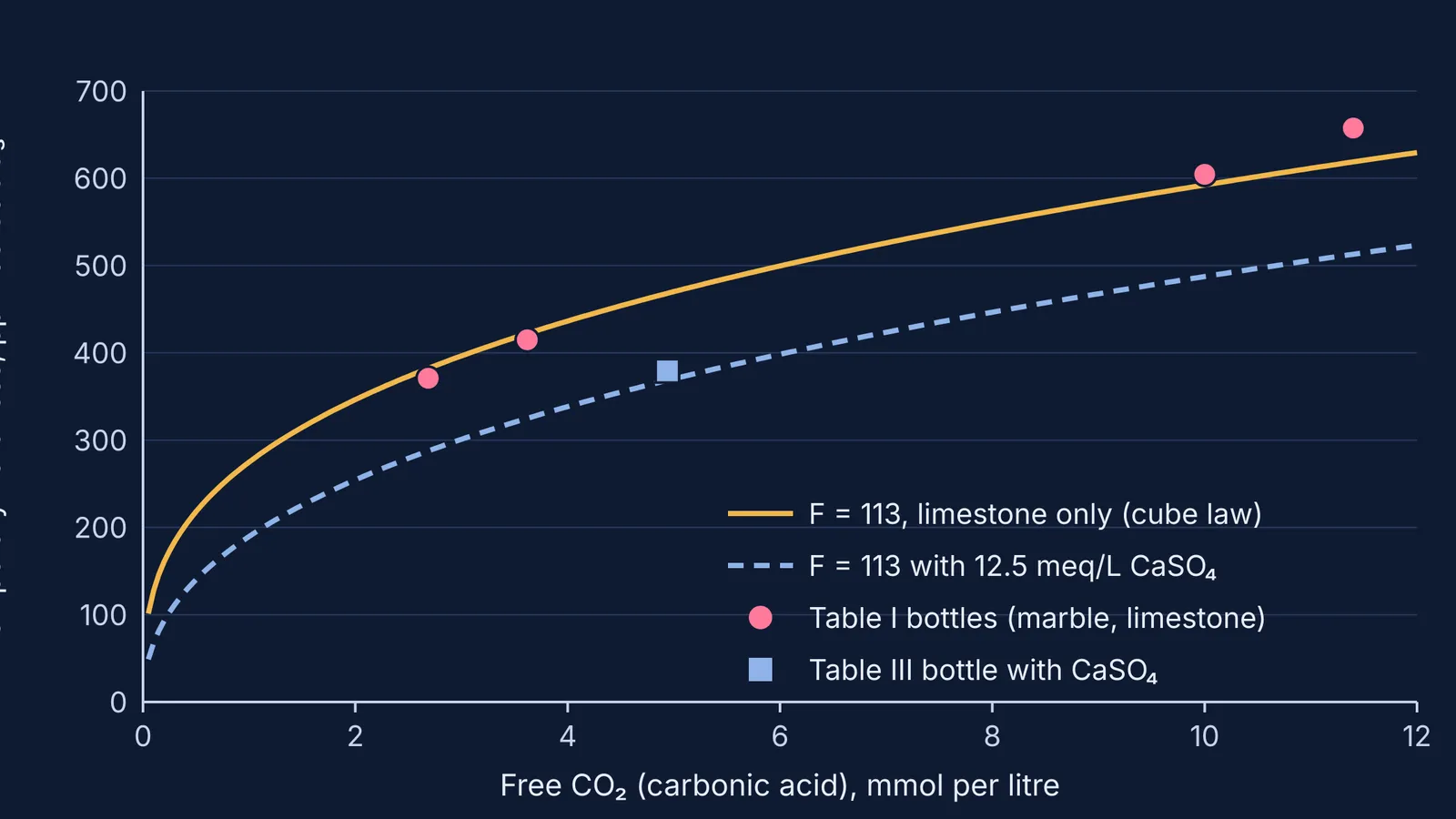
Seyler and Lloyd wrote the same thing in their own symbols (page 1349): HCO₃² × 2Ca ÷ H₂CO₃ = F × 10⁻⁶. Here concentrations are in gram-molecules per litre, "H₂CO₃" means the free carbonic acid, and only the ionised part of the bicarbonate is counted. They called F the "saturation factor". Their mean for calcite was about 113: "If less than 113, the water is not saturated, if over 113 it is supersaturated."
In plain words (their conclusion 4b): "The cube of the temporary hardness (dissolved limestone) is directly as the free carbonic acid."
Worked example: from their marble bottle to hardness in ppm
Work in millimoles per litre (mmol/L), so F × 10⁻⁶ in mol/L becomes just F.
Read Table I, first marble bottle (43 days). Free carbonic acid = 2.687 mmol/L. Total calcium = 7.41 milliequivalents per litre. Their degree of ionisation = 0.88.
Ionised bicarbonate. 7.41 × 0.88 = 6.52 mmol/L. With no other calcium, 2[Ca²⁺] equals [HCO₃⁻], so the law becomes [HCO₃⁻]³ ÷ [H₂CO₃] = F.
Check F. 6.52³ ÷ 2.687 = 103.2. They printed 103.1. Their four Table I bottles give 103.1, 107.0, 116.1 and 126.5, an average of 113.
Hardness. 7.41 meq/L of calcium is 3.705 mmol/L of Ca²⁺. As CaCO₃ (100.09 g/mol) that is 3.705 × 100.09 = 371 mg/L, or 371 ppm, all of it temporary hardness. For the ppm convention see how to calculate hardness of water in ppm of CaCO₃.
Predict a new water. Take F = 113 and 1.00 mmol/L of free CO₂. Ionised HCO₃⁻ = (113 × 1.00)^(1/3) = 4.83 mmol/L. Using 0.88 ionisation (our assumption, read from their tables), total HCO₃⁻ = 5.49 mmol/L, Ca²⁺ = 2.75 mmol/L, hardness ≈ 275 ppm as CaCO₃.
Double the CO₂. Hardness rises by 2^(1/3) = 1.26 times, to about 346 ppm. Four times the CO₂ gives only 4^(1/3) = 1.59 times, about 436 ppm.
A word of caution. Their ionisation values come from conductivity, the Arrhenius method of the time, not from modern activities. Do not compare F directly with a modern Ksp × Ka₁ ÷ Ka₂.
Why does permanent hardness make limestone dissolve less?
Ca²⁺ is a common ion. If the water already carries CaSO₄ or CaCl₂, the [Ca²⁺] term in K is larger before any limestone dissolves, so less HCO₃⁻ is needed to reach equilibrium. Seyler and Lloyd stated it as rule (c): "The square of the temporary hardness (dissolved limestone) is directly as the free carbonic acid and inversely as the total hardness."
Their Table III tested this with calcium sulphate from 2.382 to 12.5 meq/L, which they put at about 8.4 and 44 degrees of permanent hardness on Clark's scale. The average F was again 113.
Check the last row yourself. Free carbonic acid 4.94 mmol/L, ionised HCO₃⁻ 6.80, total ionised calcium 13.61 meq/L. Then F = 6.80² × 13.61 ÷ 4.94 = 127.4 (printed 127). Without the sulphate, F = 113 would allow (113 × 4.94)^(1/3) = 8.23 mmol/L of ionised bicarbonate, or about 9.36 total. They found 7.58, about 19% less.
To see the trend, keep 1.00 mmol/L of CO₂ and add P meq/L of ionised permanent calcium. Solve x²(x + P) = 113 for the ionised bicarbonate x:
P = 0: x = 4.83
P = 2: x = 4.25
P = 5: x = 3.62
P = 10: x = 2.95
At P = 10 the water dissolves about 39% less limestone. Salts with no common ion behaved the other way. Sodium chloride, sodium sulphate and magnesium sulphate gave F values of 122 to 152 in Table V, so they slightly increase the solvent action.
If you want to practise equilibrium problems where you must first find the link between ion concentrations, the Fermi Problem Library has a step-by-step solver that explains the reasoning.
Is aragonite more soluble than calcite?
Yes. Because F is proportional to the solubility product, the square roots of F for two forms of CaCO₃ should be in the ratio of their solubilities. In Table VI, after 173 days, calcite gave F = 121.3 and aragonite 163.7. The ratio is 1.35 and its square root is 1.162. Kohlrausch's solubilities at 18° were "as 15 to 13", a ratio of 1.154. Their conclusion: aragonite, "being the more soluble form, must gradually pass into calcite if both forms are present."
Where does this come up in JEE and NEET?
Class 11 Equilibrium: combining constants into one overall K, and the common ion effect on solubility.
Class 11 Hydrogen: temporary hardness is Ca(HCO₃)₂ formed exactly this way; permanent hardness is CaSO₄ or CaCl₂. How boiling or lime removes the temporary part is in Clark's method for removing temporary hardness.
Algebra: if [Ca²⁺] = [HCO₃⁻]/2, a square-times-one expression becomes a cube, so the answer goes as the cube root.
Quick checklist
CaCO₃ + CO₂ + H₂O ⇌ Ca²⁺ + 2HCO₃⁻, with K = [Ca²⁺][HCO₃⁻]²/[CO₂].
Only limestone dissolved: 4[Ca²⁺]³ = K[CO₂], so hardness ∝ cube root of the CO₂.
Doubling CO₂ raises temporary hardness only 1.26 times.
Extra Ca²⁺ from CaSO₄ or CaCl₂ is a common ion and lowers the limestone dissolved.
Convert to ppm as CaCO₃: mmol/L of Ca²⁺ × 100.09.
Seyler and Lloyd tested and extended the law; Schlösing and Bodländer came first.


