On this page
The white crust inside a kettle is temporary hardness leaving water (why kettles get white scale). This post covers the exam version: two ways to remove it, and how much slaked lime a sample needs.
The lime method is named after Thomas Clark, a chemistry professor at Marischal College, Aberdeen, who patented his method of water softening in 1841 by adding a calculated quantity of milk of lime. That word "calculated" is what exam questions test.
What is temporary hardness of water?
Temporary hardness is caused by dissolved calcium bicarbonate and magnesium bicarbonate (Hard water, Wikipedia). Permanent hardness comes from calcium and magnesium sulphates and chlorides, which boiling generally cannot remove (same source).
Hardness is reported as milligrams of calcium carbonate per litre, and the USGS calls water above 180 mg/L very hard. In India, the IS 10500:2012 table on the IIT Kanpur drinking water standards page gives 200 mg/L of hardness as CaCO3 as the permissible limit and 600 mg/L as the maximum limit. If "ppm as CaCO3" feels shaky, start with how to calculate hardness of water in ppm of CaCO3.
How does boiling remove temporary hardness?
Dissolved bicarbonate sits in an equilibrium: CaCO3 + CO2 + H2O ⇌ Ca²⁺ + 2HCO3⁻ (LibreTexts, Hard Water/Descriptive_Chemistry/Main_Group_Reactions/Hard_Water)). Heating breaks bicarbonate down into carbonate, carbon dioxide and water, so the equilibrium shifts left and calcium carbonate settles out as scale (same source). The equation you write is:
Ca(HCO3)2 → CaCO3 + H2O + CO2
Boiling suits a pot of water, not a town's supply.
How does Clark's method use slaked lime?
In Clark's method, slaked lime is added to temporarily hard water and the bicarbonates come out as insoluble solids (Unacademy, Clark's method):
Ca(HCO3)2 + Ca(OH)2 → 2CaCO3 + 2H2O
Mg(HCO3)2 + 2Ca(OH)2 → Mg(OH)2 + 2CaCO3 + 2H2O
The lime raises the pH, turning bicarbonate into carbonate, so calcium carbonate precipitates and magnesium can come out as magnesium hydroxide (Lime softening, Wikipedia). The calcium you add also ends up in the precipitate (same source). Lime is itself a calcium compound, though, so more than the reactions need would add calcium rather than remove it. That is why the amount is worked out, not guessed.
How much lime does a ppm water sample need?
Use these molar masses from PubChem, rounded: CaCO3 100.09, Ca(OH)2 74.09, Ca(HCO3)2 162.11 and Mg(HCO3)2 146.34, so 100, 74, 162 and 146.
Example 1: calcium only
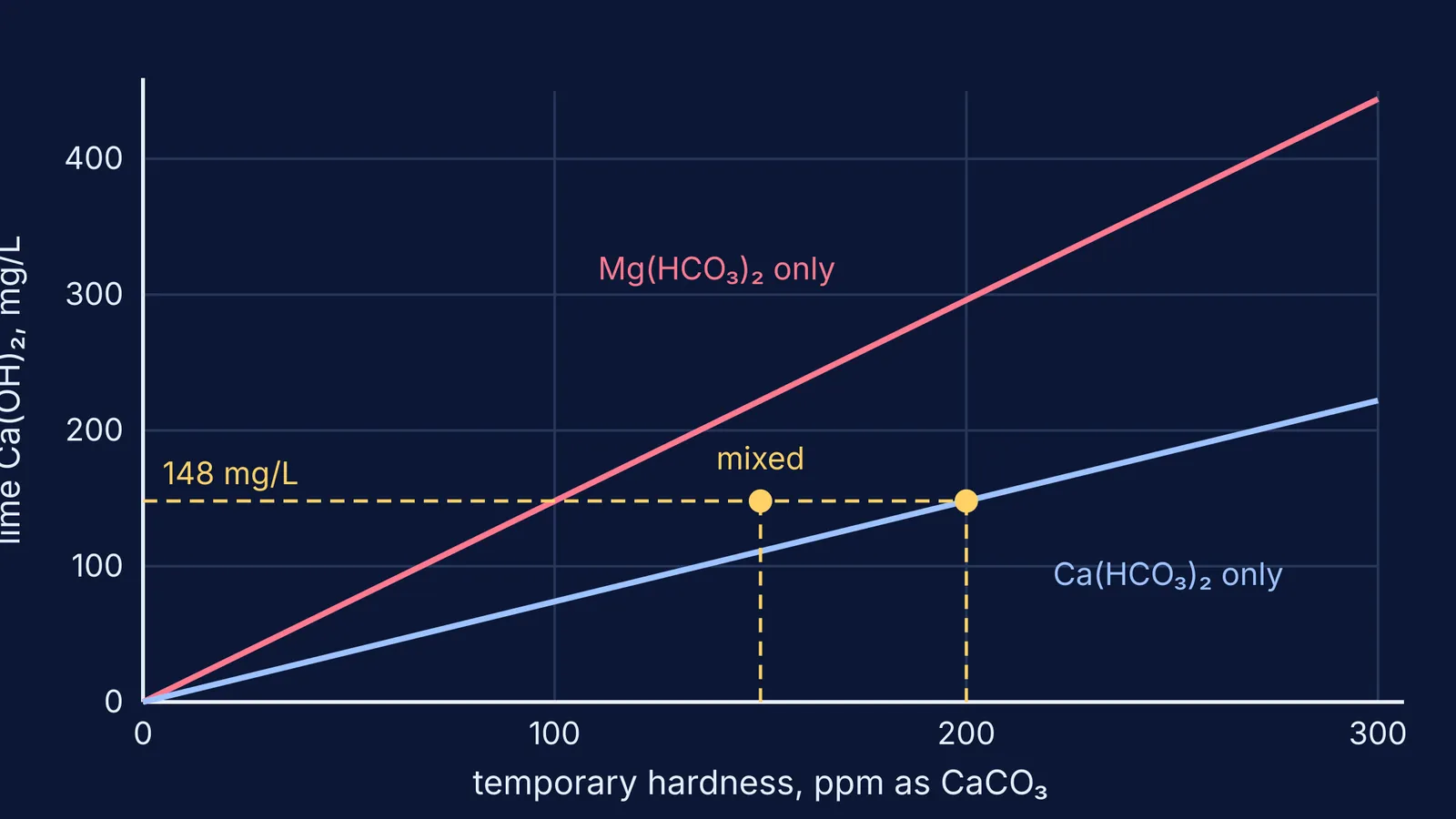
A 1,000 L tank has temporary hardness of 200 ppm as CaCO3, all from calcium bicarbonate.
200 ppm means 200 mg of CaCO3-equivalent per litre, so 200 g in 1,000 L.
200 g ÷ 100 g/mol = 2 mol of Ca(HCO3)2.
The ratio is 1:1, so you need 2 mol of Ca(OH)2.
2 mol × 74 g/mol = 148 g of slaked lime.
Example 2: calcium and magnesium
Each litre holds 162 mg of Ca(HCO3)2 and 73 mg of Mg(HCO3)2.
Calcium: 162 ÷ 162 = 1 mmol, which needs 1 mmol of lime.
Magnesium: 73 ÷ 146 = 0.5 mmol, which needs 2 × 0.5 = 1 mmol of lime.
Total lime: 2 mmol × 74 = 148 mg per litre, or 148 g for 1,000 L.
Hardness for comparison: (1 + 0.5) mmol × 100 = 150 ppm as CaCO3.
The trap: 150 ppm × 74/100 gives 111 mg per litre, which ignores magnesium's double share. A safe shortcut, with both hardness values in ppm as CaCO3:
lime (mg/L) = 0.74 × (calcium hardness + 2 × magnesium hardness)
Lime also reacts with dissolved carbon dioxide, CO2 + Ca(OH)2 → CaCO3 + H2O (Unacademy), so if a question gives free CO2, add lime for it 1:1 by moles.
If you keep dropping the factor of two, the Fermi Problem Library has worked problems with a step-by-step solver that explains the reasoning rather than printing an answer.
Boiling or Clark's method: which should you write?
A quick check before you answer:
Small volume, at home: boiling.
Large volume, "calculated quantity" or "slaked lime" in the question: Clark's method.
Sulphates or chlorides named: neither works, because that is permanent hardness.
Magnesium bicarbonate present: double its lime.
For sulphate and chloride hardness, the next step is washing soda, Calgon and ion exchange. To see where hardness sits among related ideas such as solubility and equilibrium, the Fermi Concept Library gives every concept in chemistry its own lesson and its place in the map.