

On this page
If you inspect an electric kettle after several weeks of use, you will likely find a rough, chalky white crust coating the heating base. While many assume this deposit is dirt or residual chlorine, it is a direct demonstration of inorganic solution chemistry: the thermal decomposition of dissolved minerals in hard tap water. This crust links everyday appliances to chemical equilibrium, solubility rules, and water hardness.
What causes white scale to form inside a kettle?
The white deposit inside a kettle is limescale, predominantly calcium carbonate (CaCO₃). Tap water leaves treatment plants free of visible solids. Instead, groundwater absorbs carbon dioxide (CO₂) from air and soil, forming dilute carbonic acid that dissolves underground limestone into soluble calcium hydrogen carbonate:
CaCO₃(s) + H₂O(l) + CO₂(aq) ⇌ Ca(HCO₃)₂(aq)
Calcium hydrogen carbonate remains completely dissolved and invisible at room temperature. According to the U.S. Geological Survey, water hardness reflects mineral concentration: soft water has 0 to 60 mg/L of calcium carbonate equivalent, moderately hard has 61 to 120 mg/L, hard water has 121 to 180 mg/L, and very hard exceeds 180 mg/L.
In India, the Bureau of Indian Standards standard IS 10500:2012 sets an acceptable total hardness limit of 200 mg/L, permitting up to 600 mg/L in regions without alternate sources. Groundwater in these regions carries high concentrations of dissolved calcium (Ca²⁺) and hydrogen carbonate (HCO₃⁻) ions.
Why does heating hard water trigger precipitation?
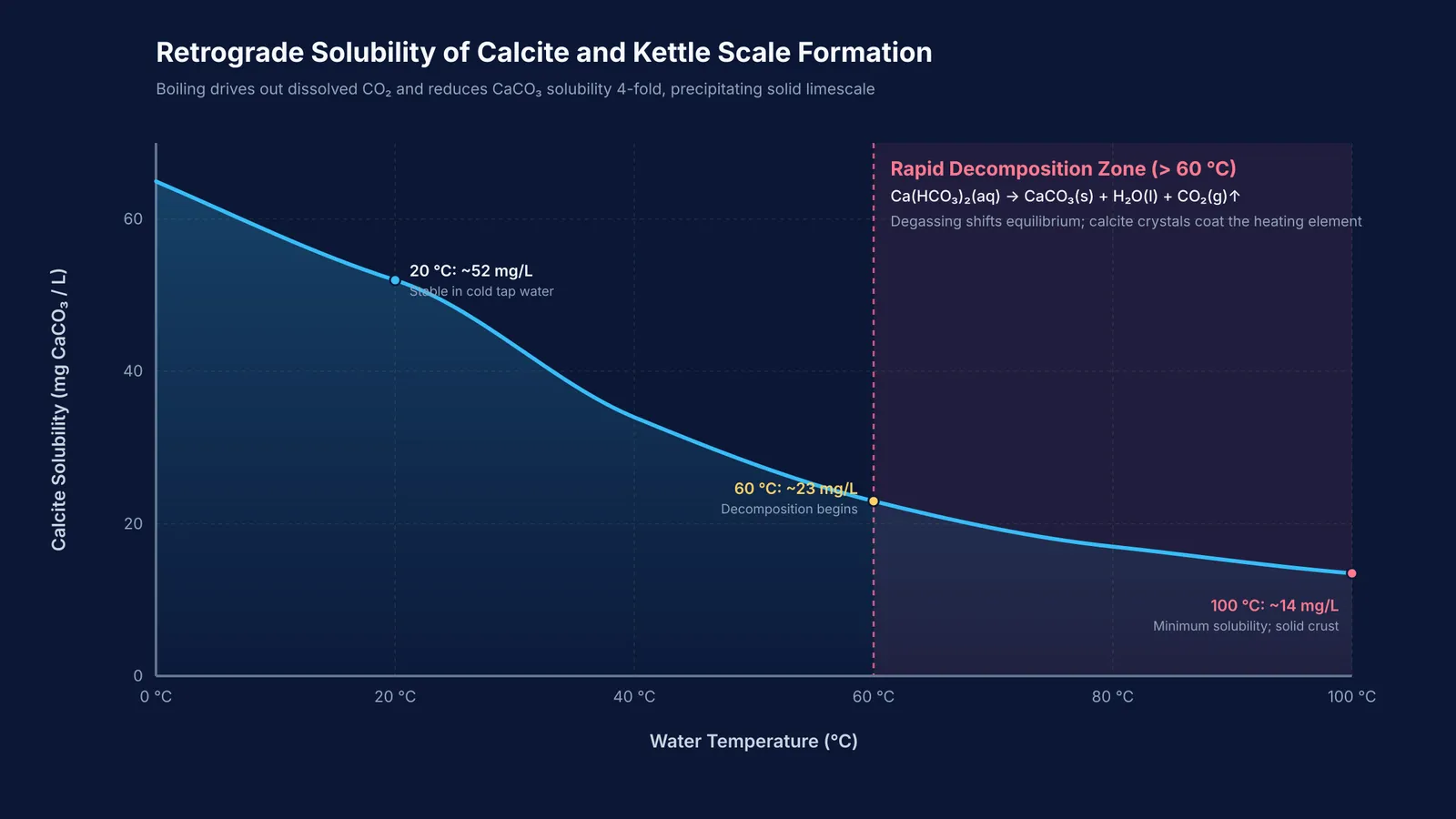
When you boil water, heating drives the reversible bicarbonate reaction backward. In research on the CaCO₃–H₂O–CO₂ system published in *Geochimica et Cosmochimica Acta* (DOI: 10.1016/S0016-7037(97)00201-900201-9)), geochemist Wolfgang Dreybrodt and colleagues showed that the conversion of bicarbonate ions to CO₂ governs the precipitation rate of calcite crystals. At temperatures above 60 °C, dissolved calcium hydrogen carbonate thermally decomposes into solid calcium carbonate, water, and carbon dioxide:
Ca(HCO₃)₂(aq) → CaCO₃(s) + H₂O(l) + CO₂(g)
Two thermodynamic factors drive this precipitation:
CO₂ degassing: Carbon dioxide gas becomes less soluble in hot water. As heating drives CO₂ bubbles out of solution, Le Chatelier's principle shifts the equilibrium toward solid CaCO₃.
Retrograde solubility: Unlike table salt, calcium carbonate exhibits retrograde solubility, becoming less soluble at higher temperatures. In air-equilibrated water, calcite solubility drops from roughly 52 mg/L at 20 °C to barely 14 mg/L at 100 °C.
Because the heating element is the hottest surface, calcium carbonate precipitates directly onto the steel base.
The Fermi Simulation Lab provides interactive simulations for the ideas that are easier to see than to read, helping students observe how temperature and gas loss drive crystal precipitation.
How does temporary hardness differ from permanent hardness?
Chemistry classifies water hardness into two distinct forms based on thermal behaviour:
Temporary hardness: Caused by dissolved calcium and magnesium hydrogen carbonates, Ca(HCO₃)₂ and Mg(HCO₃)₂. Simple boiling decomposes the bicarbonate, precipitating solid scale and softening the water.
Permanent hardness: Caused by calcium and magnesium sulfates and chlorides, such as CaCl₂ and MgSO₄. These salts do not decompose when boiled and require chemical softening agents like sodium carbonate (washing soda).
This distinction links directly to how hard water forms insoluble scum with soap. While boiling removes temporary hardness before lathering, permanent hardness still precipitates sticky curd unless chemically softened.
Why does limescale reduce kettle heating efficiency?
Limescale acts as an effective thermal insulator on heating elements. In a fouling study published in *Science in China Series E: Technological Sciences* (DOI: 10.1007/s11431-008-0051-7), ZhenHua Quan and co-authors modeled how mineral scale accumulation creates substantial thermal resistance on heat-transfer surfaces. While stainless steel has a thermal conductivity around 15 W/(m·K), calcium carbonate scale conducts heat at only 0.5 to 2.2 W/(m·K).
Because of this insulating crust, even a 1 mm scale layer can increase heating energy consumption by 7% to 10%, forcing the element to run hotter to push heat through to the water.
A quick calculation shows how deposits accumulate:
Boiling 3 litres of water daily with 180 mg/L of temporary hardness processes 1,095 litres each year.
Total dissolved scale potential equals 1,095 L × 0.180 g/L = 197.1 g of calcium carbonate annually.
If 25% crystallises on the element rather than washing out, the kettle collects nearly 50 g of solid mineral rock in twelve months.
How can you safely descale a kettle using household acids?
According to the U.S. Geological Survey, mild household acids like vinegar dissolve mineral scale from heating appliances. Because calcium carbonate is a basic salt, descaling relies on acid-base neutralisation reactions. Weak acids donate protons to carbonate ions, forming soluble salts, water, and CO₂ gas:
Dilute ethanoic acid (vinegar): Demonstrating the chemical properties of ethanoic acid, vinegar dissolves scale cleanly:
CaCO₃(s) + 2CH₃COOH(aq) → Ca(CH₃COO)₂(aq) + H₂O(l) + CO₂(g)
Citric acid: Lemon juice or citric acid powder works without leaving vinegar odor:
3CaCO₃(s) + 2C₆H₈O₇(aq) → Ca₃(C₆H₅O₇)₂(aq) + 3H₂O(l) + 3CO₂(g)
To clean your kettle safely:
Mix equal parts white vinegar and water, or dissolve 2 tablespoons of citric acid in 500 mL of water.
Pour into the kettle, warm gently to around 50 °C, then turn off before boiling to avoid frothing.
Let it rest for 20 minutes while effervescence clears the crust.
Empty the liquid, rinse thoroughly with fresh water, and discard one boiled batch before brewing.
The Fermi Concept Library covers every concept in physics, chemistry, biology, mathematics and computing, each with its own lesson and its place in the map, helping students connect kitchen observations to solubility equilibria and reaction kinetics.


