

On this page
Heat boron trioxide with magnesium and you get boron: B₂O₃ + 3Mg → 2B + 3MgO. Wash out the magnesium oxide with acid and a brown powder is left, long sold as "amorphous boron". Henri Moissan, who described the method in 1892, said it contained as much as 95% boron. In 1914 a chemist at the Indian Institute of Science in Bangalore analysed six batches and found something else. A sixth to a quarter of the powder was oxygen.
Who was Rames Chandra Ray, and what did he publish?
The paper is Rames Chandra Ray, "Magnesium Boride and Amorphous Boron", Journal of the Chemical Society, Transactions, volume 105 (1914), pages 2162–2168 (DOI 10.1039/CT9140502162; scan on the Internet Archive). It is signed from the Department of General Chemistry, Indian Institute of Science, Bangalore, India.
We have not checked his biography beyond that address. He is a different person from Prafulla Chandra Ray of Calcutta, and we know of no family link. Every number below was read from the page images.
One line shows what research from Bangalore was like then. Another chemist, Weintraub, had studied the same powder in 1909, but "this journal was not available in Bangalore", so Ray only read it after finishing his own work.
How much oxygen was in "amorphous boron"?
Ray made the powder from B₂O₃ (samples I–IV) or borax (V–VI) and magnesium, washed it with hot dilute hydrochloric acid, and heated it under vacuum. He then split the boron into two kinds: boron that dissolved in dilute nitric acid (the amorphous part) and boron that did not (crystalline boron). His six analyses, in per cent:
Boron soluble in nitric acid: 52.60 to 75.88
Crystalline boron (insoluble): 2.71 to 20.94
Magnesium: 2.36 to 11.12
Oxygen, by difference: 16.53 to 25.16
"By difference" means oxygen was not measured directly. It is 100 minus everything else, so it also carries every other error. Even so, no sample came close to 95% boron. Only the crystalline form was nearly pure: one sample analysed 98.10% boron and 2.16% silicon with a trace of magnesium.
Was the oxygen part of a compound?
Weintraub had called the powder a boron suboxide. Ray disagreed. Treating the magnesium as MgO, he worked out the atomic ratio of soluble boron to the remaining oxygen for each sample: 4.2, 6.6, 6.6, 6.1, 5.2 and 5.2. "One would expect the results to be more concordant if the substance were a compound," he wrote. A true compound would have one fixed ratio.
He then tested where the magnesium sat. Fusing one sample with B₂O₃ cut its magnesium from 11.12% to 0.58%, yet the boron-to-oxygen ratio barely moved, from 6.10 to 6.02. The magnesium had left together with oxygen, so it was there as magnesium oxide, not as boride. His conclusion: "amorphous boron" is a solution of a lower boron oxide and magnesium oxide in boron, not a pure element and not a single compound.
Worked example: a formula from a boride analysis
Ray heated his oxygen-rich boron between layers of magnesium in a closed iron vessel under hydrogen. Magnesium and boron joined: 3Mg + 2B → Mg₃B₂. Check: 3 Mg and 2 B on each side. The product also held MgO from the oxygen, and sometimes leftover magnesium. Take his sample V (per cent):
magnesium (total) 74.13, boron soluble in nitric acid 18.76, insoluble residue 0.76, oxygen by difference 6.35.
Check the difference. 100 − 74.13 − 18.76 − 0.76 = 6.35. That is the oxygen.
Remove the magnesium held as MgO. One O holds one Mg, so this magnesium is 6.35 × 24.3 ÷ 16 = 9.65 g per 100 g. Ray prints 9.51; across his columns he used a factor of 1.5, that is 24 ÷ 16.
Magnesium left for the boride: 74.13 − 9.51 = 64.62 g (his column A).
Moles, with Mg = 24.31 and B = 10.81: Mg 64.62 ÷ 24.31 = 2.658; B 18.76 ÷ 10.81 = 1.735.
Ratio: 2.658 ÷ 1.735 = 1.53, about 3 : 2, so Mg₃B₂.
Now the correction for excess metal. Column A counts magnesium "as boride, or as metal", so any unreacted magnesium is in it too. Each ratio is therefore an upper limit. For exact Mg₃B₂, 1.735 mol of B needs 1.5 × 1.735 = 2.603 mol of Mg, which is 63.27 g. Sample V had 64.62 g, so about 1.35 g per 100 g was free metal.
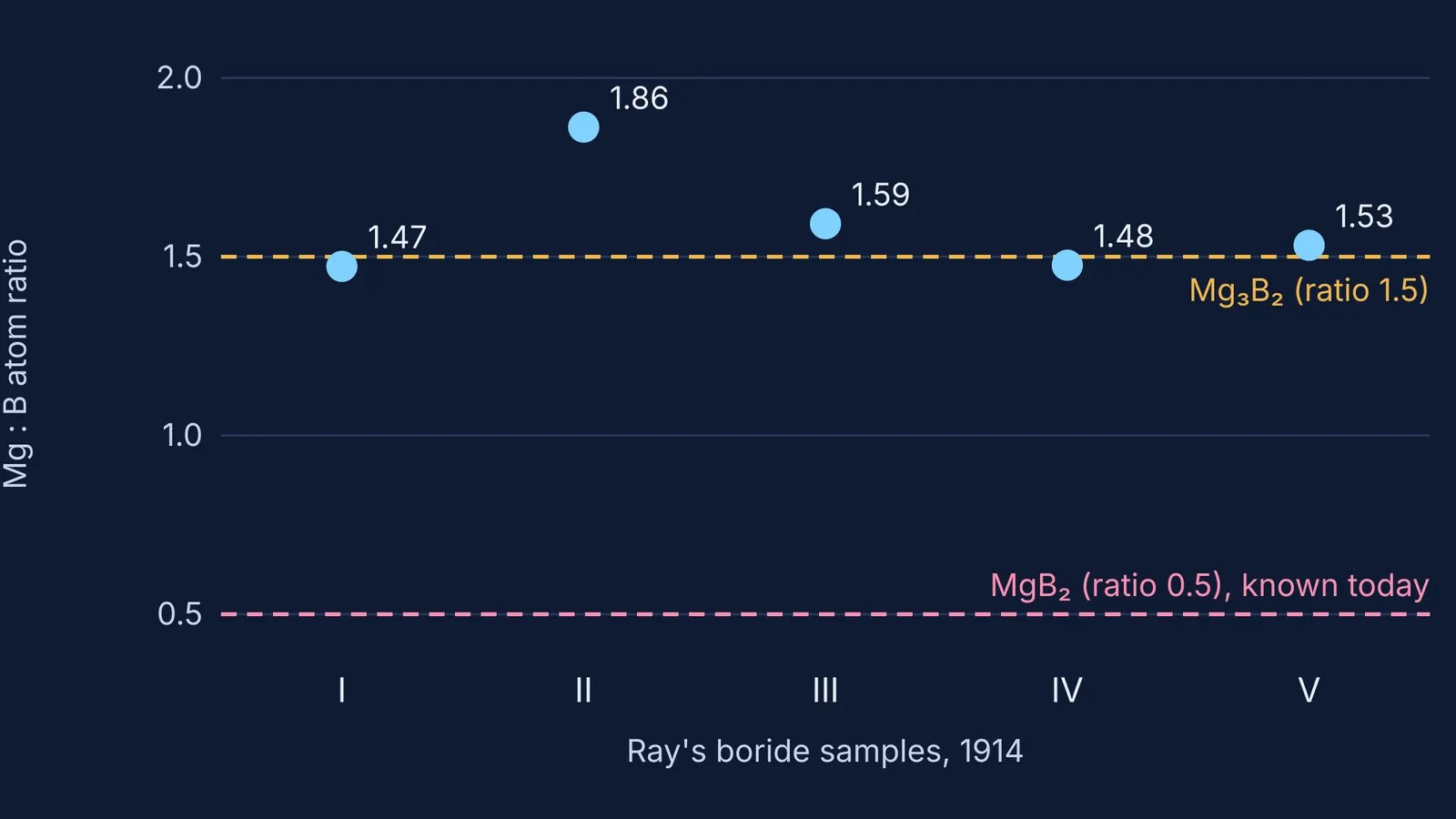
Sample II shows why the correction matters. Its ratio comes out at 1.86 (Ray printed 1.9), which would mean about 12.1 g of free magnesium per 100 g. Ray noted that sample II "had a metallic appearance, and obviously contained metallic magnesium". His five ratios were 1.5, 1.9, 1.6, 1.5 and 1.5 (our recalculation with modern atomic masses: 1.47, 1.86, 1.59, 1.48, 1.53). The lowest values set the formula. In his words, "not more than 1·5 gram-atoms of magnesium is required to combine with 1 gram-atom of boron."
A quick check on his first experiment: 1 part of B₂O₃ heated with 2¼ parts of magnesium gave, by analysis, Mg₃B₂ and MgO "in the theoretical proportions". The balanced equation is B₂O₃ + 6Mg → Mg₃B₂ + 3MgO, which needs 6 × 24.31 ÷ 69.62 = 2.09 g of Mg per gram of B₂O₃. So 2¼ parts is a small excess.
Did magnesium make only one boride?
Ray heated sample II in vacuum to drive off magnesium. While the Mg : B ratio fell towards 1.5, little free boron appeared. Once it reached about 1.5, boron began to separate quickly. He concluded that at red heat "only one boride having the formula Mg₃B₂ is formed".
That conclusion did not last. Magnesium diboride, MgB₂, is a well-known compound today. In 2001 it was found to become a superconductor at 39 K (Nagamatsu and co-workers, Nature, 2001). We have not checked how today's phase diagrams treat Ray's Mg₃B₂, so read his formula as his 1914 reading of his own analyses.
Magnesium borides react with acids to give boranes, which are toxic and catch fire in air. This post gives no procedure. The story of how those boranes were finally tamed is in our profile of Alfred Stock and his glass vacuum line.
Where does this show up in JEE and NEET?
Class 11, group 13: how boron is isolated, and why boron forms covalent compounds rather than ions (see why boron does not form B³⁺ ions). We have not checked the current NCERT wording on Mg reduction, so follow your own textbook.
Class 11, some basic concepts: formulas from mass percentages. For more practice, see empirical and molecular formulas from percentage data.
For JEE-style mole-concept questions, Fermi Test Prep covers JEE Main and Advanced preparation with an AI tutor. For multi-step analysis problems like this one, the Fermi Problem Library has a step-by-step solver that explains the reasoning.
Quick checklist
Rames Chandra Ray, Indian Institute of Science, Bangalore, J. Chem. Soc. Trans. 1914.
"Amorphous boron" from B₂O₃ + 3Mg held 16.5–25.2% oxygen (by difference).
B/O ratios of 4.2 to 6.6 argued against a single suboxide.
Fusing with B₂O₃ removed Mg as MgO; the B/O ratio stayed near 6.
Boride formula: subtract Mg held as MgO, convert to moles, treat the ratio as an upper limit.
Ray's answer was Mg₃B₂; MgB₂ is known today.


