

On this page
You learn that dimethylamine is a stronger base in water than methylamine, and that trimethylamine comes third, behind both. Somebody had to measure that. In 1912 Tom Sidney Moore and Thomas Field Winmill, at the Daubeny Laboratory of Magdalen College, Oxford, published "The State of Amines in Aqueous Solution", J. Chem. Soc. Trans. 101, 1635–1676. Under their table of constants sits one plain sentence: "In every group the secondary amine is the strongest base." We read the paper in the scanned 1912 volume and checked the numbers below against the page images.
What did Moore and Winmill measure?
They measured how well solutions of ammonia and nine amines conduct electricity, along with the amine hydrochlorides, at 18 °C, 25 °C and 32.35 °C. The paper says the experimental work "was carried out almost entirely by Winmill". From the conductivity they worked out the degree of ionisation, α, and then an "apparent dissociation constant" from Ostwald's formula, K = nα²/(1 − α), where n is the concentration. That apparent constant counts all the dissolved amine together, which is how Kb is defined today.
Their aim was accuracy to "one part in 1000", which they admitted conductivity work could not quite reach. Two details show the care:
No carbon dioxide. CO₂ would turn some of the amine into a carbonate and upset the reading. They ran the amine salt into boiling potassium hydroxide solution, so the free amine distilled over in steam into a flask protected by soda-lime.
A correction for the CO₂ already in the water. For methylamine at 18 °C, the measured specific conductivity was 542.01 "gemmhos". The carbonate, the hydrogen carbonate and dissolved salts accounted for 2.94 + 0.04 + 0.31 = 3.29, leaving 538.72 for the amine itself.
What order did they find for the methylamines?
The table on page 1651 gives K × 10⁷, with concentration in moles per cubic centimetre. Multiply by 10⁻⁴ to get mol L⁻¹. At 25 °C:
Dimethylamine, (CH₃)₂NH: 6.354, so Kb = 6.35 × 10⁻⁴
Methylamine, CH₃NH₂: 4.743, so Kb = 4.74 × 10⁻⁴
Trimethylamine, (CH₃)₃N: 0.6457, so Kb = 6.46 × 10⁻⁵
Ammonia: 0.1805, so Kb = 1.81 × 10⁻⁵
That is (CH₃)₂NH > CH₃NH₂ > (CH₃)₃N > NH₃, the aqueous order in your Class 12 book. The ethyl series in the same table gives, at 25 °C, (C₂H₅)₂NH (11.36) > (C₂H₅)₃N (5.898) > C₂H₅NH₂ (5.198). So for ethyl groups the tertiary amine beats the primary one, again the order you are taught. At 18 °C the ethyl primary and tertiary values are almost tied (5.230 and 5.143), so do not lean on that gap.
Worked example: from their K to pKb and pH
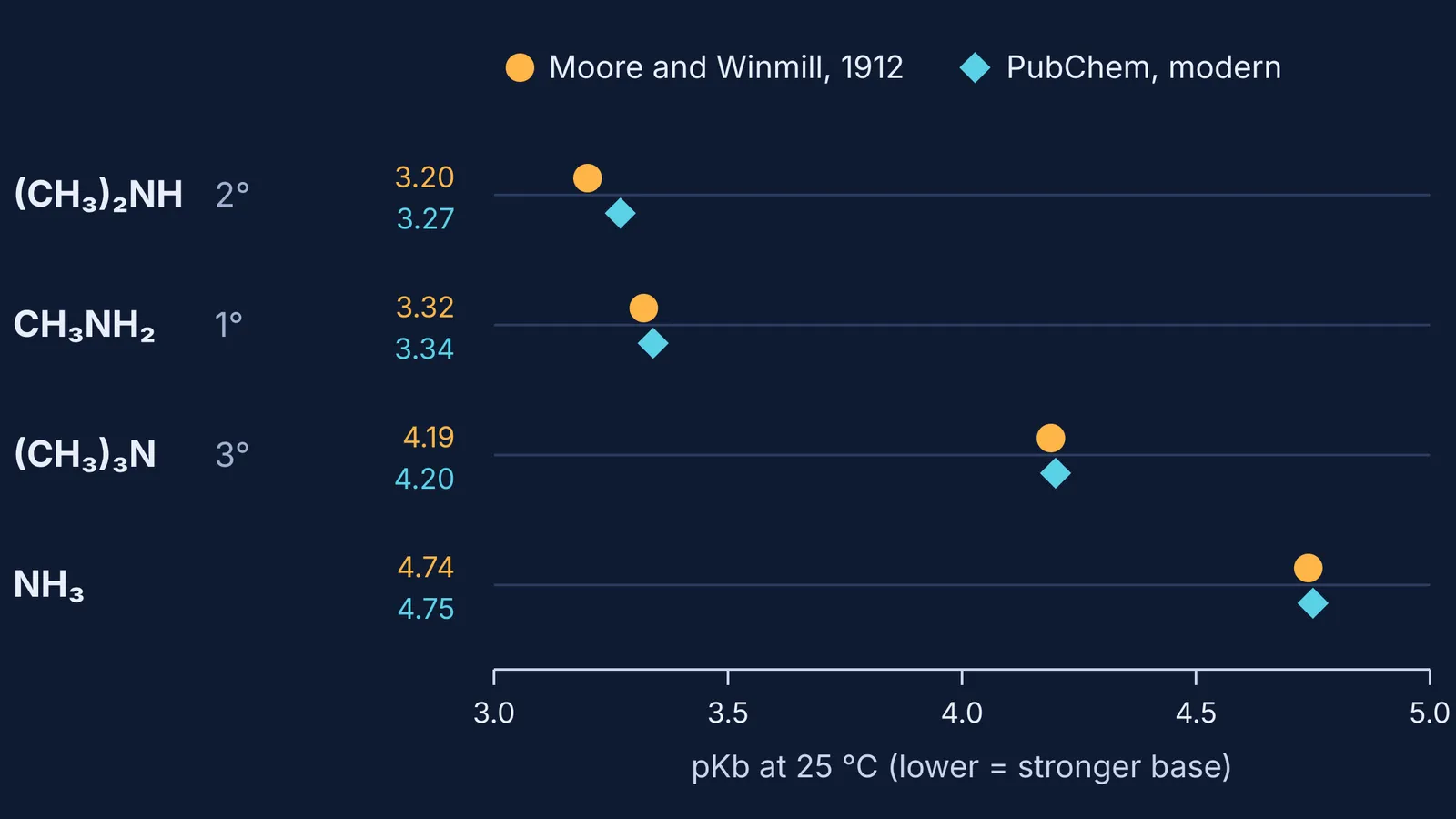
Step 1: pKb = −log Kb. Dimethylamine: −log(6.354 × 10⁻⁴) = 3.20. Methylamine: 3.32. Trimethylamine: 4.19. Ammonia: 4.74. At 18 °C the same four give 3.22, 3.34, 4.27 and 4.76, so the order holds at both temperatures.
Step 2: compare with modern values. PubChem lists conjugate-acid pKa values of 10.732 for dimethylamine, 10.66 for methylamine and 9.80 for trimethylamine, and pKb 4.751 for ammonia, all at 25 °C where a temperature is given. Using pKb = 14 − pKa gives 3.27, 3.34, 4.20 and 4.75. The 1912 values differ by 0.01 to 0.07.
Step 3: how much stronger? Kb(dimethylamine) ÷ Kb(trimethylamine) = 6.354 ÷ 0.6457 = 9.8 at 25 °C (11.2 at 18 °C). Dimethylamine over methylamine is only 1.34. The top two are close; the drop to the tertiary amine is large.
Step 4: a 0.10 M solution of dimethylamine at 25 °C. Let x = [OH⁻]. Then x² ÷ (0.10 − x) = 6.354 × 10⁻⁴. Solving the quadratic, x = 7.66 × 10⁻³ M, so α = 7.7%, pOH = 2.12 and pH = 11.88 (taking Kw = 1.0 × 10⁻¹⁴). The shortcut x = √(KbC) gives 7.97 × 10⁻³, about 4% high, because α is not tiny here. The same method gives α = 2.5% and pH 11.40 for trimethylamine, and α = 1.3% and pH 11.13 for ammonia.
Why is the tertiary amine weaker in water?
This is the modern explanation, not Moore's. Three effects compete:
Inductive effect. Each alkyl group pushes electron density towards nitrogen, which on its own would make 3° > 2° > 1° > NH₃.
Solvation of the cation. Water stabilises R₃NH⁺ by hydrogen bonding to its N–H hydrogens. CH₃NH₃⁺ has three, (CH₃)₂NH₂⁺ two, (CH₃)₃NH⁺ only one.
Steric crowding. Three alkyl groups also get in the way of the water molecules around the charge.
Dimethylamine keeps two N–H hydrogens and gains two donating groups, so it comes out on top. Our post on the basicity order of methylamines in water covers this in detail, including the gas-phase order. Moore did suggest that the strength of the union between amine and hydrogen was "affected largely by steric influences", but he did not set out the solvation argument used today.
Did Moore and Winmill discover the hydrogen bond?
No. The phrase "hydrogen bond" does not appear in the paper. What it does contain is an early picture of the same kind of interaction.
Moore compared the weak bases, the amines with at least one N–H, with tetramethylammonium hydroxide, (CH₃)₄N⁺OH⁻, which he called a "very strong base". He argued that "a definite change of constitution" happens when the last hydrogen on nitrogen is replaced by an alkyl group. In the amine hydrates, he wrote, the OH stays under the influence of "the hydrogen to which it was originally attached", and "the union between the amine and the hydrogen atom of the water" is weak. On page 1675 he drew (CH₃)₃N joined by a thin stroke to H–OH, labelled "Weak electrolyte", beside (CH₃)₄N–OH, labelled "Strong electrolyte". Thin strokes, he explained, mean "weak unions".
The first clear published statement of the hydrogen bond is usually credited to Latimer and Rodebush in 1920. Also note that Moore believed a real hydrate, R₃NH·OH, exists in solution. The modern view is different: see what ammonia solution really contains. His own hydration constants, he admitted, carried errors "possibly 70 per cent" for methylamine, so only the apparent constants above are worth quoting.
For the hydrogen bond itself, the Concept Library has a lesson for every concept in chemistry, with its place in the map.
Where does this appear in JEE and NEET?
Class 12, Amines: the basicity order in water for methyl and ethyl amines, and why quaternary ammonium hydroxides are strong bases (Hofmann elimination uses them).
Class 11, Equilibrium: Kb, pKb, degree of ionisation and pH of a weak base.
Class 11, Chemical bonding: hydrogen bonding between N–H and water.
For timed practice on these chapters, Fermi Test Prep offers JEE Main and Advanced preparation with an AI tutor.
Quick checklist
Moore and Winmill, Oxford, 1912: "In every group the secondary amine is the strongest base."
Their pKb at 25 °C: 3.20, 3.32, 4.19, 4.74 for (CH₃)₂NH, CH₃NH₂, (CH₃)₃N, NH₃.
Kb(2°) ÷ Kb(3°) for methyl is about 10; 2° over 1° is only about 1.3.
Ethyl order in water: 2° > 3° > 1° > NH₃.
3° is weaker in water because its cation is poorly solvated (one N–H) and crowded.
A "weak union" drawn in 1912 is a precursor, not the discovery, of the hydrogen bond.


