

On this page
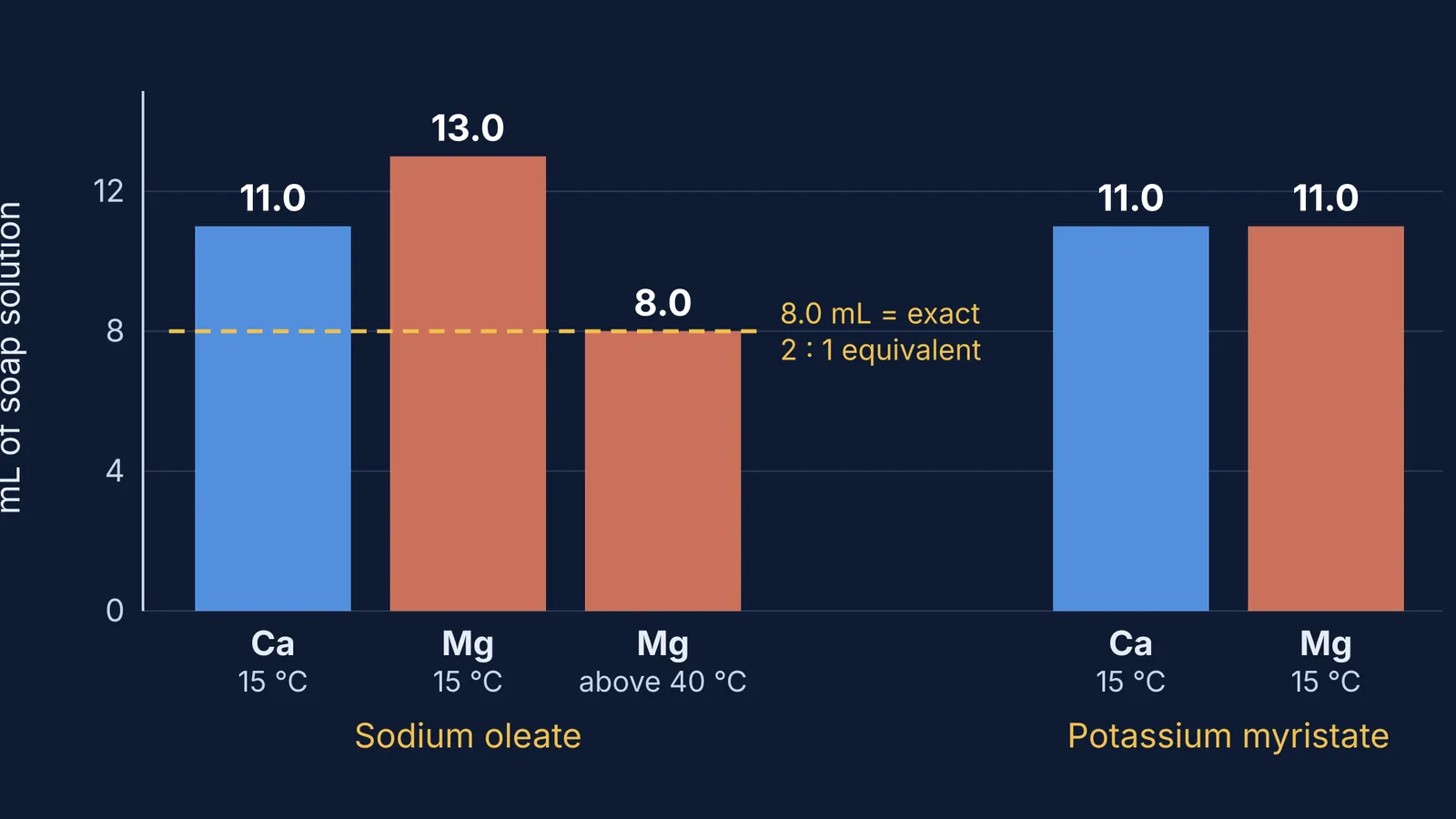
In the early 1900s, one way to measure the hardness of water was to run a standard soap solution into it from a burette and shake until a lather lasted. Chemists knew that magnesium gave poor end points. In 1913 Helen Masters and Henry Llewellyn Smith, of King's College for Women, London, tracked down why. With a sodium oleate soap, magnesium took far more soap than its equivalent, because solid magnesium oleate came out of solution and carried soap down with it. A soap made from a saturated fatty acid, potassium myristate, gave correct answers.
What did Masters and Smith test?
The paper is H. Masters and H. Ll. Smith, "The Behaviour of Calcium and Magnesium Salts with Soap Solutions and the Determination of Hardness of Water", J. Chem. Soc. Trans. 103 (1913) 992–998. We read it in the scanned 1913 volume and checked the numbers we quote against the page images.
Others had seen the problem. They quote Teed (1889): calcium salts need 1⅓ and magnesium salts 1½ times the equivalent of soap for a permanent lather.
Their method:
Four soap solutions in 50% alcohol: sodium oleate, potassium palmitate, potassium myristate and Castile soap.
Each was standardised so that 100 mL of water containing 10 mg of calcium carbonate needed 11 mL of soap.
Every test used 100 mL of water with calcium or magnesium salts equivalent to 10 mg of CaCO₃. That is 100 mg per litre, or 100 ppm hardness as CaCO₃.
How much soap does one Ca²⁺ ion need?
A soap anion carries a single negative charge and Ca²⁺ or Mg²⁺ carries two, so the scum takes two soap anions per metal ion. With oleate, C₁₇H₃₃COO⁻:
Ca²⁺ + 2C₁₇H₃₃COO⁻ → (C₁₇H₃₃COO)₂Ca↓
Mg²⁺ + 2C₁₇H₃₃COO⁻ → (C₁₇H₃₃COO)₂Mg↓
Both balance in atoms (36 C, 66 H, 4 O) and charge.
Worked example: their sodium oleate titration.
Moles of hardness. 10 mg CaCO₃ ÷ 100.09 g mol⁻¹ = 0.0999 mmol. Magnesium salts "equivalent to 10 mg CaCO₃" contain the same 0.0999 mmol of Mg²⁺.
Soap needed in theory. Twice that, 0.1998 mmol of oleate. In equivalents, 10 mg ÷ 50.05 (the equivalent mass of CaCO₃) = 0.1998 meq, and one oleate is one equivalent, so it agrees.
Mass of sodium oleate. C₁₇H₃₃COONa has M = 304.45 g mol⁻¹, so 0.1998 × 304.45 = 60.8 mg. The paper prints 60.8.
Strength of the soap. 100 mL of it contained Na₂O equivalent to 25 mL of N/10 HCl, which is 2.5 mmol of Na⁺ and so 2.5 mmol of oleate. 2.5 × 304.45 = 761 mg, which the paper gives as 0.760 g per 100 mL, or 7.60 mg per mL.
Volume for an exact 2 : 1 reaction. 60.8 ÷ 7.60 = 8.0 mL.
What they found at 15 °C. Calcium took 11.0 mL, which is 83.6 mg, or 83.6 ÷ 60.8 = 1.37 times the equivalent. Magnesium took 13.0 mL, which is 98.8 mg, or 1.62 times.
Now put it in ppm. The soap was calibrated so that 11.0 mL means 100 ppm. A water with 100 ppm of magnesium hardness took 13.0 mL, so it would be reported as 13.0 ÷ 11.0 × 100 = 118 ppm, about 18% high. Above 40 °C the same water took only 8 mL, which reads as 73 ppm, about 27% low. For the ppm arithmetic itself, see how to calculate hardness of water in ppm of CaCO₃.
Why does magnesium take more soap?
Masters and Smith followed the solid. Calcium solutions titrated with oleate stayed translucent, but magnesium ones formed "an opaque mixture with considerable precipitate" within a short time at 15 °C. Spinning them at 2,000 revolutions per minute separated a solid from the magnesium mixtures but not from the calcium ones. Its analysis matched normal magnesium oleate: MgO found 6.46%, calculated 6.83% (6.86% with modern atomic masses).
They then measured how much of each oleate dissolves. We read the figures as grams of oxide from 100 g of solution; converting to moles makes the comparison fair:
At 15 °C: calcium oleate 0.0041 g CaO, or 7.3 × 10⁻⁵ mol; magnesium oleate 0.0015 g MgO, or 3.7 × 10⁻⁵ mol. Magnesium oleate dissolves about half as much.
At 60 °C: calcium oleate 0.0023 g CaO, or 4.1 × 10⁻⁵ mol; magnesium oleate 0.0020 to 0.0025 g MgO, or 5.0 to 6.2 × 10⁻⁵ mol. The order is reversed.
The decisive test was to add solid magnesium oleate before titrating. Water with magnesium sulphate alone took 13.0 mL of sodium oleate. With 0.1 g of magnesium oleate added it took 15.5 mL, and with 0.2 g, 17.0 mL. Adding calcium oleate to calcium water at 15 °C changed the result only a little (11 mL to 11.5–12 mL). At 60 °C the calcium case behaved like magnesium at 15 °C: 12.0, 15.5 and 16.0–16.5 mL.
Their explanation: magnesium oleate "is less soluble than calcium oleate at 15°, and particles of magnesium oleate separate and carry down or adsorb some sodium oleate". The experiments above are their evidence. Heating up to 60 °C was "of no advantage".
Why did the saturated soap work?
Potassium myristate, a saturated soap, needed 11.0 mL for calcium and 11.0 mL for magnesium at 15 °C. Standardised on calcium, it "gave accurate results with magnesium salts and with mixtures of calcium and magnesium salts in all proportions". Potassium palmitate, also saturated, was rejected for a different reason: its solution kept depositing an acid soap, potassium hydrogen palmitate.
They checked how saturated each fatty acid was with the iodine value, which counts C=C bonds. Oleic acid, C₁₇H₃₃COOH (M = 282.47), has one C=C, which adds one I₂ (253.81 g mol⁻¹):
Theoretical iodine value = 253.81 ÷ 282.47 × 100 = 89.85 g of I₂ per 100 g.
Their oleic acid absorbed 87.4%, so it was 87.4 ÷ 89.85 = 97.3% oleic acid. The paper says 97.
Castile soap's fatty acids absorbed 46.1%, about 51% unsaturated acid as oleic (the paper says 52).
Myristic and palmitic acids absorbed only 0.5% and 0.8%, so they are essentially saturated.
For the full method behind these numbers, see saponification value and iodine value of fats, worked out. If you want a clear lesson on soaps, micelles and fatty acids before attempting the numericals, the Concept Library covers every concept in chemistry.
Where does this come up in JEE and NEET?
Class 11, Hydrogen: hardness of water expressed as ppm of CaCO₃.
Class 11, Some basic concepts: moles and equivalents, with two RCOO⁻ for each M²⁺.
Class 10 and Class 12: why soap forms scum in hard water. For the wider soap and detergent picture, see the difference between soap and detergent.
Class 12, Biomolecules: saturated and unsaturated fatty acids, and the iodine value.
For timed practice on hardness and mole-concept numericals, Fermi Test Prep is built for JEE Main and Advanced preparation, with an AI tutor.
Quick checklist
M²⁺ + 2RCOO⁻ → (RCOO)₂M↓, so soap mmol = 2 × hardness mmol.
10 mg CaCO₃ in 100 mL is 100 ppm and needs 60.8 mg of sodium oleate in theory.
With oleate at 15 °C, calcium took 1.37 times and magnesium 1.62 times the equivalent.
A soap calibrated on calcium read 100 ppm of magnesium as about 118 ppm.
Masters and Smith blamed solid magnesium oleate dragging soap out of solution.
A saturated soap, potassium myristate, read calcium and magnesium alike.


