

On this page
Carbon monoxide has no colour or smell, and in coal mines it matters at fractions of a per cent. In 1914 Joseph Ivon Graham and Thomas Field Winmill described a way to measure it in a 20 c.c. gas sample to 0.02 per cent. They passed the gas over warm iodine pentoxide, which turns CO into CO₂, let potash absorb the CO₂, and read how much the sample shrank. The shrinkage equals the CO. They also found the method's weak spot: hydrogen. This post covers the chemistry, their numbers, and the gas-volume bookkeeping you can reuse in exam problems. CO is a poisonous gas, so this is history and principle only, not a procedure.
Who were J. Ivon Graham and T. F. Winmill?
The paper is J. I. Graham and T. F. Winmill, "The estimation of carbon monoxide", J. Chem. Soc. Trans. 105 (1914) 1996–2003. We read it in the scanned 1914 volume and checked every number below against the page images. It prints Graham's full name first and is signed from the Doncaster Coal Owners' Laboratory, Bentley Colliery, near Doncaster. We have not checked anything else about his life.
Winmill already has a post for his work on amine basicity: Moore and Winmill on why secondary amines are the strongest bases.
Their apparatus was "a modification of the well known Haldane type of gas analysis apparatus". J. S. Haldane's work on carbon monoxide and miners is in J. S. Haldane, carbon monoxide and the animals that warned miners.
How does iodine pentoxide count carbon monoxide?
The reaction, as the paper prints it, is I₂O₅ + 5CO = I₂ + 5CO₂.
Balance. I: 2 = 2. O: 5 + 5 = 10 on the left, 10 in 5CO₂ on the right. C: 5 = 5.
Electrons. Iodine goes from +5 to 0, so one I₂O₅ gains 2 × 5 = 10 electrons. Carbon goes from +2 to +4, 2 electrons per CO. So 10 ÷ 2 = 5 CO per I₂O₅.
Volumes. The oxygen comes from a solid, so no gas is used up in the oxidation. One volume of CO becomes one volume of CO₂.
Absorption. Potassium hydroxide then takes up the CO₂, and the iodine set free. The paper says so in one line. The gas is now short by exactly the volume of CO it started with.
Before that step the sample spent four minutes in a bromine pipette. Bromine (dissolved in potassium bromide solution) removes unsaturated hydrocarbons, which would otherwise interfere. That reading also gave CO₂, H₂S and SO₂ by difference. The I₂O₅ tube was then warmed. The reaction "takes place slowly at 70—80°, but is rapid and complete at 90—100°", so they used 90–100 °C.
How accurate was it?
Table A mixed known amounts of pure CO with air (tube at 160–180 °C):
0.004 c.c. of CO: 0.02% present, 0.02% found
0.276 c.c.: 1.50% present, 1.51% found
0.568 c.c.: 3.06% present, 3.09% found
Table B went up to 24.13% present, 24.14% found. Methane ("natural fire-damp") was "not attacked even when the sample is passed over iodine pentoxide heated at 160—180°", which matters in a coal mine.
Why does hydrogen spoil the reading?
It had "been generally accepted that hydrogen is not acted on by iodine pentoxide." Their Table C says otherwise. With hydrogen and air and no CO, the contraction was 0.00% at 110–125 °C, 0.02% at 140–145 °C, 0.35% at 160–165 °C and 1.27% at 170–180 °C (100% hydrogen in each case). They concluded hydrogen "is readily attacked by iodine pentoxide at temperatures above 135°".
The matching equation is 5H₂ + I₂O₅ → I₂ + 5H₂O (H: 10 = 10, O: 5 = 5, I: 2 = 2). The water is no longer counted as gas, so each volume of hydrogen burnt disappears just like a volume of CO, and reads as CO.
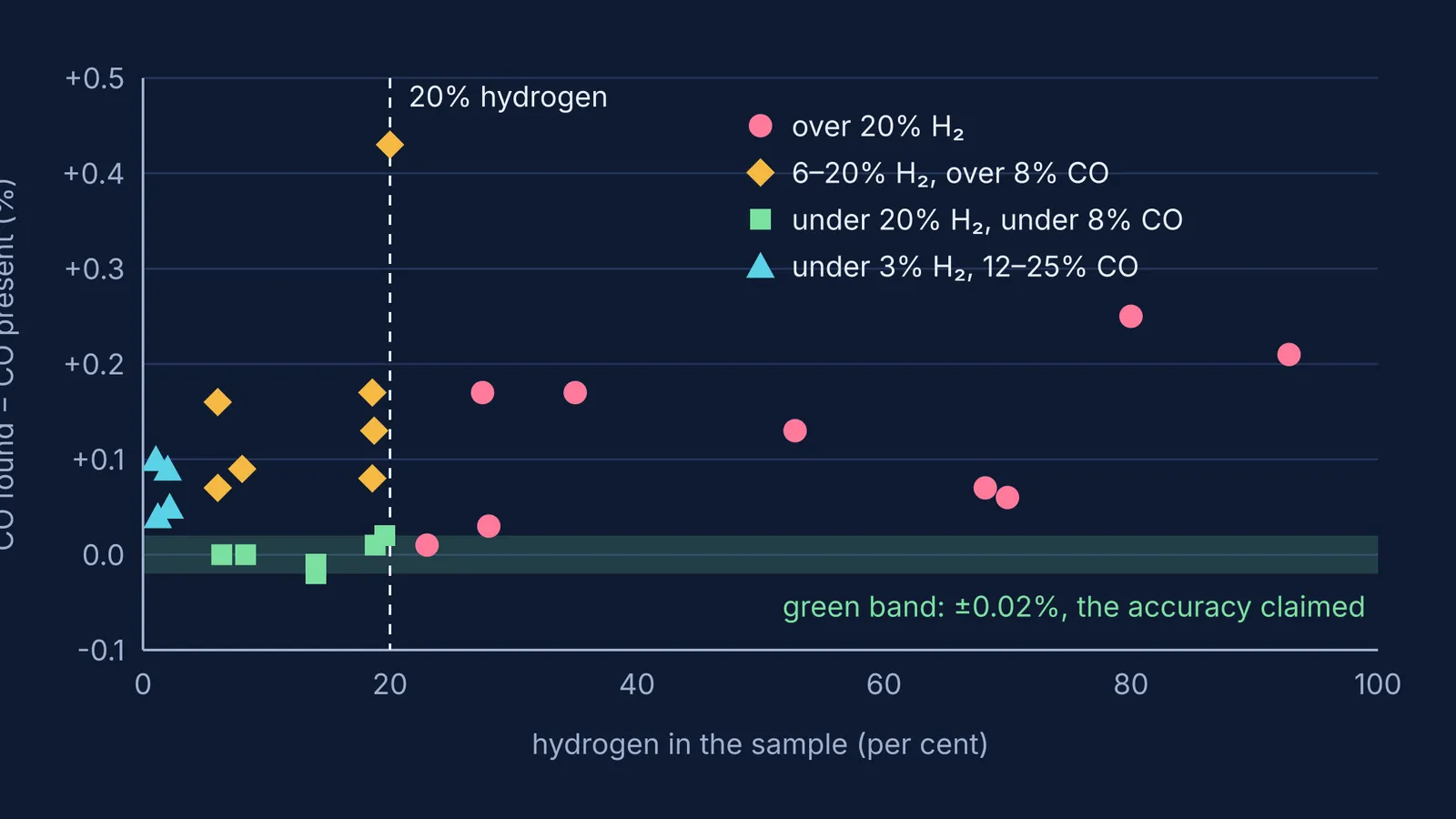
The surprise was that CO makes it worse. With CO present, hydrogen was attacked even below 100 °C once it passed 20% of the sample. They thought it "highly probable" that "nascent iodine" from the CO reaction attacks the hydrogen, but called the nature of the action "not quite clear". Their rules were:
Over 20% hydrogen: accurate CO is "impossible" (Table D).
Between 6% and 20% hydrogen with over 8% CO: still impossible (Table E).
Under 20% hydrogen and under 8% CO: accurate to 0.02% (Table F).
Under 1% hydrogen: up to 25% CO works (Table G).
So for coal gas, which has a lot of hydrogen, they diluted the sample with air "to about five times their volume" to bring hydrogen down "to about 12 per cent", and then results agreed within 0.02%.
Worked example: gas-volume bookkeeping
A 20.00 mL sample (after the bromine step) is passed over I₂O₅ at 95 °C and then through KOH. It now measures 19.39 mL.
Contraction. 20.00 − 19.39 = 0.61 mL.
Link to CO. 1 volume CO → 1 volume CO₂ → absorbed. So CO = 0.61 mL.
Percentage. 0.61 ÷ 20.00 × 100 = 3.05% CO.
Now a hydrogen-rich case, using Table D. A mix with 80.0% hydrogen and 2.82% CO, run at 100–110 °C, read 3.07%.
Extra contraction. 3.07 − 2.82 = 0.25% of the sample. In 20 mL that is 0.05 mL.
Hydrogen burnt. That 0.05 mL is hydrogen turned to water. Out of 16 mL of hydrogen, only 0.25 ÷ 80 = 0.3% reacted, but it is still more than twelve times the 0.02% accuracy they wanted.
The cure. Dilute five-fold with air. A gas that was 60% H₂ and 6% CO (round numbers for illustration) becomes 12% H₂ and 1.2% CO. That fits rule 3. If the diluted sample reads 1.20%, the original had 1.20 × 5 = 6.0%. Note the cost: an error of ±0.02% in the diluted reading becomes ±0.1% in the original.
For more eudiometry with spark and KOH readings, see how to find a hydrocarbon formula by eudiometry.
If gas-volume problems with two absorbents still trip you up, the Fermi Problem Library has a step-by-step solver that explains the reasoning at each subtraction. For JEE practice on redox and n-factors, Fermi's AI tutor for JEE prep is part of Fermi Test Prep for JEE Main and Advanced.
What can you take from this paper?
A reagent can be selective at one temperature and not at another. I₂O₅ left hydrogen alone at 110–125 °C but not at 160 °C.
A second reactant can change what the reagent attacks. CO lowered the temperature at which hydrogen reacted.
Test the method on known mixtures. Every table compares "present" with "found".
Quick checklist
I₂O₅ + 5CO → I₂ + 5CO₂; I +5 → 0 (10 e⁻ per I₂O₅), C +2 → +4 (2 e⁻ per CO).
Contraction after KOH = volume of CO, because the oxygen comes from a solid.
Run at 90–100 °C; slow at 70–80 °C.
Hydrogen alone is attacked above about 135 °C; with CO present, lower.
Rule: under 20% H₂ and under 8% CO, or dilute with air first.
Methane is not attacked, even at 160–180 °C.


