

On this page
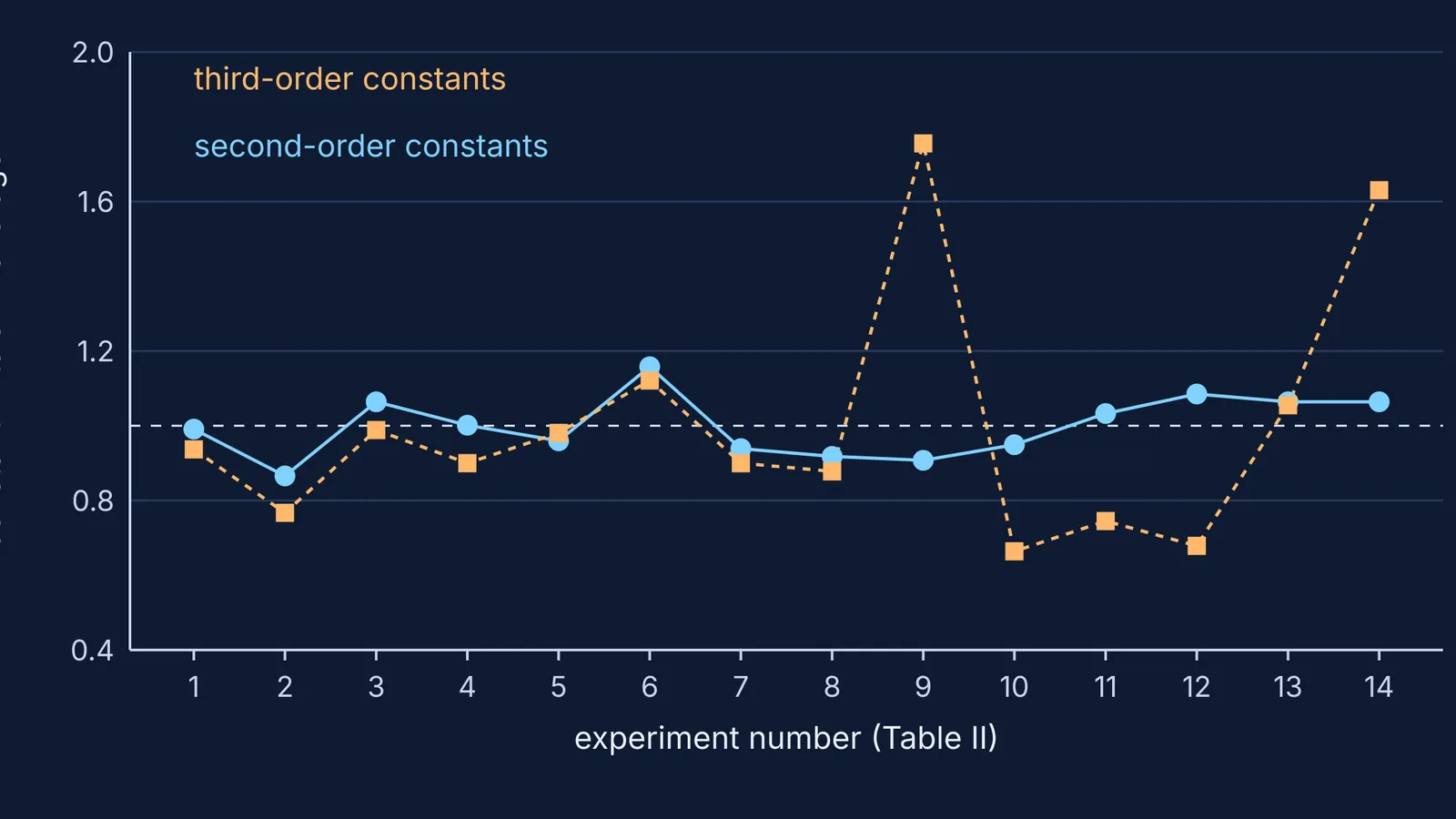
In 1913 Alexander Findlay and Morton James Pryce Davies, at University College of Wales, Aberystwyth, timed how fast sodium formate reduces mercuric chloride to calomel. The balanced equation has three reactant particles: two HgCl₂ and one formate. A single three-body collision would give third-order kinetics. Their data said second order, first order in each reactant. Their conclusion, "the reaction must take place in stages", is the textbook rule that you cannot read the order off a balanced equation.
The paper is A. Findlay and M. J. P. Davies, "The Reduction of Mercuric Chloride by Sodium Formate", J. Chem. Soc. Trans. 103 (1913) 1550–1554 (DOI 10.1039/CT9130301550; scan on the Internet Archive). It was a preliminary abstract of an M.Sc. thesis. Every number below was checked against the page images. The paper gives only the authors' names and their laboratory. Mercury compounds are highly toxic; this is history, not a lab method.
Why did chemists care how fast formate reduces HgCl₂?
The reaction was an old way to measure formic acid. Portes and Ruyssen proposed it in 1876, and Scala (1890) used it with acetic and butyric acids present. Lieben (1893) found it accurate only with five to six times the theoretical HgCl₂ and six to eight hours on a water bath. A slow reaction is worth timing.
In modern notation, with calomel written as Hg₂Cl₂ (the 1913 paper writes "HgCl"):
2HgCl₂ + HCOONa → Hg₂Cl₂ + NaCl + HCl + CO₂
Atoms balance: 2 Hg, 4 Cl, 1 Na, 1 H, 1 C and 2 O on each side. As ions, 2HgCl₂ + HCOO⁻ → Hg₂Cl₂ + 2Cl⁻ + H⁺ + CO₂, with charge −1 on each side. Two mercury atoms go from +2 to +1, and carbon goes from +2 to +4. Formate is a reducing agent for the same reason formic acid gives the Tollens test.
Similar reactions disagreed. Linhart had just found HgCl₂ + phosphorous acid to be bimolecular, while Noyes and Cottle (1898) had found silver acetate + formate to be third order.
How did they follow the reaction?
They mixed equal volumes of formate and HgCl₂ solution at 40 °C. At set times they drew off a filtered sample and measured the HgCl₂ still in solution by its reaction with iodide. They ran 14 experiments with different starting concentrations, a for HgCl₂ and b for formate, both in mol L⁻¹, with time in hours.
At first the second-order constant drifted down during each run. They traced this to the HCl formed: formic acid reduces HgCl₂ more slowly than formate does. Adding sodium acetate, which takes up the H⁺, made the constants steadier.
How did they tell second order from third?
They gave three lines of evidence.
Constants across 14 runs. The mean second-order constant, K₂, stayed between 0.83 and 1.11. The mean third-order constant, K₃, ranged from 9.0 to 23.8. The largest K₃ values came from the two runs with the least HgCl₂ (a = 0.0503 and 0.0688). That pattern is what you see when the assumed order is too high: you are dividing by a concentration that does not belong in the rate law. Their words: the second-order means are "quite obviously more constant".
Within one run (Table I). K₂ fell from 1.018 to 0.852, about 16%. K₃ rose from 10.24 to 18.17, about 77%.
Order in each reactant separately. Using van 't Hoff's differential method they got n = 0.96 for HgCl₂ and 0.99 and 1.07 for formate. As a check, they changed HgCl₂ more than threefold (0.1603 to 0.0503 M) at fixed formate. The time to reach the same fraction of reaction changed only by factors of 1.0 to 1.3. If the reaction were second order in HgCl₂, that factor would be about 3.
So rate = k₂[HgCl₂][HCOO⁻], second order overall.
Worked example: k₂ from Table I
Table I has a = 0.1040 and b = 0.3685, with sodium formate in excess. For rate = k₂(a − x)(b − x), integration gives:
k₂ = [1/(t(b − a))] × ln[a(b − x)/(b(a − x))]
Their tables subtract the same x from a and b, and we follow their bookkeeping.
Take t = 0.6 h, x = 0.0209. Then a − x = 0.0831 and b − x = 0.3476.
Ratio = (0.1040 × 0.3476)/(0.3685 × 0.0831) = 1.1805.
ln 1.1805 = 0.1660.
t(b − a) = 0.6 × 0.2645 = 0.1587.
k₂ = 0.1660/0.1587 = 1.046 L mol⁻¹ h⁻¹. The paper prints 1.044.
Our values for the other rows also match the printed ones to about 0.01, except the first (1.007 against 1.018), where a small x is most sensitive to rounding. The mean is 0.95.
Half-change of HgCl₂. Put x = a/2 = 0.0520 and k₂ = 0.95: t = ln[0.1040 × 0.3165/(0.3685 × 0.0520)]/(0.95 × 0.2645) = 2.15 h. The table agrees: 0.0553 M remains at 2.0 h and 0.0509 M at 2.3 h.
Differential method. In one pair of runs, HgCl₂ fell from 0.1034 to 0.0679 M in 3 h (rate 0.0118 M h⁻¹, mean concentration 0.0857 M). In the other it fell from 0.0503 to 0.0326 M (rate 0.0059, mean 0.0415). Then n = log(0.0118/0.0059)/log(0.0857/0.0415) = 0.301/0.315 = 0.96, so first order in HgCl₂.
Why doesn't the balanced equation give the order?
The equation records the overall change: two HgCl₂ for each formate. The rate law records what limits the speed. Here it says that the slowest stage, whatever it is, involves one HgCl₂ and one formate, and the second HgCl₂ joins later. Note what NCERT's rule does and does not say. It says reactions with more than three molecules in the equation must be complex (NCERT Class 12, Unit 3). This equation has three, so only the measured order shows it goes in steps.
Findlay and Davies did not propose a mechanism. They thought Linhart's explanation for phosphorous acid "appears to be very doubtful" here and deferred the question to later work. We do not invent one for them. For the general contrast, see order vs molecularity of a reaction, and for the a = b case and its 1/[A] plot, [second-order kinetics and the 1/[A] plot](https://news.fermi.ai/academic-success/second-order-kinetics-1-over-a-plot).
Where does this come up in JEE and NEET?
Exam line: stoichiometry does not set the order; if the order is lower than the number of particles in the equation, the reaction goes in steps. In Class 12 Chemical Kinetics this appears as:
rate laws from initial-rate or differential data, n = log(r₁/r₂)/log(c₁/c₂);
the integrated second-order law, including unequal starting concentrations;
formic acid and formate as reducing agents, and Hg₂Cl₂ containing the Hg₂²⁺ ion.
For more rate-law-from-data numericals, the Fermi Problem Library has a step-by-step solver that explains the reasoning.
Quick checklist
2HgCl₂ + HCOONa → Hg₂Cl₂ + NaCl + HCl + CO₂: three reactant particles.
Findlay and Davies (1913), 40 °C: first order in HgCl₂, first order in formate, second overall.
14 runs: mean K₂ 0.83 to 1.11; mean K₃ 9.0 to 23.8.
HCl formed slowed the reaction; sodium acetate steadied the constants.
Table I: k₂ about 0.95 L mol⁻¹ h⁻¹, half of the HgCl₂ gone in about 2.15 h.
Order lower than the particle count means the reaction goes in steps.


