

On this page
Boil an organic compound with acidified dichromate for long enough and most of its carbon leaves as CO₂. Most, but not all. Where a CH₃ group sits on another carbon, that pair of carbons tends to stop as acetic acid, which dichromate barely touches. In 1914 Egerton Charles Grey, a Beit Memorial Research Fellow at the Lister Institute in London, turned this into a method (E. C. Grey, J. Chem. Soc. Trans. 1914, 105, 2204). He measured the CO₂ as a gas, titrated the acetic acid left behind, and added the two. The total matched the formula's carbon content, and the acetic acid told him how many methyl groups the molecule had.
Why did wet carbon estimation give low results?
Oxidising a substance "in the wet way" with dichromate or chromic acid was an old method, used mainly for soils and for carbon in steel. For soils it gave low results, which had been "variously attributed to the formation of carbon monoxide, acetaldehyde, acetic acid, and other substances not completely oxidised".
Grey argued that carbon monoxide could be avoided "by using a proper excess of oxidising agent". He pointed at a different culprit: "it is more likely that the low results observed by many workers were due to acetic acid, which substance is attacked only with great difficulty by the chromic acid mixture."
He wanted a method for alcohols and amino acids, "for which accurate methods are not available". He thanked Professor Arthur Harden "for help and criticism".
What did Grey's method measure?
The principle, in outline:
The dissolved sample was boiled under a reflux condenser with potassium dichromate and phosphoric acid. Most substances needed 15 to 30 minutes; urea and succinic acid needed three hours.
The CO₂ was collected and its volume measured in a gas burette, then absorbed in potassium hydroxide.
Any acetic acid was steam-distilled out and titrated with N/30 baryta.
The phosphoric acid itself contained some organic impurity, so a blank of 1.5 to 2.6 c.c. of CO₂ had to be allowed for.
Which compounds burn fully and which leave acetic acid?
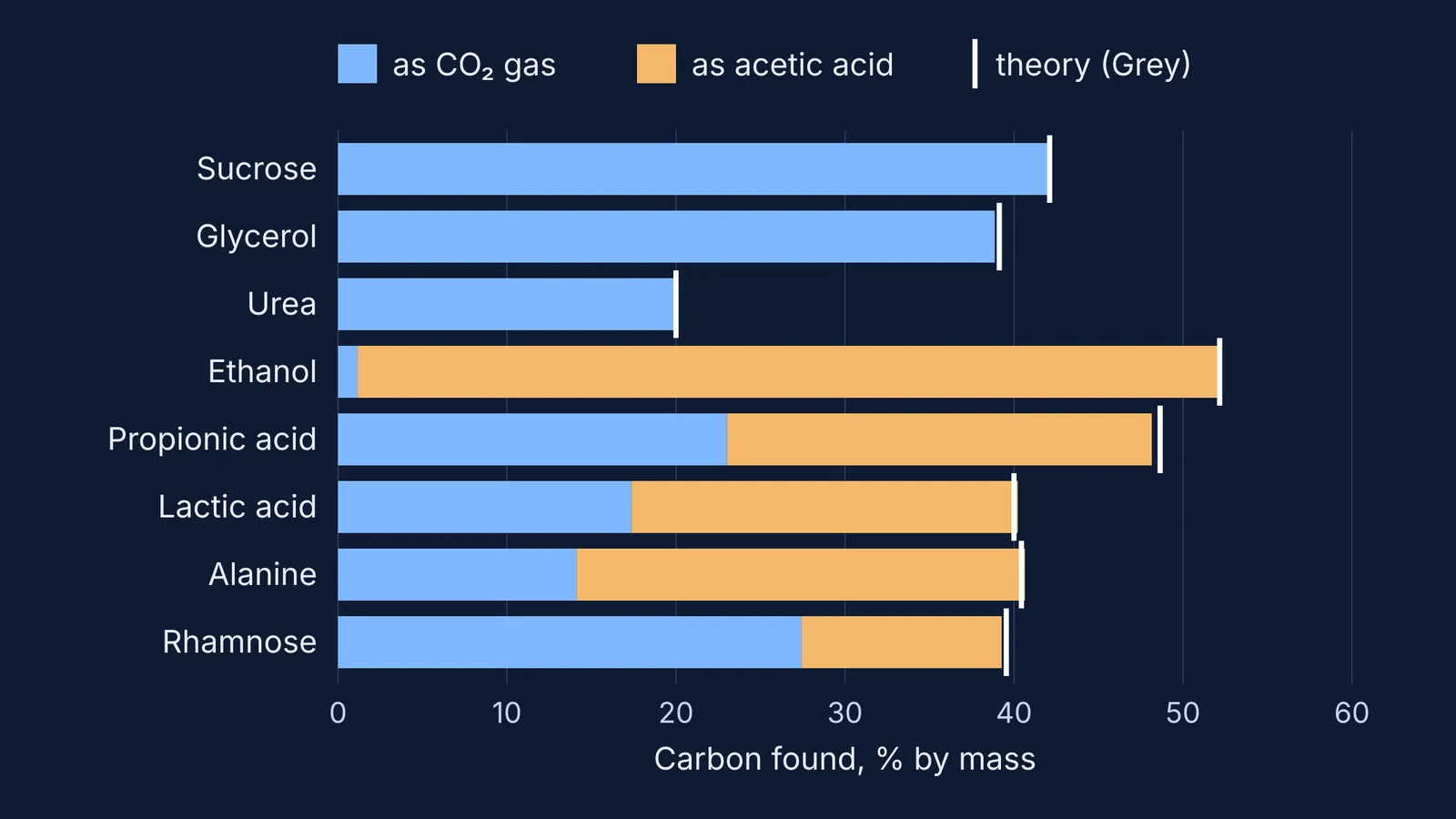
His table splits cleanly into two groups (% carbon found, against his calculated value).
No CH₃, all to CO₂. Sucrose 42.13 (calculated 42.11). Glycerol 38.86 (39.13). Urea 20.01 (20.00).
Ethanol. 50.87 as acetic acid plus 1.16 as CO₂, total 52.03 (52.17). About 98% of the carbon found was in acetic acid.
Three-carbon acids with CH₃. Propionic acid, lactic acid and alanine each gave acetic acid plus CO₂. For alanine, 26.52 as acetic acid and 14.12 as CO₂, total 40.64 (40.44).
Rhamnose, a sugar with a CH₃ at one end, gave two of its six carbons as acetic acid.
Grey's rule: "In each case the methyl group, together with the next adjacent carbon atom, forms acetic acid." So "the titre of the acetic acid indicates the number of methyl groups in the compound". For ethanol and alanine:
3CH₃CH₂OH + 2Cr₂O₇²⁻ + 16H⁺ → 3CH₃COOH + 4Cr³⁺ + 11H₂O
3CH₃CH(NH₂)COOH + 2Cr₂O₇²⁻ + 19H⁺ → 3CH₃COOH + 3CO₂ + 3NH₄⁺ + 4Cr³⁺ + 8H₂O
Both balance in atoms and charge. "A small amount of acetic acid is at the same time oxidised to carbon dioxide", and this is "greatest when the oxidising fluid contains least water". Propionic acid shows it clearly: 23.02 came out as CO₂ and only 25.13 as acetic acid, though the CH₃–C pair holds two-thirds of the carbon. Ethanol, he wrote, is "practically", not exactly, quantitatively oxidised to acetic acid.
Why does the CH₃–C unit survive dichromate?
This explanation is the modern one; it is not in Grey's paper.
Chromic acid oxidises a carbon that already carries an oxygen and a hydrogen. An alcohol forms a chromate ester through its O–H, and the C–H on the same carbon is then removed to make C=O. An aldehyde does the same after adding water. So in ethanol the CH₂OH carbon goes step by step to COOH, the same chemistry as in the acidified dichromate test for alcohols.
Acetic acid leaves dichromate nothing to grip. The carboxyl carbon has no hydrogen. The methyl carbon has hydrogens but no oxygen, so it cannot form a chromate ester. In sucrose or glycerol, by contrast, every carbon carries an oxygen, so every carbon is attacked and ends as CO₂. Acetic acid's resistance is so dependable that glacial acetic acid is used as a solvent for chromium(VI) oxidations.
Urea is a special case. Its carbon is already at +4, the same as in CO₂. In hot acid it releases CO₂ without changing oxidation state: CO(NH₂)₂ + H₂O + 2H⁺ → CO₂ + 2NH₄⁺.
Worked example: % carbon in sucrose from a gas volume
Grey's first sucrose run: 0.0353 g gave 30.1 c.c. of moist CO₂ at 20.0 °C and 765 mm. Note the word moist.
Aqueous tension. The gas is saturated with water vapour. At 20 °C that is about 17.5 mm. Dry CO₂ pressure = 765 − 17.5 = 747.5 mm (Dalton's law of partial pressures).
Volume at STP. V = 30.1 × (747.5 ÷ 760) × (273.15 ÷ 293.15) = 27.58 c.c.
Mass of CO₂. CO₂ is not quite ideal: its density at STP is about 1.977 g/L, so one mole fills 22.26 L, not 22.41 L. Mass = 27.58 × 1.977 = 54.53 mg.
Mass of carbon. 54.53 × 12.011 ÷ 44.009 = 14.88 mg.
Percentage. 14.88 ÷ 35.3 × 100 = 42.16%. Grey printed 42.13; the formula C₁₂H₂₂O₁₁ gives 42.11.
The same steps reproduce his urea (20.02 against his 20.01) and glycerol (38.90 against 38.86). His printed volumes give his percentages directly, so they appear to be net of the blank already.
In an exam you will use 22.4 L/mol. Then step 3 becomes 27.58 ÷ 22,400 = 1.231 × 10⁻³ mol CO₂, which contains 14.79 mg of carbon, or 41.90%. That is still within 0.5% of the true value.
The same correction appears in the nitrogen method, covered in Dumas and Kjeldahl methods for estimating nitrogen.
Where does this show up in JEE and NEET?
Class 12 Alcohols: acidified dichromate oxidises a primary alcohol to the carboxylic acid, and there it stops.
Redox and n-factor: Cr₂O₇²⁻ + 14H⁺ + 6e⁻ → 2Cr³⁺ + 7H₂O, so n = 6. Ethanol to acetic acid is 4 e⁻; ethanol to 2CO₂ would be 12 e⁻. Sucrose to 12CO₂ is 48 e⁻, which is 8 Cr₂O₇²⁻. Why COD counts dichromate this way is in COD by dichromate.
Class 11 quantitative analysis: % carbon from a gas volume, with Dalton's law.
To see how oxidation states, n-factors and gas laws connect, the Concept Library covers every concept in chemistry, each with its own lesson. For timed practice on redox and mole-concept numericals, Fermi Test Prep offers JEE Main and Advanced preparation with an AI tutor.
Quick checklist
Grey, 1914, Lister Institute: dichromate and phosphoric acid; CO₂ by gas volume, acetic acid by titration.
Sugars, glycerol and urea: all carbon as CO₂.
A CH₃ and its neighbouring carbon stop as acetic acid; the titre counts methyl groups.
Some acetic acid still burns, most when least water is present.
Moist gas: subtract aqueous tension before converting to STP.
Sucrose: 30.1 c.c. at 20 °C and 765 mm from 0.0353 g gives 42.2% C.


