

On this page
Your NCERT table gives oxalic acid two constants: Ka₁ = 5.9 × 10⁻² and Ka₂ = 6.4 × 10⁻⁵. The first is easy to measure. The second is not, because the second proton barely leaves while the first is still around. In 1915 two chemists at Presidency College, Calcutta, found a way round this with a pair of flasks, a balance and a stream of carbon dioxide. A solution of a salt such as sodium oxalate soaks up a little more CO₂ than plain water, and that small extra mass carries K₂.
Who were Datta and Dhar, and what did they publish?
The paper is Aswini Kumar Datta and Nilratan Dhar, "A New Method of Finding the Second Dissociation Constants of Dibasic Acids", Journal of the Chemical Society, Transactions, volume 107 (1915), pages 824–827 (DOI 10.1039/CT9150700824; scan on the Internet Archive). It is signed from the Physicochemical Laboratory, Presidency College, Calcutta, and was received on 12 January 1915.
Dhar's later career is told in our profile of Nil Ratan Dhar and his work on photochemistry. We have not checked Aswini Kumar Datta's biography beyond this byline (he is a different person from Rasik Lal Datta), so this post sticks to what the paper prints. Every number below was checked against the page images.
Why was the second dissociation constant so hard to measure?
The paper opens with the problem. A dibasic acid H₂X first gives only one H⁺; the second "does not appear as an ion until the first has for the most part assumed the ionic state". Conductivity gives K₁, but the second constant "is, however, very difficult to determine, and a trustworthy method has hitherto not been published". Our post on the pH of a diprotic acid shows why: the second step hardly changes [H⁺], so pH and conductivity of the acid itself barely feel K₂.
How does extra CO₂ reveal K₂?
Start from the salt, Na₂X, not the acid. X²⁻ is a base, so it hydrolyses: X²⁻ + H₂O ⇌ HX⁻ + OH⁻. Pass in CO₂ and the hydroxide is mopped up: OH⁻ + H₂CO₃ → HCO₃⁻ + H₂O. Adding the two:
X²⁻ + H₂CO₃ ⇌ HX⁻ + HCO₃⁻
Check: carbon, hydrogen and oxygen balance, and the charge is −2 on each side. Every HCO₃⁻ formed makes one HX⁻, and that is exactly the CO₂ the salt solution takes up beyond plain water.
Their bookkeeping, with a = CO₂ concentration in water and s = CO₂ concentration in the salt solution:
Extra CO₂: s − a = [HCO₃⁻] = [HX⁻].
[H⁺] from the carbonic acid equilibrium: [H⁺] = K₁(H₂CO₃) × a/(s − a), using Walker's K₁ = 3 × 10⁻⁷. This is the Henderson equation run backwards.
[X²⁻]: the paper writes c − 2(s − a), where c is the salt concentration.
K₂ = [H⁺][X²⁻]/[HX⁻], which gives K₂ = 3 × 10⁻⁷ × a × {c − 2(s − a)}/(s − a)².
The apparatus was a 250 c.c. Erlenmeyer flask and a matched second flask in series, each holding 100 c.c. of water (the salt went in the first) and each followed by two calcium chloride U-tubes. CO₂ flowed for about an hour at a mean 25 °C. The difference between the weight gains of the two flask sets was the extra CO₂. A final "corrected" column allows for the salt not being fully ionised; in their tables it equals the first K multiplied by the per cent ionised.
One detail to think about: a plain mass balance would give [X²⁻] = c − (s − a), since each X²⁻ that takes a proton becomes one HX⁻. The paper does not explain its factor of 2.
Worked example: K₂ of oxalic acid from one row
Take their second oxalate row: salt 0.02043 mol L⁻¹, 80% ionised, extra CO₂ 0.0089 g per 100 c.c.
Extra CO₂ in mol L⁻¹: 0.0089 g per 100 mL is 0.089 g L⁻¹; ÷ 44.01 = 0.00202 mol L⁻¹. The paper prints 0.00202.
[X²⁻]: 0.02043 − 2 × 0.00202 = 0.01638 mol L⁻¹.
a, the CO₂ in water: the paper does not print it. Working back from their printed K, we get a ≈ 0.0345 mol L⁻¹ for this row (0.031–0.036 across all rows, about 1.5 g L⁻¹). This value is our reconstruction.
[H⁺]: 3 × 10⁻⁷ × 0.0345/0.00202 = 5.12 × 10⁻⁶ mol L⁻¹, pH 5.29.
K₂ before correction: 5.12 × 10⁻⁶ × 0.01638/0.00202 = 4.15 × 10⁻⁵. Printed: 41.6 × 10⁻⁶.
Corrected: × 0.80 = 3.32 × 10⁻⁵. Printed: 33.2 × 10⁻⁶.
The exchange constant, K₁(H₂CO₃)/K₂ = 3 × 10⁻⁷/4.15 × 10⁻⁵ ≈ 0.007, is small. That is why only about a tenth of the oxalate picks up a proton and the extra CO₂ is only milligrams.
What K₂ values did they get?
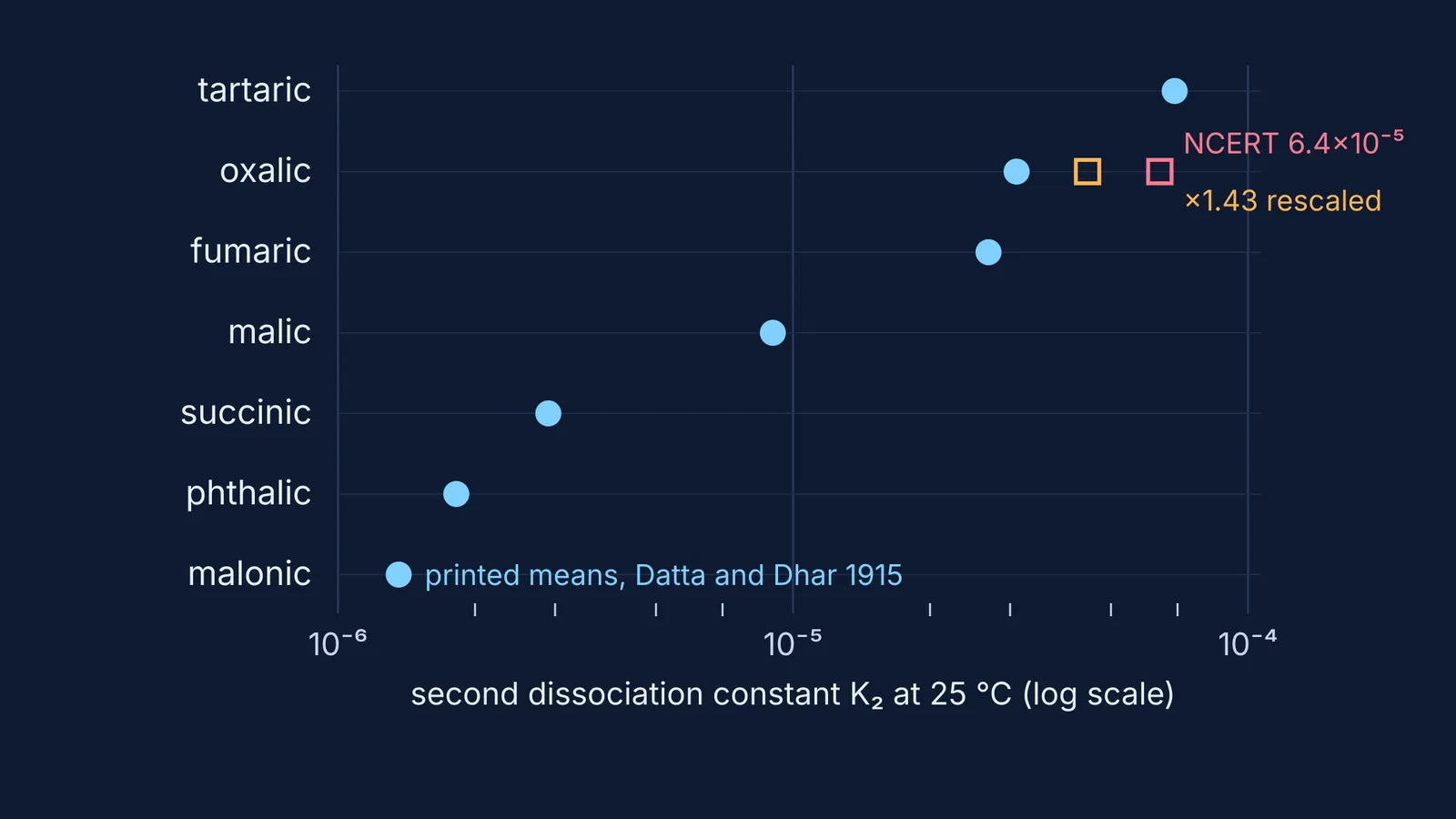
Their printed means of corrected K₂ at 25 °C, with pK₂ = −log K₂ worked out by us:
tartaric 6.90 × 10⁻⁵ (pK₂ 4.16)
oxalic 3.10 × 10⁻⁵ (4.51)
fumaric 2.69 × 10⁻⁵ (4.57)
malic 9.03 × 10⁻⁶ (5.04)
succinic 2.9 × 10⁻⁶ (5.54)
phthalic 1.82 × 10⁻⁶ (5.74)
malonic 1.36 × 10⁻⁶ (5.87)
Oxalic K₂ is about 23 times malonic K₂, the same order as in our post on why oxalic acid is stronger than malonic acid. They noted their values "are generally higher than those of Smith, which were measured at 100°".
How does their oxalic value compare with NCERT?
NCERT Class 11 Chemistry, Unit 6, Table 6.8 lists oxalic acid Ka₂ = 6.4 × 10⁻⁵ and carbonic acid Ka₁ = 4.3 × 10⁻⁷ at 298 K. Their 3.10 × 10⁻⁵ is 0.48 of NCERT's value.
Part of the gap is inherited. Every K₂ in the paper is proportional to the carbonic acid K₁ they assumed. Replace Walker's 3 × 10⁻⁷ by NCERT's 4.3 × 10⁻⁷ and every value rises by 4.3/3 = 1.43, putting oxalic at 4.4 × 10⁻⁵, about 0.69 of NCERT's figure. A derived constant carries the error of every constant used to derive it.
The scan also has a misprint: the first oxalate row prints the extra CO₂ as 0·1003 g. Its own [HCO₃⁻] of 0.00234 needs 0.0103 g (0.0103 × 10/44.01 = 0.00234).
Where does this show up in JEE and NEET?
Class 11, Equilibrium: polyprotic acids (Ka₁ ≫ Ka₂), salt hydrolysis, buffers (H₂CO₃/HCO₃⁻ sets [H⁺]) and the Henderson equation.
Class 11, Some basic concepts: converting g per 100 mL to mol L⁻¹, as in step 1.
To practise multi-step equilibrium calculations like this one, the Fermi Problem Library has a step-by-step solver that explains the reasoning. For JEE-style ionic equilibrium questions, Fermi Test Prep covers JEE Main and Advanced preparation with an AI tutor.
Quick checklist
Datta and Dhar, Presidency College, Calcutta, J. Chem. Soc. Trans. 1915.
Salt solution takes up extra CO₂: X²⁻ + H₂CO₃ ⇌ HX⁻ + HCO₃⁻.
Extra CO₂ = [HCO₃⁻] = [HX⁻]; [H⁺] = K₁ × a/(s − a).
Printed oxalic K₂ = 3.10 × 10⁻⁵; NCERT gives 6.4 × 10⁻⁵.
Using NCERT's carbonic K₁ raises all their values by 1.43.
K₂ order: tartaric > oxalic > fumaric > malic > succinic > phthalic > malonic.


