

On this page
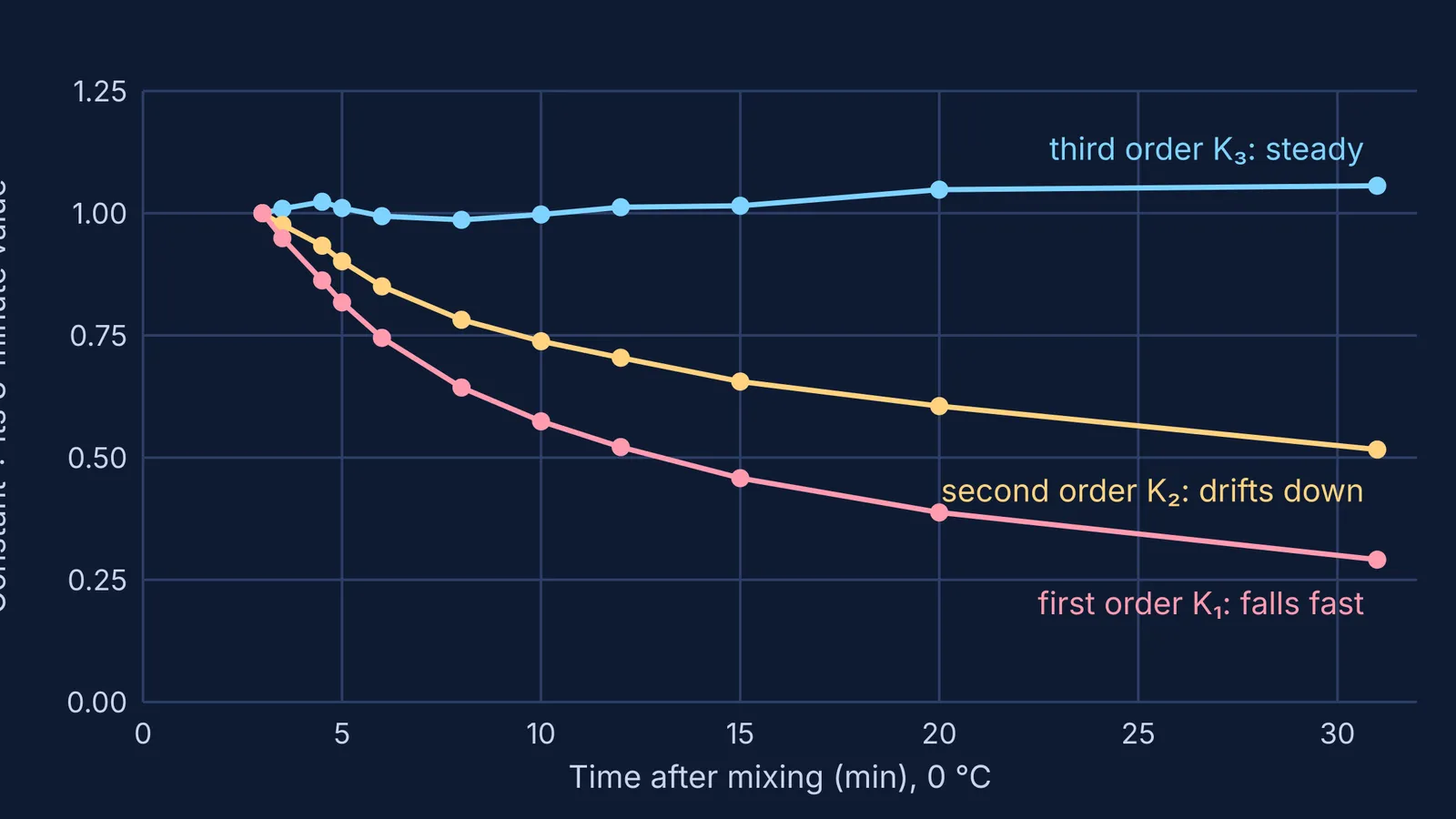
NCERT's example of a termolecular reaction is 2NO + O₂ → 2NO₂. Its chlorine twin, 2NO + Cl₂ → 2NOCl, was timed in 1913 at the University of Birmingham by Ada Finney and Joseph Edward Coates. They watched a manometer fall as three volumes of gas became two, then tested which rate law the numbers obeyed. First- and second-order constants drifted. Only the third-order constant stayed put.
Who were Ada Finney and J. E. Coates?
The paper is J. E. Coates and A. Finney, "The Rate of Combination of Gaseous Nitric Oxide and Chlorine. Part I", J. Chem. Soc. Trans. 105 (1914) 2444–2452. We read it in the scanned 1914 volume and checked every number below against the page images. It is signed from "The Chemical Laboratories, University of Birmingham" and prints the authors' full names, Joseph Edward Coates and Ada Finney. We have not checked anything else about their lives.
The work began in January 1913, and its results "formed the subject of a thesis presented in June, 1913, to the University of Birmingham". The paper does not say whose thesis. Then the authors learned that M. Trautz, and Kiss Árpád in a Budapest dissertation published only in Hungarian, had studied the same reaction. "Both of these investigators arrive at the same general conclusion as the authors, namely, that the reaction is termolecular", so they decided "to publish at once".
The reaction itself was old news. Gay-Lussac first saw NO and Cl₂ combine in 1848, by the contraction when two bulbs were joined. Nitric oxide, chlorine and nitrosyl chloride are all toxic gases, so this post covers history and numbers only.
How do you follow 2NO + Cl₂ by pressure?
Three molecules of gas become two. So each mm of Cl₂ used up lowers the total pressure by exactly 1 mm. The paper writes the pressure loss as π = P₀ − P, and the chlorine left as p = p₀ − π.
They mixed the gases in the 2 : 1 ratio of the equation, about two-thirds of an atmosphere of NO and one-third of Cl₂. The NO pressure is then always 2p, so one variable describes the whole mixture. The method is the same total-pressure bookkeeping as in finding k from total pressure data.
Two practical traps:
Mercury. Chlorine and nitrosyl chloride "rapidly attack mercury". A cushion of nitrogen between the bulb and the manometer gave "much better, although not a complete, protection".
Heat of mixing. The gas warmed when the two were mixed, so each reading was corrected to the bath temperature before p was worked out. In Table III at 3 minutes the printed P gives P₀ − P = 767.6 − 675.1 = 92.5 mm, but p₀ − p = 255.3 − 156.2 = 99.1 mm. The gas was at 2.75 °C: 675.1 × 273.15 ÷ 275.9 = 668.4 mm, and 767.6 − 668.4 = 99.2 mm. Work from the p column.
Which rate law fits the data?
They computed all three constants for every reading, with p in mm and t in minutes:
K₁ = (1/t) log(p₀/p)
K₂ = (1/t)(p₀ − p)/(p₀p)
K₃ = (1/2t)(1/p² − 1/p₀²)
Table III, at 0 °C with p₀ = 255.3 mm:
3 min, p = 156.2: K₁ = 7.1 × 10⁻², K₂ = 8.3 × 10⁻⁴, K₃ = 4.27 × 10⁻⁶
10 min, p = 99.7: 4.1 × 10⁻², 6.1 × 10⁻⁴, 4.26 × 10⁻⁶
20 min, p = 71.7: 2.8 × 10⁻², 5.0 × 10⁻⁴, 4.47 × 10⁻⁶
31 min, p = 58.2: 2.1 × 10⁻², 4.2 × 10⁻⁴, 4.51 × 10⁻⁶
K₁ falls to less than a third, K₂ to about half, and K₃ moves by about 6%. In their words, K₁ and K₂ "show a distinct drift throughout, whilst those of K₃ remain very fairly constant until about three-quarters of the reaction is over". The late rise they put down to attack on the mercury. At 14.8 °C (Table IV), K₃ stayed between 5.6 and 5.8 × 10⁻⁶ from 2 to 28 minutes. Their means were 4.2 × 10⁻⁶ at 0 °C and 5.7 × 10⁻⁶ at 14.8 °C.
Worked example: the third-order integrated rate law
Their rate law is −dp/dt = K₃p³, where p is the chlorine pressure and NO is 2p. Integrating gives 1/p² − 1/p₀² = 2K₃t.
Check a row. At 3 min: 1/156.2² = 4.099 × 10⁻⁵ and 1/255.3² = 1.534 × 10⁻⁵ mm⁻². The difference is 2.564 × 10⁻⁵. Divide by 2 × 3: K₃ = 4.27 × 10⁻⁶ mm⁻² min⁻¹, the printed value.
Half-life. Put p = p₀/2: 3/p₀² = 2K₃t½, so t½ = 3/(2K₃p₀²) = 3 ÷ (2 × 4.2 × 10⁻⁶ × 255.3²) = 5.5 min. The table agrees: 49% reacted at 5 min, 52% at 6 min.
Units. For n = 3, k has units of (concentration)⁻² time⁻¹. In concentration, c = p/(760 × 0.082T) mol/L with p in mm. Since K₃ multiplies p², multiply by (760 × 0.082T)². At 0 °C, using T = 273 K as the paper does: 760 × 0.082 × 273 = 17,014, squared 2.895 × 10⁸, times 4.2 × 10⁻⁶ = 1216 L² mol⁻² min⁻¹, the paper's figure. That is about 20 L² mol⁻² s⁻¹. At 14.8 °C (287.8 K) the same sum gives about 1830; the paper prints 1820.
Watch the convention. If you write rate = −d[Cl₂]/dt = k[NO]²[Cl₂], then k(2c)²c = 4kc³, so k = K₃/4, about 304 L² mol⁻² min⁻¹ at 0 °C. Always say which rate law your k belongs to.
The same integrated law, used on a solution reaction, is in Arthur Noyes's 1895 tin and iron third-order reaction.
Why did heating barely speed it up?
The paper calls the temperature coefficient "very small (about 1.23 for an increase of temperature of 10°)". Most reactions you meet roughly double or triple per 10 °C.
Activation energy, two points. With the pressure-unit constants, Ea = R ln(k₂/k₁) ÷ (1/T₁ − 1/T₂) = 8.314 × ln(5.7/4.2) ÷ (1/273.15 − 1/287.95) = 8.314 × 0.3054 ÷ 1.882 × 10⁻⁴ ≈ 13.5 kJ/mol. Over 10 °C this gives (5.7/4.2)^(10/14.8) = 1.23, the paper's figure.
If you use the concentration-unit constants, 1216 and 1820, you get about 18 kJ/mol instead. The unit conversion multiplies by T², which adds roughly 2RT. Either way the barrier is small. Treat both as rough: "Only one trustworthy set of readings was obtained at a temperature above zero".
The paper says only that the reaction is "termolecular". A two-step route through a short-lived intermediate gives the same rate law, as shown in deriving a rate law from a mechanism. The 1914 data cannot choose between them.
Where does this come up in JEE and NEET?
Class 12 Chemical Kinetics: finding order by testing integrated rate laws, units of k for n = 3, following a gas reaction by pressure, the Arrhenius equation, and order versus molecularity.
For more integrated-rate-law numericals, the Fermi Problem Library has a step-by-step solver that explains the reasoning. For exam practice, Fermi Test Prep covers JEE Main and Advanced preparation with an AI tutor.
Quick checklist
2NO + Cl₂ → 2NOCl: 3 volumes become 2, so the pressure drop equals the Cl₂ used.
K₁ and K₂ drifted; K₃ stayed near 4.2 × 10⁻⁶ mm⁻² min⁻¹ at 0 °C.
1/p² − 1/p₀² = 2K₃t, and t½ = 3/(2K₃p₀²) ≈ 5.5 min.
mm⁻² min⁻¹ to L² mol⁻² min⁻¹: multiply by (760 × 0.082T)², giving 1216 at 0 °C.
rate = k[NO]²[Cl₂] gives k = K₃/4.
About 1.23 times faster per 10 °C; Ea roughly 13–18 kJ/mol.


