

On this page
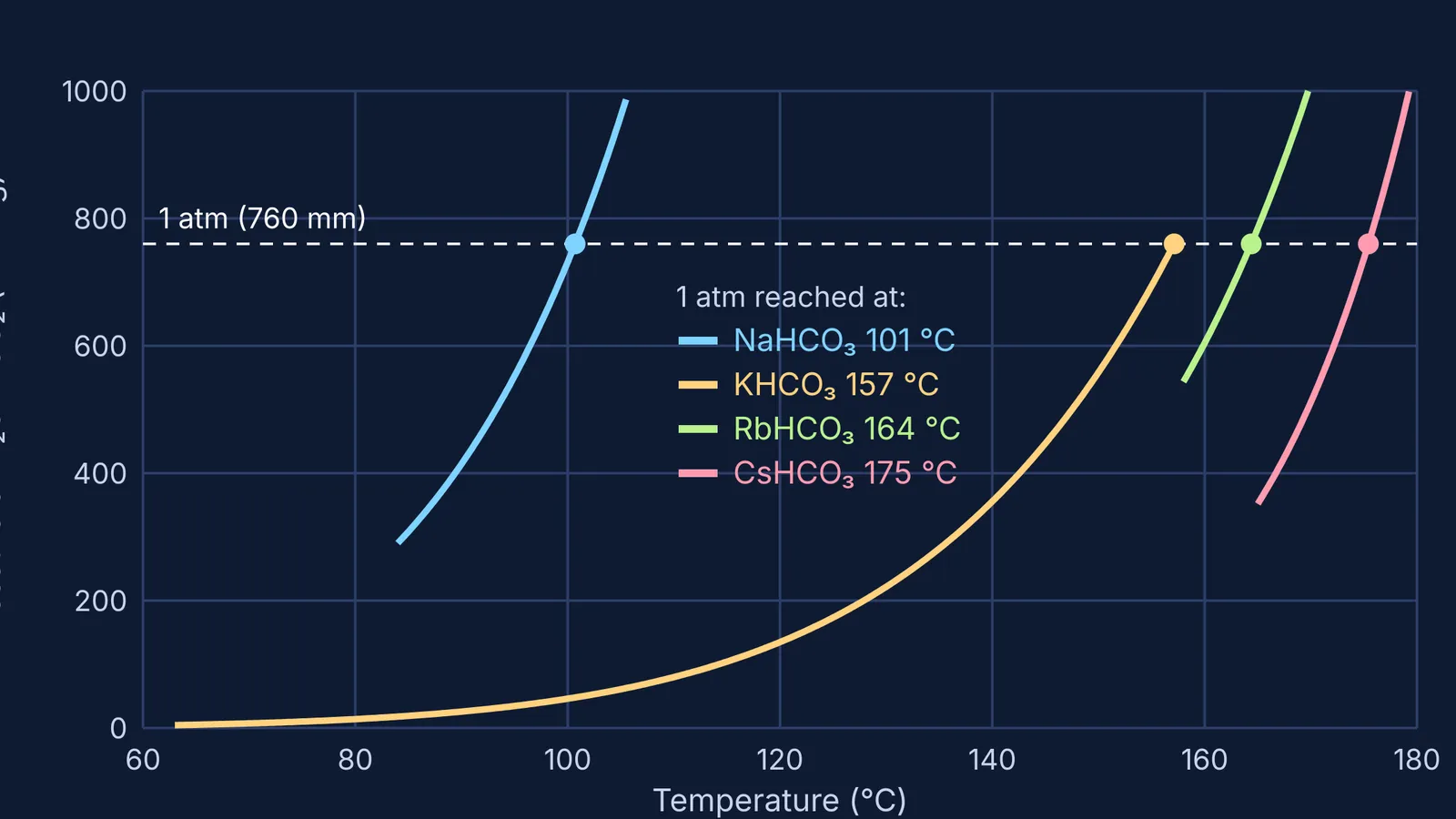
Warm baking soda in a sealed, evacuated flask and the gas pressure settles at a value set by temperature alone. Between 1911 and 1914 Robert Martin Caven and Henry Julius Salomon Sand measured that pressure for the four alkali bicarbonates. For NaHCO₃ it reaches 1 atm just above 100 °C. For KHCO₃ it takes about 157 °C. The curves put numbers on "thermal stability increases down group 1", and they make a clean Kp = (P/2)² problem.
Who were Caven and Sand, and what did they measure?
The work is in two papers: R. M. Caven and H. J. S. Sand, "The Dissociation Pressures of Alkali Bicarbonates. Part I. Sodium Hydrogen Carbonate", J. Chem. Soc. Trans. 99 (1911) 1359–1369, and "Part II. Potassium, Rubidium, and Caesium Hydrogen Carbonates", 105 (1914) 2752–2761. We read both in the scanned volumes for 1911 and 1914 and checked the numbers below against the page images. Part II is signed from University College, Nottingham and the Sir John Cass Technical Institute, London. We have not checked any other biographical details.
Their aim was "to discover to what extent the relative stability of each is connected with the basigenic behaviour of its metal, and the position of the latter in the periodic system". The reaction is:
2MHCO₃(s) ⇌ M₂CO₃(s) + H₂O(g) + CO₂(g)
How do you measure the gas pressure over a hot solid?
They heated bicarbonate mixed with normal carbonate in an evacuated flask in a thermostat. Two problems took most of the effort.
Stray water. Excess of either gas would give "a too high result", so they pumped off gas at high temperature until two successive withdrawals gave the same reading.
Crusts. Equilibrium was slow, "doubtless the result of impermeable crusts". They used about "five hundred-fold" the NaHCO₃ the gas required, and trusted a reading only when heating and cooling gave the same value. The lowest good heating point, 95 °C, needed "about ten days".
In 1914 they absorbed and weighed the gas. At 101.5 °C, NaHCO₃ gave 0.0118 g of water (6.55 × 10⁻⁴ mol) and 0.0295 g of CO₂ (6.70 × 10⁻⁴ mol): 1 : 1.02, as the equation says.
Why is Kp equal to (P/2)²?
The two solids drop out of the expression, as explained in heterogeneous equilibria: why solids drop out of K. So Kp = p(H₂O) × p(CO₂). With no other gas added, the two are formed 1 : 1, so each is half the total pressure P and Kp = (P/2)².
They fitted every salt to log p = a − b/T, with p in mm of mercury, base-10 logs, and T = t + 273:
NaHCO₃: a = 11.8185, b = 3340
KHCO₃: a = 10.832, b = 3420
RbHCO₃: a = 12.712, b = 4300
CsHCO₃: a = 16.930, b = 6300
These reproduce their printed values, such as 604 mm for KHCO₃ at 151.8 °C. The same idea, with ammonia over a cadmium salt, is in Lang and Rigaut's 1899 cadmium ammine pressures.
Worked example: Kp, Le Chatelier and ΔH for baking soda
Pressure at 100 °C. log P = 11.8185 − 3340 ÷ 373 = 2.864, so P = 731 mm.
Kp. 731 ÷ 760 = 0.962 atm. Each gas is 0.481 atm, so Kp = 0.481² = 0.231 atm².
Le Chatelier: add a product. Suppose the flask already holds CO₂ at 0.50 atm. Let the steam pressure be x. Then x(0.50 + x) = 0.231, so x² + 0.50x − 0.231 = 0 and x = (−0.50 + √1.176) ÷ 2 = 0.292 atm. Steam falls from 0.481 to 0.292 atm: less bicarbonate decomposes, as the principle predicts.
Le Chatelier: heat it. At 110 °C the fit gives 1253 mm, or 1.648 atm, so Kp = 0.824² = 0.679 atm². Kp nearly triples for 10 °C. The reaction is endothermic.
ΔH from the slope. Since log Kp = 2 log P + constant, a plot of log Kp against 1/T has slope −2b. So ΔH = 2 × 2.303 × R × b = 2 × 2.303 × 8.314 × 3340 = 127.9 kJ for 2 mol of NaHCO₃.
Check. Common textbook enthalpies of formation (NaHCO₃ −950.8, Na₂CO₃ −1130.7, H₂O(g) −241.8, CO₂ −393.5 kJ/mol) give ΔH = −1766.0 − (−1901.6) = +135.6 kJ. That is within 6%.
For KHCO₃ the same arithmetic gives 131 kJ; Caven and Sand compared their 31,460 cal with 32,830 cal from de Forcrand's heats of formation.
Does baking soda decompose at 50 °C or at 100 °C?
Both figures are fine. They answer different questions.
In a closed vessel, decomposition stops once the gases reach Kp. The fit crosses 760 mm at 373.7 K, or 100.7 °C on their T = t + 273 scale: the temperature at which the salt can push its gases out against the atmosphere, like a boiling point.
In open air, the gases are swept away and never build up. Our post on washing soda vs baking soda quotes PubChem: decomposition starts above 50 °C. Caven and Sand's own 1911 paper cites Gautier (1876), who saw solid NaHCO₃ decompose "when temperatures above 35° were employed".
The numbers show why. At 50 °C their equation gives about 30 mm, so Kp = (15/760)² ≈ 3.9 × 10⁻⁴ atm². In room air, with say 0.02 atm of steam and 0.0004 atm of CO₂, Q = 8 × 10⁻⁶ atm², about 50 times smaller than K. With Q < K, decomposition is favoured. How fast it goes is a rate question, so the open-air figure marks where the loss becomes noticeable. Treat the 50 °C value as rough: it lies below about 85 °C, the lowest point where they trusted their readings.
How does stability change from sodium to caesium?
The pressure reaches 1 atm at about 101 °C for NaHCO₃, 157 °C for KHCO₃, 164 °C for RbHCO₃ and 175 °C for CsHCO₃. At 100 °C, KHCO₃ manages only about 46 mm.
Rubidium and caesium fitted only above 158 °C and 165 °C. Below that the pressures ran high, which they traced to water held by the "exceedingly hygroscopic" normal carbonates; the 1-atm points lie in the range that fits. Their Rb and Cs heats disagreed with de Forcrand's (59,960 against 36,260 cal for Cs), and "We are unable to offer any explanation". So do not use their Cs value for ΔH.
Their conclusion: the stabilities "increase with rise of atomic weight", and NaHCO₃ "is widely separated from the other three salts in stability". The gaps are 56 °C from Na to K, then 7 and 11 °C. They called this a break at "the transition from the short to the long periods". Your textbook explains the trend by cation size; these curves are the measurements behind it.
Where does this come up in JEE and NEET?
Class 11 Equilibrium: heterogeneous Kp, Le Chatelier's principle, and how K changes with temperature.
Class 11 s-block: 2NaHCO₃ → Na₂CO₃ + H₂O + CO₂, and the thermal stability of alkali-metal hydrogencarbonates.
The Fermi Simulation Lab has interactive simulations for ideas easier to see than read, such as a shifting equilibrium. For timed equilibrium numericals, Fermi Test Prep covers JEE Main and Advanced preparation with an AI tutor.
Quick checklist
2MHCO₃(s) ⇌ M₂CO₃(s) + H₂O(g) + CO₂(g), with Kp = (P/2)² when no gas is added.
NaHCO₃: 731 mm at 100 °C, Kp ≈ 0.231 atm²; 1 atm at about 101 °C.
Slope of log P against 1/T gives ΔH/2; ΔH ≈ 128 kJ per 2 mol NaHCO₃.
Closed-vessel 1 atm point and open-air decomposition are different questions.
1 atm at about 101, 157, 164 and 175 °C for Na, K, Rb and Cs.


