

On this page
Put methanol and methylamine side by side. Their molar masses are almost the same (32 and 31 g/mol), both have an H on an electronegative atom, and both can, in principle, lose that H⁺. Yet methanol is about 10²⁴ times more acidic than methylamine. That gap explains several reactions you meet in JEE and NEET: why amines ignore NaOH, why sodamide is such a strong base, and why a sulphonyl group suddenly makes an N–H acidic in Hinsberg's test.
Why are amines less acidic than alcohols?
When an acid loses H⁺, what matters is how comfortable the leftover anion is.
Methanol gives the methoxide ion, CH₃O⁻. The negative charge sits on oxygen.
Methylamine gives the methylamide ion, CH₃NH⁻. The negative charge sits on nitrogen.
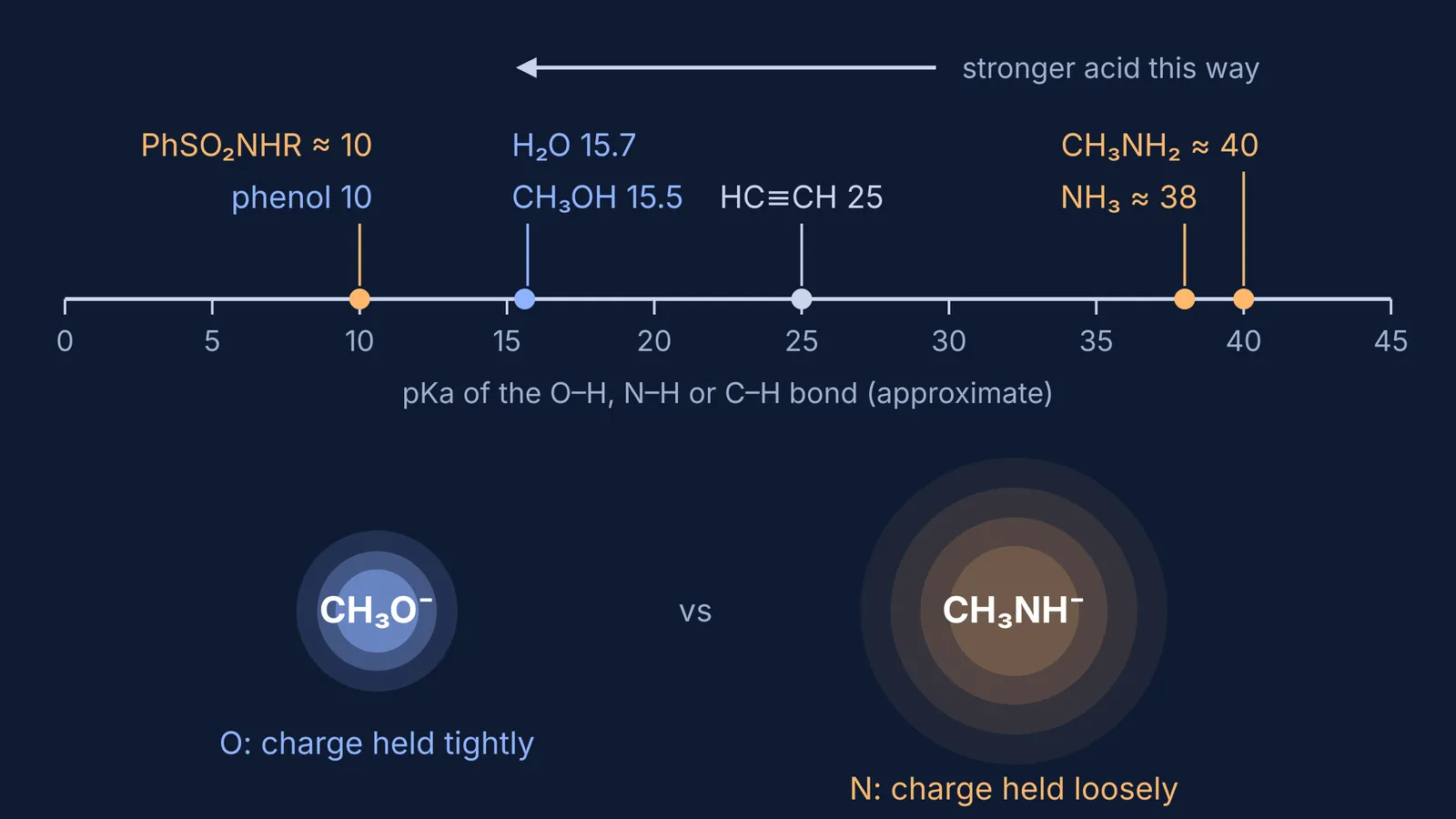
Oxygen is more electronegative than nitrogen (about 3.4 against 3.0 on the Pauling scale). An electronegative atom pulls electron density towards its nucleus and holds an extra negative charge at lower energy. So CH₃O⁻ is the more stable anion, and the equilibrium R–OH ⇌ R–O⁻ + H⁺ lies further to the right than R–NH₂ ⇌ R–NH⁻ + H⁺.
This is the NCERT answer and it is correct. Two details make it stronger:
It is not about bond strength. An N–H bond is not stronger than an O–H bond; if anything it is a little weaker. If bond strength decided acidity, amines would win. The difference comes from the anion.
N and O are in the same period. Because they are similar in size, electronegativity is the deciding factor. (Down a group, size takes over, which is why H₂S is more acidic than H₂O.)
Note the fair comparison: "alcohols of similar mass", such as methanol (32) vs methylamine (31), or ethanol (46) vs ethylamine (45). Within alcohols, the order primary > secondary > tertiary has its own story, told in why primary alcohols are more acidic than tertiary ones.
How weak an acid is an amine, in numbers?
Typical textbook values, rounded (tables differ, especially for N–H):
Phenol: pKa about 10.
Water: pKa 15.7. Methanol: pKa about 15.5.
Ethyne (HC≡CH): pKa about 25.
Ammonia: pKa about 38.
Methylamine (N–H): pKa about 40.
Sources quote anywhere from about 33 to 41 for ammonia and simple amines, depending on the solvent and method. The exact number does not matter for exams. The size of the gap does: around 24 pKa units between an alcohol and an amine.
Worked example: does methoxide pull a proton off methylamine?
Consider CH₃O⁻ + CH₃NH₂ ⇌ CH₃OH + CH₃NH⁻. Which side wins, and by how much?
Write K from the two Ka values. K = Ka(CH₃NH₂) / Ka(CH₃OH). The acid on the left is CH₃NH₂; the acid on the right is CH₃OH.
Convert to pKa. K = 10^(−pKa left acid) / 10^(−pKa right acid) = 10^(pKa(CH₃OH) − pKa(CH₃NH₂)).
Substitute. K = 10^(15.5 − 40) = 10⁻²⁴·⁵ ≈ 3 × 10⁻²⁵.
Interpret. The equilibrium lies almost entirely on the left. Methoxide cannot remove a proton from methylamine. The reverse is true: CH₃NH⁻ grabs a proton from methanol completely (K ≈ 3 × 10²⁴).
The rule behind the calculation is general. An acid–base equilibrium favours the side with the weaker acid (higher pKa). Methylamine (pKa ≈ 40) is the weaker acid, so it stays on the side where it is protonated.
You can redo this for any pair on the list. NH₂⁻ + HC≡CH: K = 10^(38 − 25) = 10¹³, so sodamide deprotonates ethyne. That is the reaction used in the acidity of terminal alkynes with sodamide. For more acid–base equilibria worked line by line, the Fermi Problem Library has a step-by-step solver that explains the reasoning.
Do amines react with NaOH or sodium?
Not with NaOH. For CH₃NH₂ + OH⁻ ⇌ CH₃NH⁻ + H₂O, K = 10^(15.7 − 40) ≈ 5 × 10⁻²⁵. Hydroxide is far too weak a base. This is why amines dissolve in acids but not in alkali, which is the basis of separating them by extraction.
Removing an N–H proton needs a base stronger than the amide ion itself, or a very reactive metal:
Butyllithium. (CH₃)₂CH–NH–CH(CH₃)₂ + C₄H₉Li → [(CH₃)₂CH]₂NLi + C₄H₁₀. This makes lithium diisopropylamide (LDA). It works because butane (pKa above 45) is an even weaker acid than the amine.
Sodium metal. 2Na + 2NH₃ → 2NaNH₂ + H₂, usually with an iron catalyst. This is how sodamide is made.
So amines are not "non-acidic". They are extremely weak acids, and you need extreme reagents to show it.
Why is the amide ion a stronger base than alkoxide?
Weak acid, strong conjugate base. Because NH₃ (pKa ≈ 38) holds its proton about 10²² times more tightly than CH₃OH (pKa ≈ 15.5), NH₂⁻ wants a proton much more than CH₃O⁻ does.
That is why NaNH₂ deprotonates alcohols completely (NH₂⁻ + CH₃OH → NH₃ + CH₃O⁻, K ≈ 10²²·⁵), deprotonates terminal alkynes, and is used to make alkynes by double elimination. It also explains a lab rule: you cannot use sodamide in water or alcohol, because it is destroyed at once.
When does an N–H become acidic?
Attach an electron-withdrawing group that can spread the negative charge. In a sulphonamide, R–NH–SO₂Ph, the anion's charge is shared with the two oxygens of the SO₂ group. The pKa falls to about 10, close to phenol. That is why the product from a primary amine and benzenesulphonyl chloride dissolves in KOH while the one from a secondary amine (no N–H left) does not, as explained in Hinsberg's reagent: separating 1°, 2° and 3° amines.
The full ladder of acidity, weakest to strongest, is:
amine N–H (≈ 40) < ammonia (≈ 38) < terminal alkyne C–H (25) < alcohol O–H (≈ 15.5) ≈ water (15.7) < phenol O–H (10) ≈ sulphonamide N–H (≈ 10)
Quick checklist
Amines are weaker acids than alcohols because RNH⁻ holds negative charge less well than RO⁻ (N is less electronegative than O).
Rounded pKa: CH₃OH ≈ 15.5, NH₃ ≈ 38, CH₃NH₂ ≈ 40.
Do not confuse the amine's own pKa (≈ 40) with that of R–NH₃⁺ (≈ 10.6).
K for a proton transfer = 10^(pKa of product acid − pKa of reactant acid).
Amines do not react with NaOH; BuLi or Na is needed to remove N–H.
NH₂⁻ is a much stronger base than RO⁻, so NaNH₂ deprotonates alcohols and alkynes.
A sulphonyl group brings N–H acidity down to about pKa 10.


