

On this page
Ask why methanol is a stronger acid than tert-butanol and the usual answer is two words: inductive effect. That answer is in the textbook, and it is half the story. The other half is water.
What makes an alcohol acidic at all?
An alcohol acts as an acid when it gives up the hydrogen of its O–H group and becomes an alkoxide ion, RO⁻. The more stable that alkoxide is, the more readily the proton leaves, and the lower the pKa.
The NCERT Class 12 chemistry chapter on alcohols, phenols and ethers gives the order of acid strength as primary > secondary >> tertiary. It explains this with electron-releasing groups such as –CH₃ and –C₂H₅, which increase electron density on oxygen and decrease the polarity of the O–H bond.
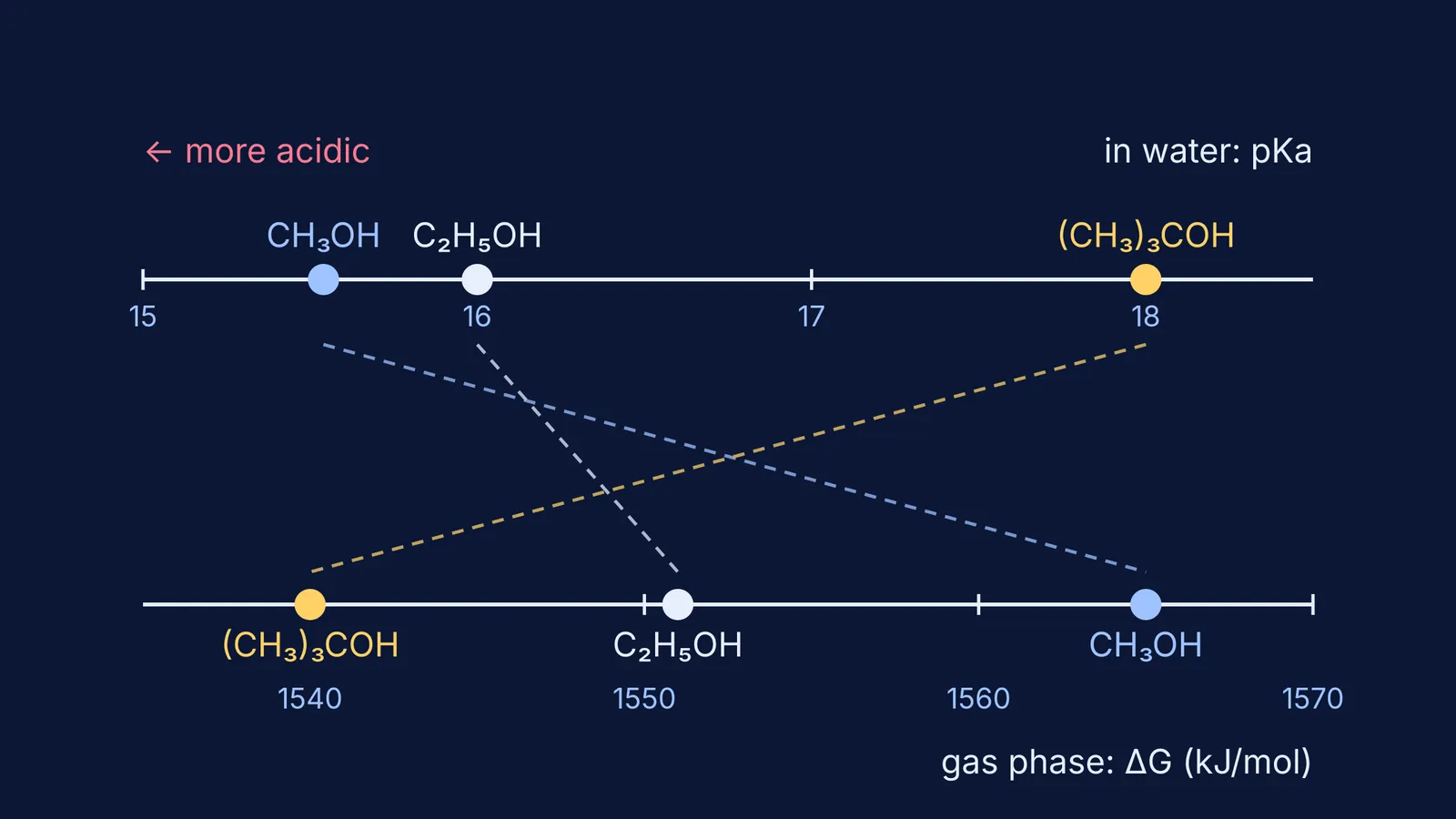
Measured values agree. The OpenStax Organic Chemistry table of pKa values lists methanol at 15.54, ethanol at 16 and tert-butyl alcohol at 18. The same table puts water at 15.74, so methanol is roughly level with water, even though NCERT's general statement is that alcohols are weaker acids than water.
Why do alkyl groups make an alcohol less acidic?
In water, two effects work in the same direction.
Electron push. Each alkyl group releases electron density toward the oxygen (the +I effect). The alkoxide already carries a full negative charge, so adding more density makes it less stable. Tert-butoxide has three methyl groups on the carbon next to oxygen; methoxide has none. Our post on why the inductive effect fades along a carbon chain shows how far this push reaches.
Crowded solvation. A negative charge in water is stabilised by water molecules hydrogen-bonding to it. OpenStax explains that the oxygen of an unhindered alkoxide such as methoxide is easily solvated by water, while the hindered oxygen of tert-butoxide is less easily solvated and so less stable. Three methyl groups act like elbows that keep the water away.
A less stable conjugate base means the equilibrium ROH ⇌ RO⁻ + H⁺ sits further to the left. That is exactly what a higher pKa says.
Is the inductive effect the whole story?
No, and the clearest evidence comes from taking the water away. John Brauman and Larry Blair measured the acidities of alcohols in the gas phase (Journal of the American Chemical Society, 1968; fuller paper in 1970). As the LibreTexts summary of their work/Alcohols/Properties_of_Alcohols/Acidities_of_Alcohols) explains, the order of acidity in the gas phase is the opposite of the order in aqueous solution: tert-butanol is more acidic than isopropanol, followed by ethanol and then methanol. They attributed the order in solution mainly to polarisability and solvation, not to electron donation by the alkyl groups.
The NIST Chemistry WebBook shows the flip in numbers. From a 1979 study by Bartmess and colleagues, the free energy needed to remove the proton in the gas phase is 1565 kJ/mol for methanol, 1551 kJ/mol for ethanol and 1540 kJ/mol for tert-butanol. A smaller number means the proton comes off more easily, so in the gas phase tert-butanol wins.
Without water, a bigger, more polarisable alkyl group helps spread the charge. In water, poor solvation of bulky tert-butoxide outweighs that.
Worked example: how much more acidic is methanol than tert-butanol?
pKa is a log scale, so a difference of 1 means a factor of 10 in the acid constant Ka. Using the OpenStax values:
Difference in pKa: 18 − 15.54 = 2.46.
Ratio of acid constants: Ka(methanol) ÷ Ka(tert-butanol) = 10^2.46.
10^2.46 is about 290.
So in water, methanol's acid constant is about 290 times that of tert-butanol. Try the same steps for methanol and ethanol: 16 − 15.54 = 0.46, and 10^0.46 is about 2.9. One extra carbon costs a factor of about three; a carbon carrying three methyl groups costs a factor of nearly 300. To see where alcohols sit among other acids, use our pKa ladder of common organic acids.
How do you rank any set of alcohols by acidity?
Classify each alcohol as primary, secondary or tertiary by counting the carbons attached to the carbon that holds –OH.
Check for electron-withdrawing groups such as F, Cl or NO₂ near the oxygen. They pull charge away from the alkoxide, make the alcohol more acidic and can outweigh the primary-secondary-tertiary pattern.
With no such groups, fewer alkyl groups on that carbon means a stronger acid in water: methanol, then other primary alcohols, then secondary, then tertiary.
In a written answer, name both reasons: the +I effect and the poorer solvation of the bulkier alkoxide.
If your rankings keep going wrong at step 2 or 3, the Fermi Problem Library has worked problems with a step-by-step solver that explains the reasoning rather than printing an answer. If the gap is the idea itself, the Fermi Concept Library gives every concept in chemistry its own lesson and its place in the map.
Before you write inductive effect next time, ask: in water, or in the gas phase?


