

On this page
Statement and match-the-list questions appear in recent NEET papers and are slow: every statement or pair needs a check. Here are eight original Wave Optics questions, four per format.
What do these Wave Optics questions cover?
Every item fits the wave-optics part of Unit 16 in the NMC's NEET (UG)-2026 syllabus. The NEET (UG)-2026 information bulletin sets single-correct questions, +4 or −1. Facts follow NCERT Physics Chapter 10, Wave Optics. New to the chapter? Read our guide on how to prepare Optics for NEET.
Statement I/II options: (1) Both correct (2) Both incorrect (3) I correct, II incorrect (4) I incorrect, II correct.
Statement questions
Q1 (easy, statements). Which are correct? A. Huygens' principle gives a wavefront's later shape from its present shape. B. Where light's speed is the same in every direction, secondary wavelets are spherical. C. The new wavefront is the backward envelope of the wavelets. D. Huygens' construction gives the law of reflection. E. Huygens removed the backwave using rigorous wave theory.
(1) A, C and D only (2) A, B and D only (3) A, B, D and E only (4) B, C and E only
Answer: (2). A, B true: NCERT. C false: it is the forward envelope. D true: congruent triangles give i = r. E false: Huygens made an ad hoc assumption; rigorous theory came later.
Trap: (3) credits Huygens with the later theory.
Q2 (easy, Statement I/II). Statement I: Huygens' construction predicts that a wave bending towards the normal is slower in the second medium. Statement II: Foucault's 1850 experiment found light faster in water than in air.
Answer: (3). I is correct: sin i/sin r = v₁/v₂, so r < i means v₂ < v₁. II is incorrect: Foucault found light slower in water, backing the wave model.
Trap: (1) recalls the corpuscular prediction.
Q3 (medium, Statement I/II). Sodium-lamp light falls on one Polaroid. Statement I: Rotating this Polaroid leaves the transmitted intensity unchanged. Statement II: The light leaving this Polaroid is linearly polarised, with its electric field along the Polaroid's pass axis.
Answer: (1). I is correct: unpolarised light has no preferred direction. II is correct: NCERT defines the pass axis this way.
Trap: (4) assumes a single Polaroid dims as it turns.
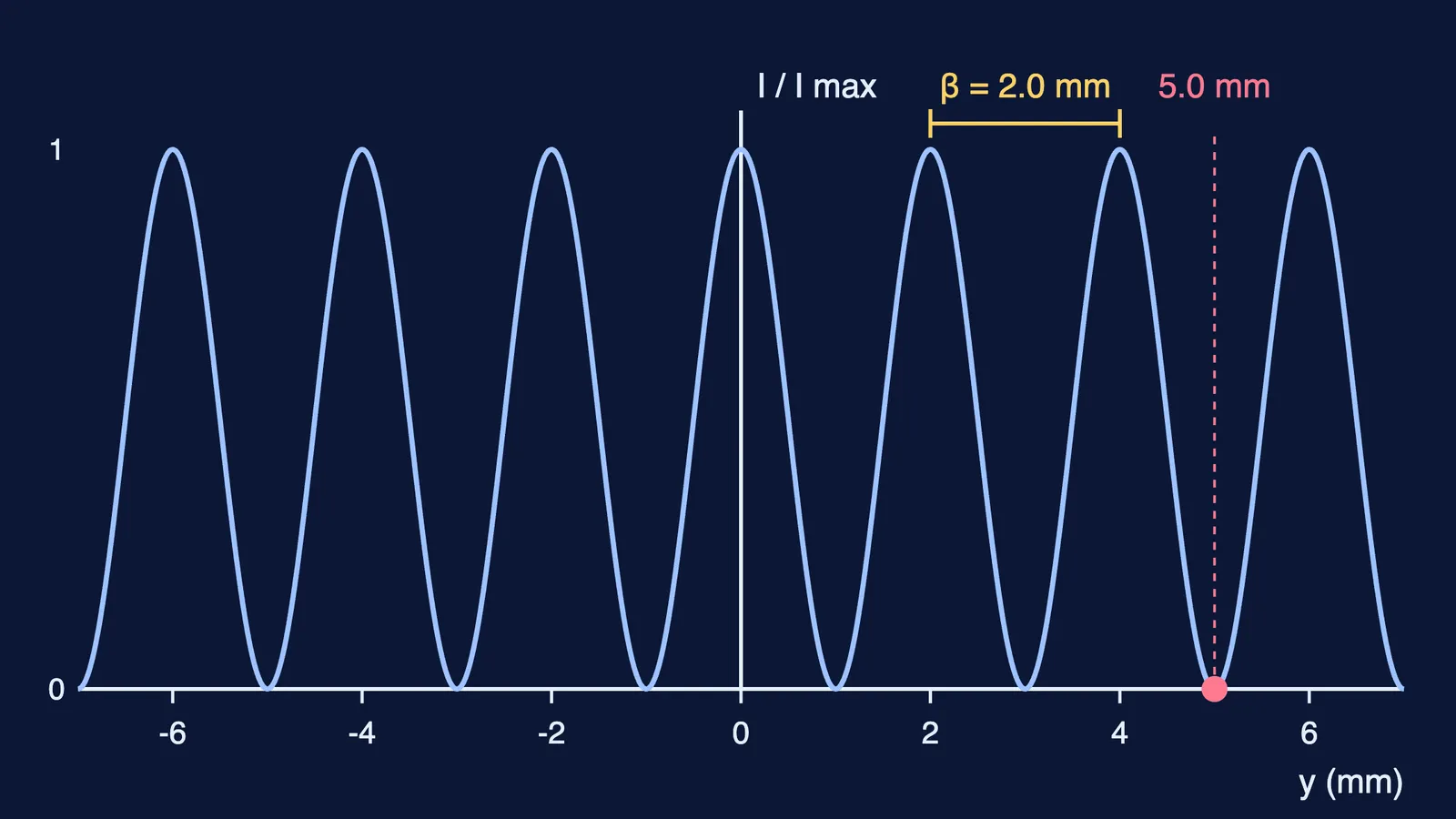
Q4 (hard, statements). Young's experiment: λ = 640 nm, d = 0.40 mm, D = 1.25 m. Which are correct? A. Fringe width is 2.0 mm. B. The third dark fringe is 6.0 mm from the centre. C. The angular fringe width is 1.6 × 10⁻³ rad. D. With the screen at 2.5 m, fringe width is 1.0 mm. E. With d = 0.80 mm, fringe width is 1.0 mm.
(1) A, B and E only (2) A, B, C and E only (3) A, C and D only (4) A, C and E only
Answer: (4). A true: β = λD/d = 2.0 mm. B false: dark fringes sit at (n + ½)β, so the third is at 5.0 mm. C true: λ/d = 640 nm ÷ 0.40 mm = 1.6 × 10⁻³ rad. D false: β doubles to 4.0 mm. E true: β ∝ 1/d.
Trap: (2) puts dark fringes at nβ.
Match-the-list questions
Q5 (easy, match). List-I: (A) Huygens' principle (B) Malus' law (C) Snell's law from the wave model (D) Coherent sources. List-II: (I) I = I₀cos²θ (II) every wavefront point is a source of secondary wavelets (III) phase difference constant in time (IV) sin i/sin r = v₁/v₂.
(1) A-II, B-I, C-III, D-IV (2) A-IV, B-I, C-II, D-III (3) A-II, B-I, C-IV, D-III (4) A-III, B-IV, C-I, D-II
Answer: (3). A-II: NCERT's statement. B-I: Malus' law. C-IV: from Huygens' construction for refraction. D-III: NCERT's definition.
Trap: (1) swaps C and D.
Q6 (medium, match). List-I: (A) path difference for constructive interference (B) angle of the nth single-slit minimum (C) intensity of two identical coherent waves, phase difference φ (D) position of a Young's dark fringe. List-II: (I) nλ/a (II) (n + ½)λD/d (III) nλ (IV) 4I₀cos²(φ/2).
(1) A-III, B-I, C-IV, D-II (2) A-III, B-II, C-IV, D-I (3) A-I, B-III, C-IV, D-II (4) A-II, B-I, C-IV, D-III
Answer: (1). A-III: bright. B-I: minima at θ ≈ nλ/a. C-IV: equal amplitudes. D-II: halfway between bright fringes.
Trap: (3) swaps A and B: a whole number of wavelengths is bright for two slits, but a sin θ = nλ is dark for one.
Q7 (medium, match). Single slit: match each set-up with its central maximum's width. List-I: (A) λ = 700 nm, a = 0.20 mm, D = 2.0 m (B) 700 nm, 0.40 mm, 2.0 m (C) 420 nm, 0.20 mm, 1.0 m (D) 420 nm, 0.30 mm, 1.0 m. List-II: (I) 2.8 mm (II) 4.2 mm (III) 7.0 mm (IV) 14 mm.
(1) A-IV, B-III, C-I, D-II (2) A-III, B-IV, C-II, D-I (3) A-II, B-I, C-IV, D-III (4) A-IV, B-III, C-II, D-I
Answer: (4). First minima at ±λ/a give width 2λD/a. A-IV: 14 mm. B-III: double the slit, half the width. C-II: 4.2 mm. D-I: 2.8 mm.
Trap: (1) gives the wider slit the wider maximum.
Q8 (hard, match). Unpolarised light of 96 W m⁻² meets the first Polaroid. Match the arrangement with the intensity that emerges. List-I: (A) one Polaroid (B) two, axes 60° apart (C) two crossed, with a third between at 60° to the first (D) three, each axis turned 60° from the one before. List-II: (I) 3 W m⁻² (II) 9 W m⁻² (III) 12 W m⁻² (IV) 48 W m⁻².
(1) A-IV, B-III, C-I, D-II (2) A-IV, B-III, C-II, D-I (3) A-IV, B-II, C-III, D-I (4) A-III, B-IV, C-II, D-I
Answer: (2). A-IV: half passes, 48. B-III: 48 cos²60° = 12. C-II: 48 cos²60° cos²30° = 9. D-I: 48 cos²60° cos²60° = 3.
Trap: (1) swaps C and D; C's second step is only 30°.
How do you work these faster?
Mark each statement T or F before reading codes.
In Young's experiment, find β = λD/d first; every fringe is a multiple of it.
The central maximum spans 2λ/a, not λ/a.
Halve unpolarised light once, then apply cos² at each later Polaroid.
Struggling to picture why a third Polaroid lets light through two crossed ones? The Fermi Simulation Lab has interactive simulations for the ideas that are easier to see than to read.
For a method that works in any chapter, read our strategy for NEET statement-based questions.


