

On this page
A Taylor polynomial is only useful if you know how wrong it might be. Approximations like sin θ ≈ θ lean on the first few terms of a series; the Lagrange form of the remainder turns "a few terms" into an error you can state and trust.
What is the Lagrange form of the remainder?
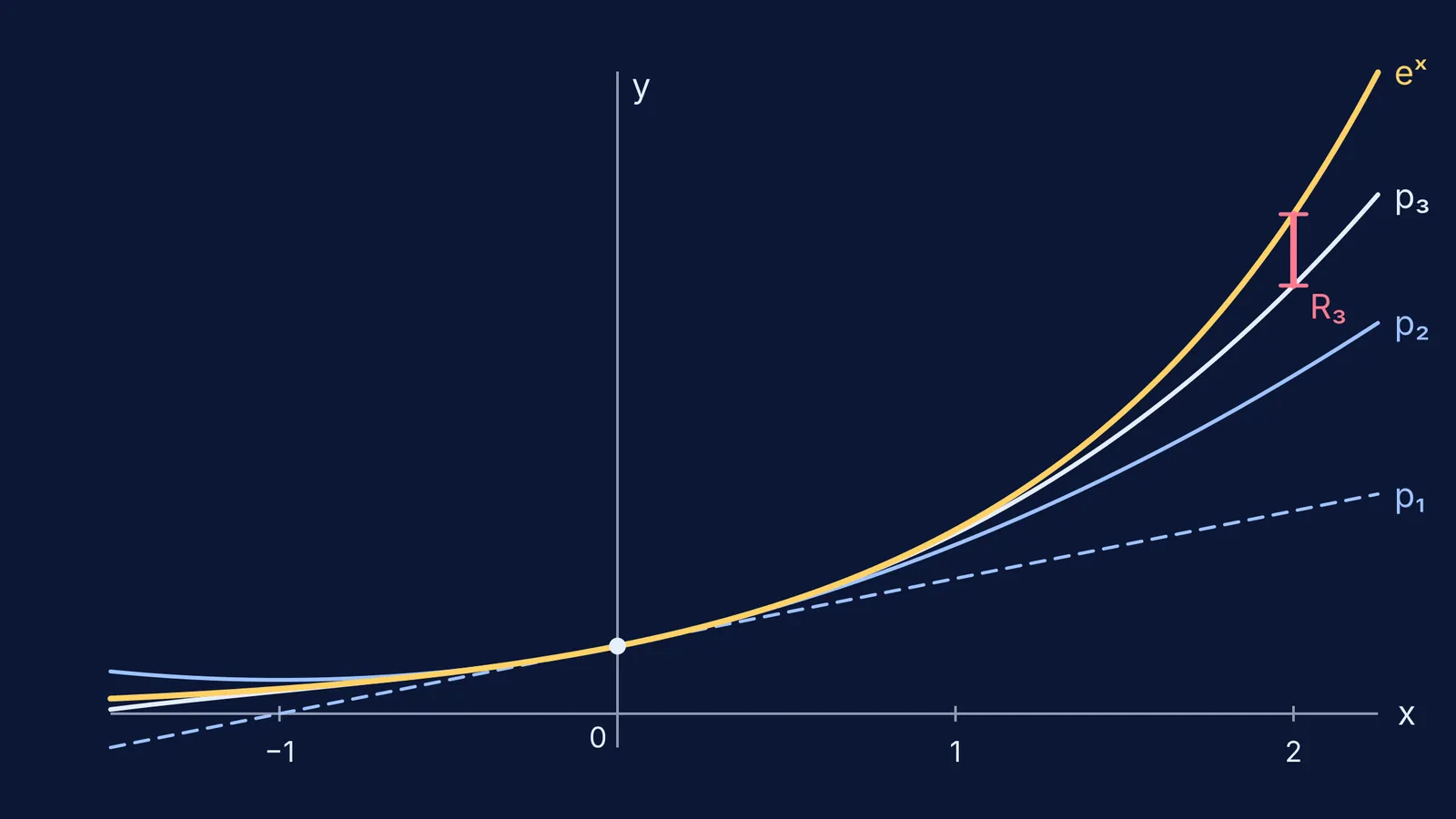
Write pₙ(x) for the degree-n Taylor polynomial of f centred at a, and Rₙ(x) = f(x) − pₙ(x) for the error. Taylor's theorem with remainder, as stated in OpenStax Calculus Volume 2, section 6.3, says that if f can be differentiated n + 1 times on an interval containing a, then for each x in that interval there is a number c between a and x with Rₙ(x) = f⁽ⁿ⁺¹⁾(c) · (x − a)ⁿ⁺¹ / (n + 1)!.
You never find out what c is. You do not need to. If the (n + 1)th derivative stays below some ceiling M everywhere on the interval, the same OpenStax section gives the usable bound: the error is at most M · |x − a|ⁿ⁺¹ / (n + 1)!.
If you have used the mean value theorem to prove inequalities, the move is the same: swap an unknown point for a bound you can defend.
How accurate is a Taylor polynomial for eˣ?
Every derivative of eˣ is eˣ. To estimate e, take a = 0 and x = 1. Then c lies between 0 and 1, so the derivative eᶜ is below e, which is below 3. The error of the degree-n polynomial at x = 1 is therefore at most 3/(n + 1)!. Here is what that promises as you add terms:
Degree 4: at most 3/120 = 0.025
Degree 5: at most 3/720, about 0.0042
Degree 6: at most 3/5040, about 0.00060
Degree 7: at most 3/40320, about 0.000074
So if you want e to within 0.0001, degree 7 is the first that guarantees it: 1 + 1 + 1/2 + 1/6 + 1/24 + 1/120 + 1/720 + 1/5040 = 2.718254 (to six decimals). The true value is 2.718282, so the real error, about 0.00003, sits inside the guarantee. Degree 6 gives 2.718056, which really is off by more than 0.0001.
The factorial eventually beats any fixed power of x, which is how OpenStax (Example 6.16 in the same section) shows the remainder of the eˣ series goes to zero for every real x. Estimating that factorial for large n is its own problem, covered in our post on Stirling's approximation for n!.
How many terms do you need for sin x?
Every derivative of sin x is ± sin x or ± cos x, so M = 1 works for every x. The series has no even powers, so p₅ is also p₆ and you may bound its error with the seventh derivative. OpenStax Example 6.14 uses exactly this: the fifth-degree polynomial estimates sin(π/18) with an error of at most (π/18)⁷/7!, below 9.8 × 10⁻¹⁰, and stays within 0.0001 whenever |x| < 0.907.
A worked example: find sin 0.5 to within 0.0001.
Try p₃(x) = x − x³/6. At x = 0.5 it gives 0.479167. Since p₃ = p₄, the error is at most 0.5⁵/5! = 0.03125/120, about 0.00026. Not good enough.
Add the next term: p₅(x) = x − x³/6 + x⁵/120 gives 0.479427. Now the error is at most 0.5⁷/7! = 0.0078125/5040, about 0.0000016. Done.
The true value of sin 0.5 is 0.4794255 to seven decimals, so p₅ is off by about 0.0000016: here the bound is almost exact.
A four-step method for any "how many terms" question
Fix the centre a and the largest distance from a to x that you care about.
Find M, a ceiling for the (n + 1)th derivative anywhere between a and x. For eˣ with x > 0, use its value at the right end; for sin and cos, use 1.
Try n = 1, 2, 3 and so on in M · |x − a|ⁿ⁺¹ / (n + 1)! until it falls below your tolerance.
If the series skips powers, as sin and cos do, use the next derivative for a sharper bound.
Three slips cost marks here: taking M at the centre instead of the worst point on the interval, writing n! where (n + 1)! belongs, and bounding with the nth derivative instead of the (n + 1)th. The same remainder sits behind numerical methods too: it is why halving the step size in Euler's method roughly halves the error.
Where can you practise remainder estimates?
If Taylor's theorem still feels like a formula you copy, the Fermi Concept Library gives each mathematics concept its own lesson and its place in the map. When you are ready to test yourself, the Fermi Problem Library has worked problems with a step-by-step solver that explains the reasoning rather than printing an answer.
Pick one function this week, bound its error by hand, then check the true value on a calculator.


