

On this page
NCERT's Chemical Kinetics chapter has an exercise that reads like a news story. A nuclear explosion releases strontium-90, a radioactive isotope with a half-life of 28.1 years. Suppose 1 µg of it is taken up by a newborn baby's bones in place of calcium, and none is lost by metabolism. How much is left after 10 years, and after 60? The maths is first-order decay, and it takes four lines. This post works it step by step, then adds two things the textbook leaves out: how radioactive 1 µg actually is, and why strontium ends up in bone at all.
What does the NCERT strontium-90 question ask?
You are given three facts:
the half-life of ⁹⁰Sr: 28.1 years (NCERT's value; most data tables today list about 28.8 years, but use the value in the question)
the starting amount: 1 µg, absorbed into bone
the assumption: no strontium leaves the body, so only radioactive decay lowers the amount
You are asked for the amount left after 10 years and after 60 years. Radioactive decay is a first-order process, so you need only the half-life, the integrated rate law and a calculator.
The two equations you need are:
k = 0.693/t½
N = N₀ e^(−kt), or in NCERT's log form, log(N₀/N) = kt/2.303
Here N₀ is the starting amount and N is the amount left after time t. N comes out in µg if N₀ is in µg, so you do not need moles or atoms.
How do you calculate how much strontium-90 is left after 10 and 60 years?
Worked example. 1 µg of ⁹⁰Sr, t½ = 28.1 years, no biological loss.
Find the rate constant. k = 0.693/28.1 years = 0.02466 year⁻¹.
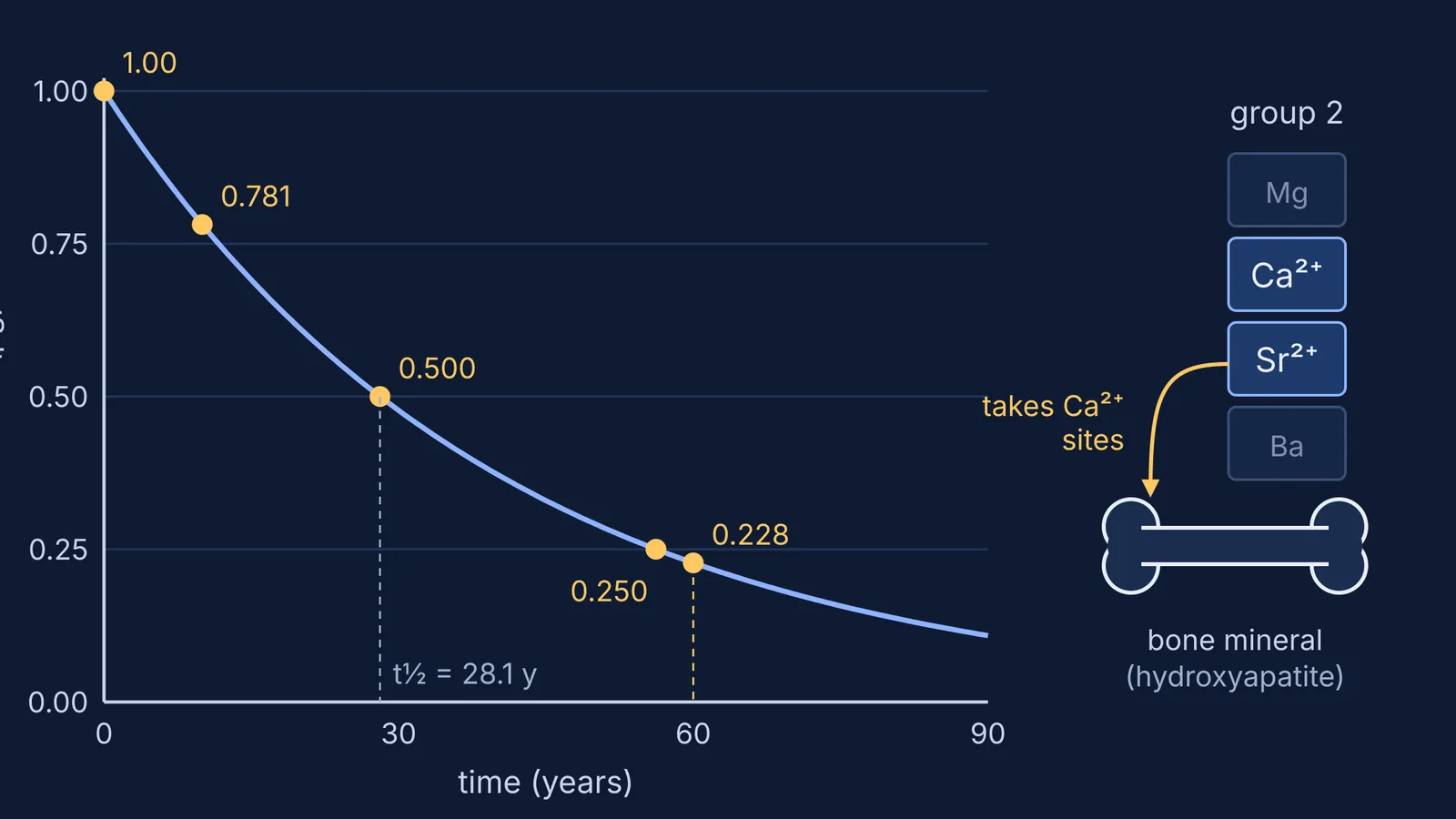
After 10 years. kt = 0.02466 × 10 = 0.2466. N = 1 µg × e^(−0.2466) = 0.7814 µg.
After 60 years. kt = 0.02466 × 60 = 1.480. N = 1 µg × e^(−1.480) = 0.2278 µg.
Check with half-lives. 60 years is 60/28.1 = 2.14 half-lives. Two half-lives would leave 0.25 µg, and a little more time leaves a little less. 0.228 µg fits.
Answer. About 0.781 µg remains after 10 years and about 0.228 µg after 60 years. These match NCERT's answers of 0.7814 µg and 0.2278 µg.
So a person who absorbed this strontium as a baby would still carry almost a quarter of it at age 60. That is the point of the question: a long half-life means the isotope stays for a lifetime.
How radioactive is 1 µg of strontium-90?
The textbook stops at mass. Activity is the number of decays per second. The units are explained in activity units: becquerel and curie; here is the calculation.
Count the atoms. Taking the molar mass of ⁹⁰Sr as 90 g mol⁻¹, 1 µg = 1 × 10⁻⁶ g is (1 × 10⁻⁶/90) × 6.022 × 10²³ = 6.69 × 10¹⁵ atoms.
Convert the decay constant to seconds. 28.1 years = 28.1 × 365.25 × 86400 s = 8.87 × 10⁸ s. So λ = 0.693/(8.87 × 10⁸ s) = 7.81 × 10⁻¹⁰ s⁻¹.
Multiply. A = λN = 7.81 × 10⁻¹⁰ × 6.69 × 10¹⁵ = 5.2 × 10⁶ Bq.
In curies. 5.2 × 10⁶/3.7 × 10¹⁰ = 1.4 × 10⁻⁴ Ci, about 0.14 mCi.
So a mass far too small to see gives about 5 million decays every second. Activity is proportional to the number of atoms, so it falls exactly as the mass does: about 4.1 × 10⁶ Bq after 10 years and about 1.2 × 10⁶ Bq after 60 years.
Why does strontium end up in bones?
Strontium is in group 2 of the periodic table, two places below magnesium and directly below calcium. Like calcium, it forms a 2+ ion, Sr²⁺, and its compounds behave in similar ways. Bone mineral is mostly a calcium phosphate called hydroxyapatite, Ca₁₀(PO₄)₆(OH)₂. When the body builds bone, Sr²⁺ can take some of the sites that Ca²⁺ would normally fill.
Sr²⁺ is not identical to Ca²⁺. It is a larger ion, because strontium has one more shell of electrons, and the body does handle the two differently in some ways. But the ions are similar enough, with the same charge and comparable size, that strontium gets built into the mineral along with calcium.
Being locked inside bone does not change the half-life. Radioactive decay is a nuclear process, so chemical bonding, temperature and pressure have essentially no effect on its rate. 1 µg of ⁹⁰Sr decays at the same rate in a bone, in a rock or in a test tube.
What does the textbook problem leave out?
The exercise is built to test first-order kinetics, so it simplifies three things.
Biological loss. The question assumes no strontium leaves the body. In reality bone is slowly broken down and rebuilt throughout life, so some strontium is released and excreted over the years. The real amount left after 60 years would be lower than 0.228 µg. How much lower depends on the person and on the bone, so the exercise sensibly leaves it out.
The daughter isotope. ⁹⁰Sr decays by beta emission: ⁹⁰₃₈Sr → ⁹⁰₃₉Y + ⁰₋₁e. The product, yttrium-90, is itself radioactive, with a half-life of about 64 hours, and decays to stable zirconium-90. Because ⁹⁰Y decays so much faster than its parent, its activity soon builds up to match the strontium's. The exercise tracks only the strontium.
The half-life value. NCERT gives 28.1 years. Use it in the exam, since the answer key is built on it, but know that tables now list about 28.8 years.
Even with these simplifications, the exercise shows the two features that made ⁹⁰Sr a public concern after atmospheric nuclear tests: a long half-life and uptake into bone. This post is about the chemistry and the arithmetic, not health guidance.
How is this different from carbon dating?
Both problems use the same first-order equation, but they run it in opposite directions. In this question you know the starting amount and the time, and you find the amount left. In carbon-14 dating calculations you measure the fraction left and work back to the time. If you can rearrange N = N₀ e^(−kt) for any one of N, N₀, k or t, you can answer both kinds of question.
To practise rearranging the rate law for different unknowns, the Fermi Problem Library has a step-by-step solver that explains the reasoning at each stage.
Quick checklist
Radioactive decay is first order: k = 0.693/t½ and N = N₀ e^(−kt).
For ⁹⁰Sr, k = 0.02466 year⁻¹ with NCERT's half-life of 28.1 years.
1 µg becomes 0.7814 µg after 10 years and 0.2278 µg after 60 years.
Check with half-lives: 60 years is just over two half-lives, so just under 0.25 µg.
For activity, convert to atoms and to seconds: A = λN ≈ 5.2 × 10⁶ Bq for 1 µg.
Sr²⁺ goes to bone because it is in group 2 with calcium, similar but not identical.
The answer ignores biological loss and the radioactive daughter ⁹⁰Y.


