

On this page
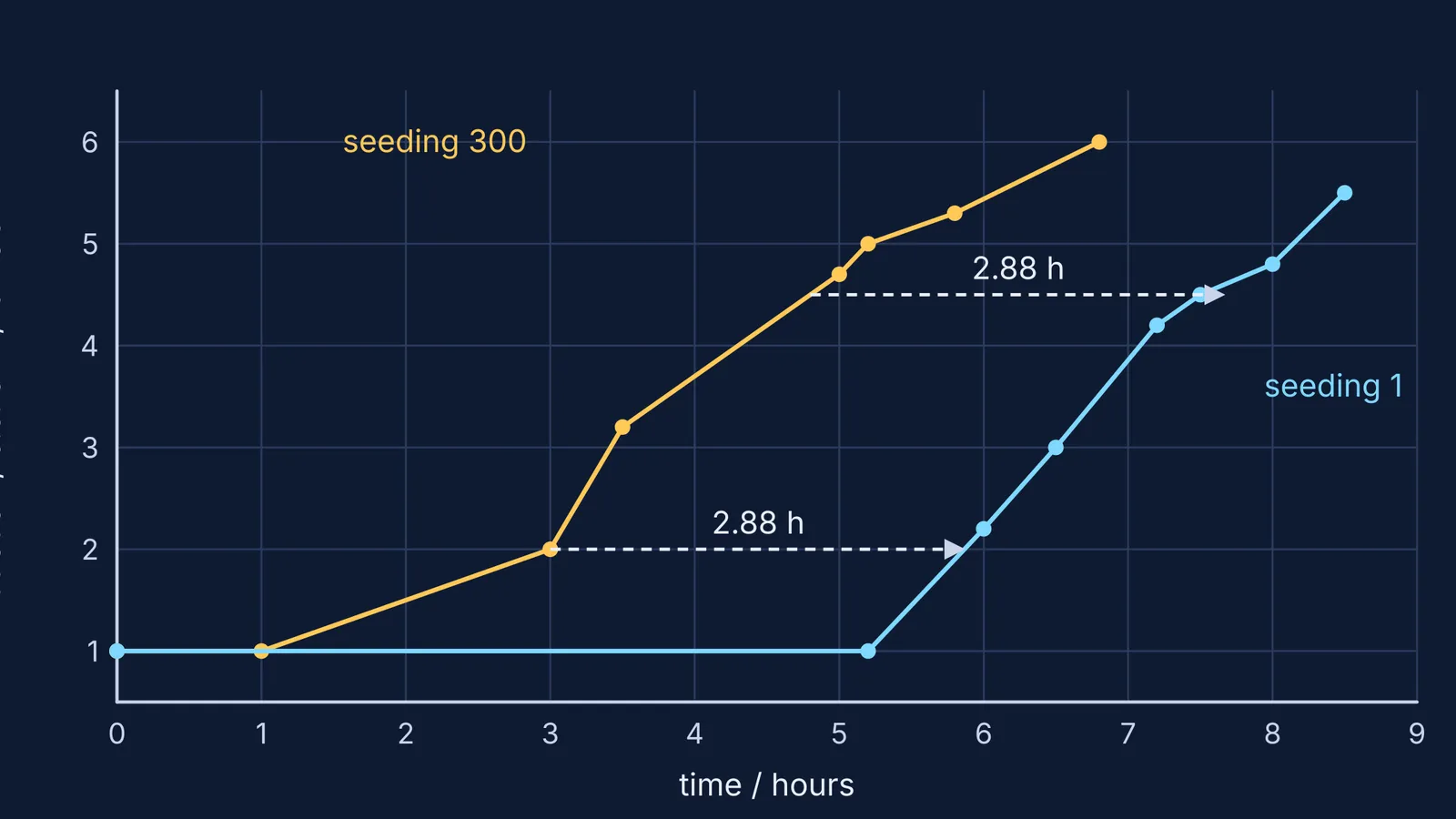
In 1916 Arthur Slator, writing from Burton-on-Trent, wanted the growth rate of a lactic-acid-producing bacillus from malt wort. The usual way was to count bacteria on plates, which is slow. Slator found a shortcut. He seeded two flasks of wort with the same culture in the ratio 300 : 1 and followed the acid each one made by titration. The two acid curves had the same shape, but the small seeding's curve came 2.88 hours later. That delay, put into the first-order integrated rate law, gives the rate constant (A. Slator, J. Chem. Soc. Trans. 1916, 109, 2).
What law did Slator use for bacterial growth?
Slator wrote the law for unrestricted growth as 0.434k = (1/t) log((N + n)/N), where the number of cells rises from N to N + n in time t and log is to base 10. The 0.434 is log₁₀ e, so his "0.434k" is the base-10 rate constant.
In NCERT form this is k = (2.303/t) log(Nₜ/N₀). It is the first-order equation you use for decay, with the ratio turned upside down because the population grows instead of shrinks. The derivation is the same as in the first-order integrated rate equation for board exams.
His first method used turbidity. A growing culture of these thread-like bacilli looks "silky" when shaken, and so does finely divided asbestos in water. He matched each culture against asbestos standards in the ratio 1 : √2 : 2 : 2√2 : 4. In his Table I at 45 °C, for example, a 119-fold increase took 2.53 h:
0.434k = log 119 ÷ 2.53 = 2.076 ÷ 2.53 = 0.82 h⁻¹
His five runs gave 0.82 to 0.85, mean 0.84, and he wrote the generation time as log 2 ÷ 0.84 = "0.358 hour = 21.5 minutes".
Why could he not just measure the acid directly?
Because the acid slows the bacteria down. Slator measured acid in degrees, where 1° is an increase of N/1000 acid. At 45 °C, adding 5.6° of acid lowered 0.434k from 0.82 to 0.55, and 11.1° lowered it to 0.35. Most of the acid appears only after growth has already slowed. So the acid curve is not a clean first-order curve, and you cannot read k from its slope.
The time-shift method gets round this. Both flasks get the same active culture, so they behave the same way. The big seeding has a 300-fold head start. The small one needs exactly the time for a 300-fold increase to reach the same state, and from then on it does everything the big one did, acid included. Whatever happens to the curve later, the two curves are copies of each other, one shifted along the time axis.
How does a shift between two curves give k?
Here is the worked example with Slator's numbers.
Read the shift. He read the horizontal gap between the curves at three heights: 2.9, 2.9 and 2.85 h. Mean = 2.88 h.
Set up the ratio. In 2.88 h the small seeding grows 300-fold, so (N + n)/N = 300.
Take the log. log 300 = 2.477.
Divide. 0.434k = 2.477 ÷ 2.88 = 0.860 h⁻¹. Slator gives 0.86.
Convert to the natural-log constant. k = 0.860 × 2.303 = 1.98 h⁻¹.
Find the doubling time. t = 0.693 ÷ k = 0.693 ÷ 1.98 = 0.350 h = 21.0 min. You get the same from log 2 ÷ 0.860.
So one titration curve and one dilution ratio give the rate constant without counting a single cell. A second experiment gave 0.89, which means a doubling time of 20.3 min. Both sit close to the turbidity value of 0.84 (21.5 min).
You can check the shift from his Table IV yourself. Joining his data points with straight lines (our calculation, not his), the gap at titration levels of 2, 3, 4, 4.5 and 5 c.c. comes to 2.9, 3.1, 2.8, 2.7 and 2.9 h. Hand-drawn smooth curves gave him 2.88.
Doubling time plays the role that half-life plays for decay: t = 0.693/k, independent of how many cells you start with. If half-life shortcuts are rusty, see how long a first-order reaction takes to reach 99%.
What happens when the temperature changes?
Slator measured growth at many temperatures. From his text:
20 °C: no growth.
22 °C: slow growth.
25 °C: 0.434k = 0.083, a doubling time of 3.6 h.
30 °C: 0.184 (when seeded from a culture grown at 30 °C).
45 °C: 0.84.
About 50 °C: the maximum rate.
52.5 °C: the rate "nearly halved".
55 °C: slight growth, which soon stops. 58 °C: none.
Compare these with the textbook rule that k roughly doubles for a 10 °C rise, explained in the temperature coefficient of reaction rate. From 25 to 30 °C, k rises 0.184 ÷ 0.083 = 2.2 times in only 5 degrees. From 30 to 45 °C it rises 0.84 ÷ 0.184 = 4.6 times in 15 degrees, about 2.75 per 10 degrees. Near 50 °C the ratio falls to 1, and above that it is less than 1.
Try the Arrhenius equation on the 25 and 30 °C points (our calculation): log(0.184/0.083) = 0.346, and Ea = 2.303 × 8.314 × 0.346 ÷ (1/298.15 − 1/303.15) ≈ 120 kJ/mol. That value predicts 0.434k ≈ 1.7 at 45 °C. Slator measured 0.84. A single activation energy does not fit.
Slator saw this coming. The controlling reactions in the cell, he wrote, are different at different temperatures, "and the figures, therefore, cannot be considered true temperature-coefficients." Above about 50 °C the rate falls as temperature rises, which no single Arrhenius line can describe.
He also found that the culture's history mattered. At 30 °C, a culture grown at 30 °C gave 0.184, but one taken straight from 45 °C gave values that rose from 0.110 to 0.150. A rate constant needs a steady system.
Where does this show up in JEE and NEET?
Class 12 Chemical Kinetics: the first-order integrated law in log₁₀ form, k = (2.303/t) log ratio, and half-life t½ = 0.693/k.
Reading graphs: a constant horizontal gap between two curves means a constant ratio, so k comes from the gap and the ratio alone.
Arrhenius: the 10-degree rule and a single Ea hold for one reaction over a modest range, not for a living system.
For more numericals in this pattern, the Fermi Problem Library has a step-by-step solver that explains the reasoning. For timed chapter practice, Fermi Test Prep offers JEE Main and Advanced preparation with an AI tutor.
Quick checklist
Growth law: 0.434k = (1/t) log(Nₜ/N₀), so k = (2.303/t) log(Nₜ/N₀).
Seedings 300 : 1, curves 2.88 h apart: 0.434k = log 300 ÷ 2.88 = 0.860 h⁻¹, k = 1.98 h⁻¹.
Doubling time = 0.693/k ≈ 21 min at 45 °C.
The ratio 300 is a dilution ratio, not a cell count.
Temperature ratios fell from about 2.2 per 5 degrees near 25 °C to below 1 above 50 °C.


